Why Switch · Sensei AI alternative
Looking for a Sensei AI Alternative? PhantomCode is the real-time-during-interview version.
Sensei AI is built for the rehearsal — structured behavioral drills, deliberate practice, and feedback loops between rounds. PhantomCode is built for the moment you actually need help: while you are on the call, sharing your screen, with a recruiter watching the timer. Both have their place. This page is for engineers who already prepped with Sensei AI and now want a live safety net for the round itself.
Why engineers reach for PhantomCode after Sensei AI
Sensei AI does one thing very well: it turns interview prep into a structured, measurable practice loop. You drill behavioral stories, you get coaching on framing, and you walk into the round with a tighter narrative. That work is real, and we are not here to replace it.
But here is the awkward part of the funnel that prep tools rarely talk about. The actual interview is a different problem. You are screen-sharing on Zoom, Google Meet, HackerRank, or CoderPad. The recruiter is watching your editor tab. The timer is moving. You hit a recursion edge case you have seen ten times in practice and your brain blanks. None of your stored stories help. No amount of prep coaching reaches into that moment.
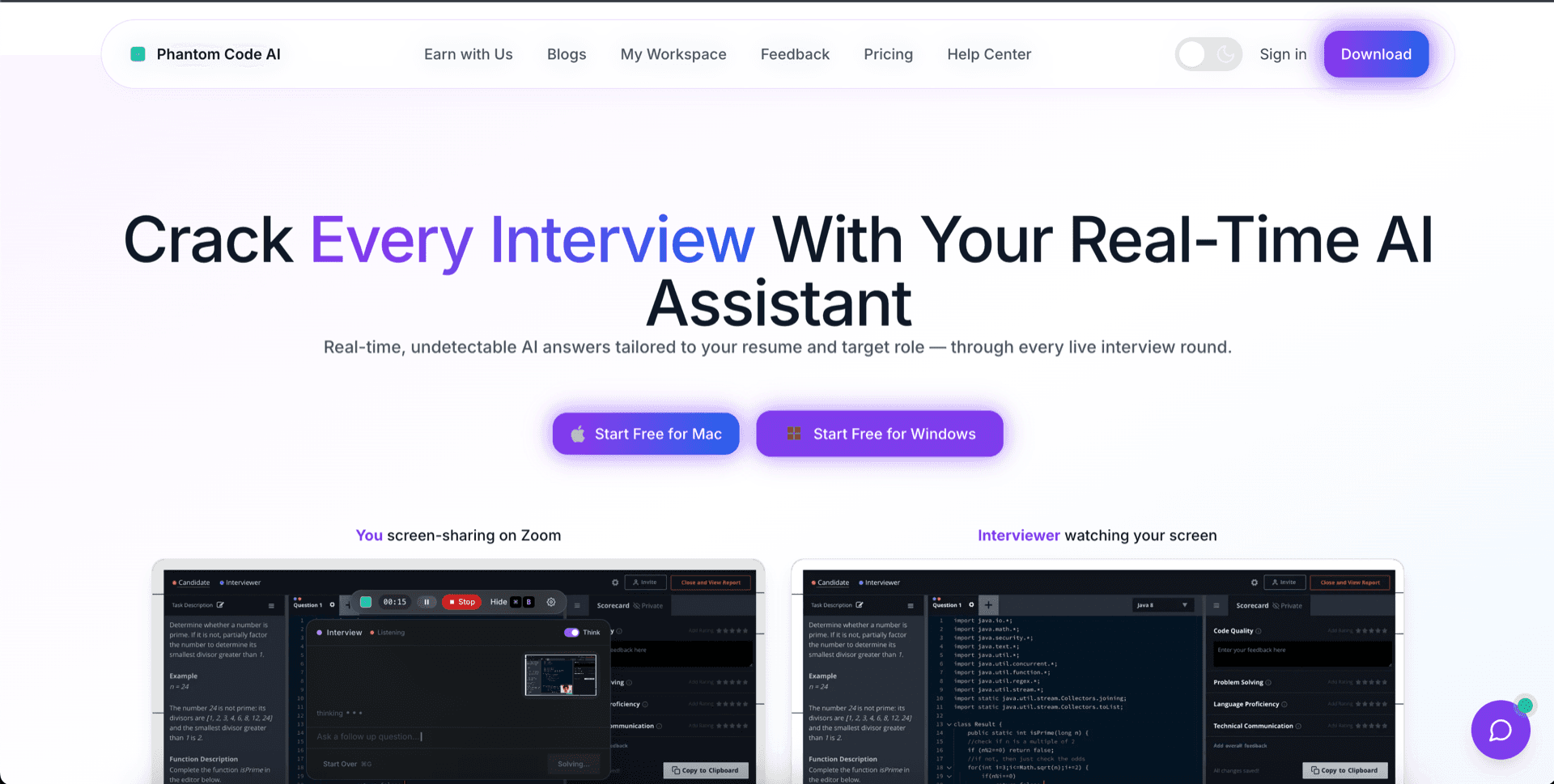
PhantomCode is what runs during that moment. It listens to the question, reads the problem on screen, and gives you a clean approach, a working solution, and an explanation you can talk through — all in an overlay that stays out of the screen recording and out of your shared window. You stay on camera, you stay in flow, and you do not have to alt-tab to a second device or a phone hidden under the desk.
Engineers who use both treat it as a stack. Sensei AI on the days leading up to the interview. PhantomCode on the day of, during the round, when the cost of one wrong answer is the offer.
5 reasons to switch from Sensei AI to PhantomCode
1. Live during the round, not just prep before it
Sensei AI is a coach you talk to between interviews. PhantomCode is an assistant that activates while the interview is in progress. The whole system — listening, problem reading, solution generation, explanation — runs in real time on the same machine you are interviewing from. You do not schedule a session. You do not review notes after. The help arrives during the round, when it matters. There is a real difference between knowing the answer the night before and producing it under a fifty-minute clock with a hiring manager watching your cursor. PhantomCode collapses that gap. The latency is low enough that the assist feels like an internal thought, not a second tab you are tabbing to. Most engineers who try it tell us the first round feels like cheating, and by the third round it just feels like having a senior teammate quietly pair with them.
2. Coding optimization, not behavioral framing
Sensei AI is strong on behavioral structure — STAR, leadership stories, conflict-resolution narratives. PhantomCode is strong on the part Sensei does not focus on: the live coding round. Optimal time and space complexity, edge cases the interviewer typically asks about, idiomatic syntax in 11 programming languages, and follow-up answers when they ask "can you make this faster?" That is the wedge. Different focus, different coverage. We cover Python, JavaScript, TypeScript, Java, C++, C#, Go, Rust, Swift, Kotlin, and Ruby with first-class quality — meaning the solution that lands in your overlay is idiomatic for that language, not a Python solution translated word-for-word into Go. Interviewers notice. The way you name variables, the way you handle errors, the data structure you reach for first — all of that signals seniority, and PhantomCode keeps it consistent with the language you chose to interview in.
3. Invisible to screen recording and screen share
Sensei AI runs in the browser. That is fine for prep — there is nothing to hide during practice. But during a real interview, anything in your browser is in the share. PhantomCode runs as a desktop overlay that does not appear in screen recordings, screen shares, or interview-platform proctoring capture. The interviewer sees your editor and your face. They do not see the overlay, even when looking directly at your shared screen. We do not detail how — that is the proprietary part — but the result is what matters: the help is there for you and invisible to them.
4. After-interview transcript matches Sensei’s coaching pattern, automatically
One thing engineers love about Sensei AI is the structured retrospective — what went well, what to tighten, which stories landed. PhantomCode produces the same kind of artifact, but it is generated from the actual round you just did. After every interview, you get a transcript with the questions asked, the solutions you delivered, the parts where you stalled, and concrete suggestions for the next loop. You do not have to recall the round from memory and feed it to a coach. The coach already saw the round.
5. 50+ spoken languages — interview in your strongest one
PhantomCode listens and responds in 56 spoken languages plus 6 bilingual modes — Arabic, English, Hindi, Mandarin, Tamil, Spanish, French, German, Portuguese, Japanese, Korean, Vietnamese, Bengali, Punjabi, Telugu, Marathi, Urdu, Turkish, Polish, Dutch, Swedish, Indonesian, Thai, and many more. If your interviewer speaks one language and you think most clearly in another, PhantomCode bridges the gap inside the round itself. Sensei AI is English-centric for its coaching content. For non-English-first engineers interviewing at global companies, that gap matters.
Ready to Ace Your Next Interview?
Download now — invisible, undetectable, and works on every platform. Plans start at $19.
When Sensei AI still makes sense
We are not going to pretend Sensei AI is the wrong tool. If your interview loop is heavy on behavioral rounds — staff-level system design with leadership framing, manager screens, values-based panels at companies that lean on the STAR method — Sensei AI is genuinely useful. It builds the muscle of telling a tight, structured story under pressure. There is no shortcut for that, and an in-the-moment overlay cannot replace the reps.
Sensei AI also makes sense for engineers who are weeks out from their first real loop and want a structured curriculum. Deliberate practice across a calendar, with a coach that pushes back on weak stories, is exactly the right shape of tool for that phase. The mistake is treating prep as the whole problem and assuming the live round will take care of itself.
The honest recommendation is to use both. Sensei AI for the runway. PhantomCode for the runway lights at touchdown. They solve different problems, and stacking them costs less than missing one offer.
Switch (or stack) in 5 minutes
You do not have to cancel anything. Most engineers we talk to keep their Sensei AI workflow for the prep cycle and add PhantomCode for the live round. Setup is straightforward — download, sign in, and PhantomCode is ready before your next interview. No browser extension, no calendar integration to wire up, no team admin to convince. If you have a screen on your desk and an interview on the calendar, you are five minutes from being covered for the round itself.
Frequently Asked Questions
- Is PhantomCode better than Sensei AI?
- For the live round, yes — that's the entire wedge. Sensei AI is genuinely useful for behavioral-heavy loops: STAR structure, leadership stories, and deliberate practice in the weeks before a loop. PhantomCode covers what Sensei doesn't focus on — real-time help during the actual interview, with optimal complexity, edge cases and idiomatic code in 11 programming languages.
- Can I use Sensei AI and PhantomCode together?
- Yes, and that's what most engineers who use both do. Sensei AI runs on the days leading up to the interview, building tight behavioral narratives. PhantomCode runs on the day of, during the round, when the cost of one wrong answer is the offer. You don't have to cancel anything — they solve different problems.
- Will the interviewer see PhantomCode on my shared screen?
- No. Sensei AI runs in the browser, which is fine for prep — but during a real interview anything in your browser is in the share. PhantomCode is a desktop overlay that does not appear in screen recordings, screen shares, or interview-platform proctoring capture. The interviewer sees your editor and your face; the overlay stays yours.
- Does PhantomCode give feedback after the interview like Sensei AI does?
- Yes — automatically, from the real round. After every interview you get a transcript with the questions asked, the solutions you delivered, the moments you stalled, and concrete suggestions for the next loop. It's the same structured retrospective engineers value in Sensei AI, except generated from the actual interview instead of your memory of it.
- How much does PhantomCode cost?
- Plans start from $19 / ₹1,599, with a monthly subscription at $49 / ₹4,299 and a yearly plan at $199 / ₹19,999 — no lifetime tier. Setup is a five-minute download for Mac or Windows, so stacking it alongside an existing Sensei AI prep workflow costs less than missing one offer.