Looking for a Verve AI Alternative? PhantomCode is the real-time copilot, not just mock prep.
Verve AI runs scheduled mock interviews with personalized coaching afterward. PhantomCode runs during the actual coding round — listening, reading the screen, and surfacing the next step while the interviewer is still asking the question. Different category. Different moment in the funnel.
Why engineers move past Verve AI for the live round
Mock interviews are valuable. Anyone who has bombed a behavioral question in a real loop knows the difference between rehearsing in your head and rehearsing out loud with feedback. Verve AI does that piece well — it gives you a structured prep cycle, an AI to bounce answers off, and notes you can revisit before the real round.
But mocks are scheduled. They are limited. They run on a calendar, end at a fixed time, and produce a coaching report you read after the fact. The real interview does not work that way. The real interview is a live event with a hostile clock, a question you have never seen, a shared editor that records every keystroke, and a hiring manager watching you think. You do not get to pause and ask the AI for a hint. You do not get a second take.
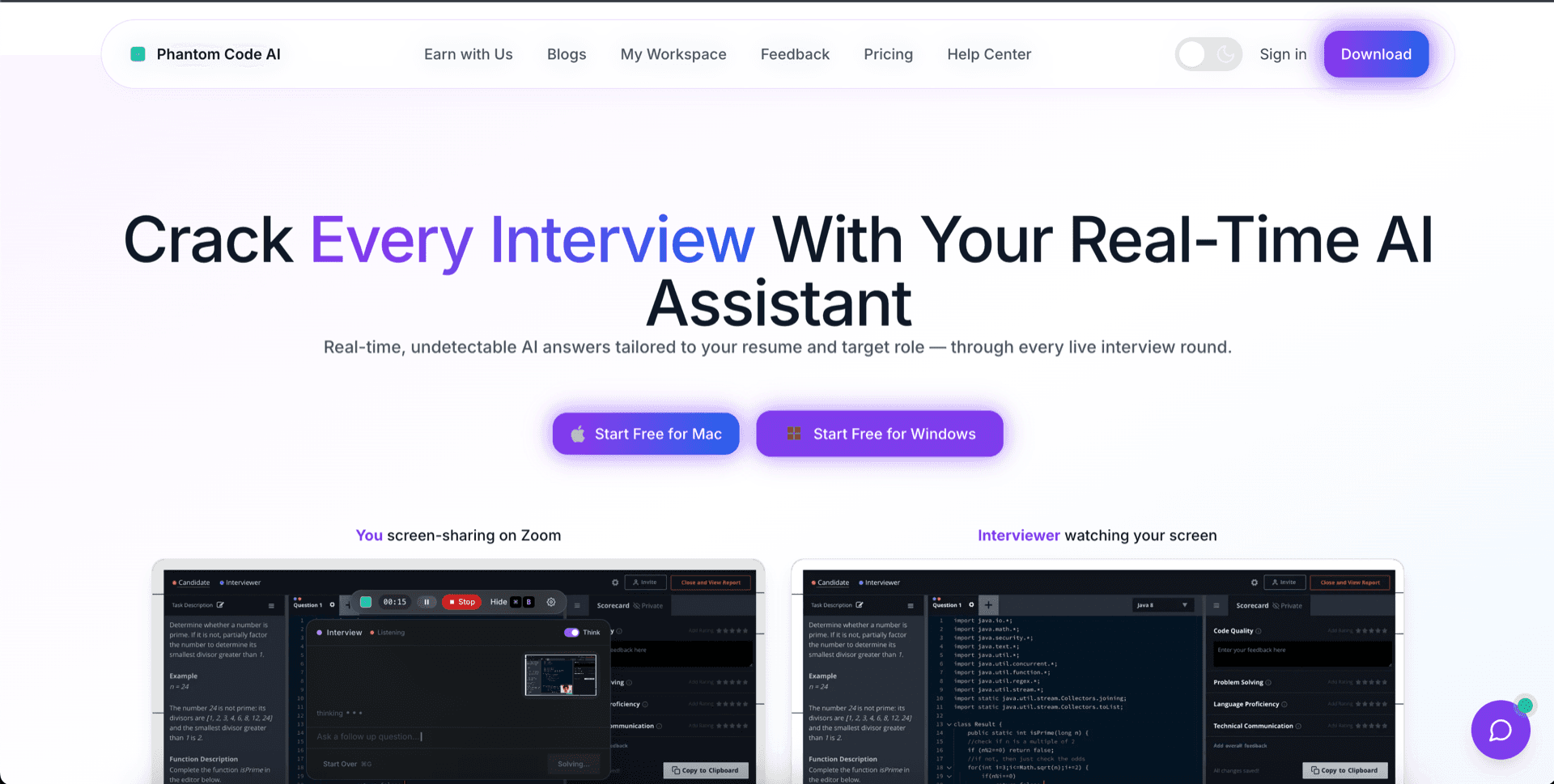
Engineers who switch to PhantomCode — or, more often, who stack PhantomCode on top of Verve AI — do it for one reason: they want help that shows up while the round is still happening. Not before. Not after. During. A copilot that listens to the question being asked, reads the prompt on the screen, and pushes a suggestion into an overlay only you can see is a fundamentally different product than a mock rehearsal tool. Both have a place. They solve different problems.
The framing we hear from candidates is consistent: Verve AI got me ready for the interview. PhantomCode got me through it.
5 reasons to switch
1. Live during the round, not mock-only
Verve AI is a rehearsal room — you schedule a session, run a mock, and read the coaching report afterward. PhantomCode is on-screen during the actual interview, listening to the prompt and surfacing the next move in real time. The mock is preparation. The copilot is the round itself. When the interviewer pastes a problem you have never seen and the timer starts ticking, a coaching report from yesterday cannot help you. A live overlay reading the same screen you are reading absolutely can.
2. Built for code, not generic Q&A
PhantomCode is tuned for technical rounds: data structures, algorithms, system design, SQL, debugging, and language idioms across Python, Java, JavaScript, TypeScript, C++, Go, Rust, Kotlin, Swift, Ruby, and C#. Mock-prep tools are great at behavioral fluency and storytelling, but they are not optimized to read a function signature, infer the intended time and space complexity, propose a clean implementation, and walk through edge cases while the timer runs. Coding interviews reward depth in a narrow lane — and PhantomCode lives in that lane.
3. 50+ spoken languages with code-switching
Interviews are not always in your strongest spoken language. PhantomCode understands Arabic, Bengali, Cantonese, Dutch, English, Filipino, French, German, Hebrew, Hindi, Hungarian, Indonesian, Italian, Japanese, Korean, Mandarin, Marathi, Polish, Portuguese, Punjabi, Russian, Spanish, Swahili, Swedish, Tamil, Telugu, Thai, Turkish, Ukrainian, Urdu, Vietnamese, and many more — with bilingual modes that handle the natural code-switching engineers do mid-sentence (Hindi-English, Spanish-English, Mandarin-English, Tamil-English, Arabic-English, and Filipino-English). Verve AI supports a strong slate of languages for mock practice; PhantomCode stretches that coverage into the live round itself.
4. After-interview transcript and structured replay
Every PhantomCode session produces a clean transcript of the questions asked, the suggestions surfaced, and the timing of each beat. You get the exact artifact a mock-prep tool would have used to coach you — except it is built from the real interview you just walked out of, not a simulated one. That means your post-interview review is anchored in what actually happened: the question you fumbled, the moment you went silent, the cue you missed. Coaching feedback hits harder when it is grounded in the real round.
5. Invisible to screen recording and proctor capture
PhantomCode does not appear on the shared screen, the recorded video, or the proctor's capture. You see it. The interviewer does not. That is the entire point of a live copilot — it has to be present without being visible. A scheduled mock cannot give you that, and it does not need to: the whole point of a mock is that the AI is visible and engaged. Different product, different moment, different requirement.
Ready to Ace Your Next Interview?
Download now — invisible, undetectable, and works on every platform. Plans start at $19.
When Verve still helps
We are not telling you to drop Verve AI. The honest answer is that the two tools live at different points in your interview funnel, and the candidates who do best use both. PhantomCode is what runs during the live round. Verve AI is what runs before it.
Verve AI continues to earn its slot when you are:
- Pre-interview prep cycles — drilling behavioral questions until your STAR answers feel natural.
- Building behavioral fluency for senior and staff-level rounds where the bar shifts to leadership stories.
- Practicing tone, pacing, and filler-word reduction in a low-stakes setting before a high-stakes loop.
- Rehearsing the same question a dozen times so your answer arrives in a clean 90 seconds.
Use both. Run Verve in the week leading up to the loop to drill your behavioral answers and warm up your delivery. Run PhantomCode the moment the interviewer shares the coding link. The mock builds confidence. The copilot ships the offer.
Switch (or stack) in 5 minutes
- 1Download PhantomCode for macOS or Windows. Install completes in under a minute on most machines.
- 2Pick your preferred AI mode and your spoken language — including any of the 50+ options or one of the bilingual code-switching modes.
- 3Self-record a Zoom call to confirm the overlay does not appear in the recording. Two minutes, one sanity check, total peace of mind.
- 4Keep using Verve AI for behavioral prep cycles between rounds. Run PhantomCode the moment a real coding interview starts.
Ready for the live round, not just the mock?
Stack PhantomCode on top of your Verve AI prep, or switch entirely. Either way, you walk into the next interview with a copilot in your corner.
Frequently Asked Questions
- Is PhantomCode better than Verve AI?
- They're different categories, so 'better' depends on the moment. Verve AI does the prep piece well — structured mock cycles, an AI to bounce answers off, coaching notes to revisit. PhantomCode is built for the live round itself: real-time, code-optimized, invisible on the shared screen. The framing we hear from candidates: Verve got me ready for the interview; PhantomCode got me through it.
- Should I use Verve AI and PhantomCode together?
- Yes — that's the explicit recommendation on this page. Run Verve AI in the week leading up to the loop to drill behavioral answers and warm up your delivery; run PhantomCode the moment the interviewer shares the coding link. The mock builds confidence, the copilot ships the offer. They live at different points in the funnel and never conflict.
- What makes PhantomCode better for coding rounds specifically?
- It's tuned for the technical lane: data structures, algorithms, system design, SQL, debugging, and language idioms across Python, Java, JavaScript, TypeScript, C++, Go, Rust, Kotlin, Swift, Ruby and C#. Mock-prep tools excel at behavioral fluency, but they aren't optimized to read a function signature, infer intended complexity, and propose a clean implementation while the timer runs.
- Can the interviewer see PhantomCode during the round?
- No. PhantomCode does not appear on the shared screen, the recorded video, or the proctor's capture — you see it, the interviewer doesn't. That's the defining requirement of a live copilot. A scheduled mock tool doesn't need that property, and by design Verve AI's sessions are ones where the AI is visible and engaged.
- How much does PhantomCode cost?
- Plans start from $19 / ₹1,599 for a one-time Starter pack, with a monthly subscription at $49 / ₹4,299 and a yearly plan at $199 / ₹19,999 — no lifetime tier. Setup takes about five minutes: install on macOS or Windows, pick your spoken language, and self-record a Zoom call to confirm the overlay stays off the recording.