Looking for a Parakeet AI alternative? Here's why engineers are switching to PhantomCode.
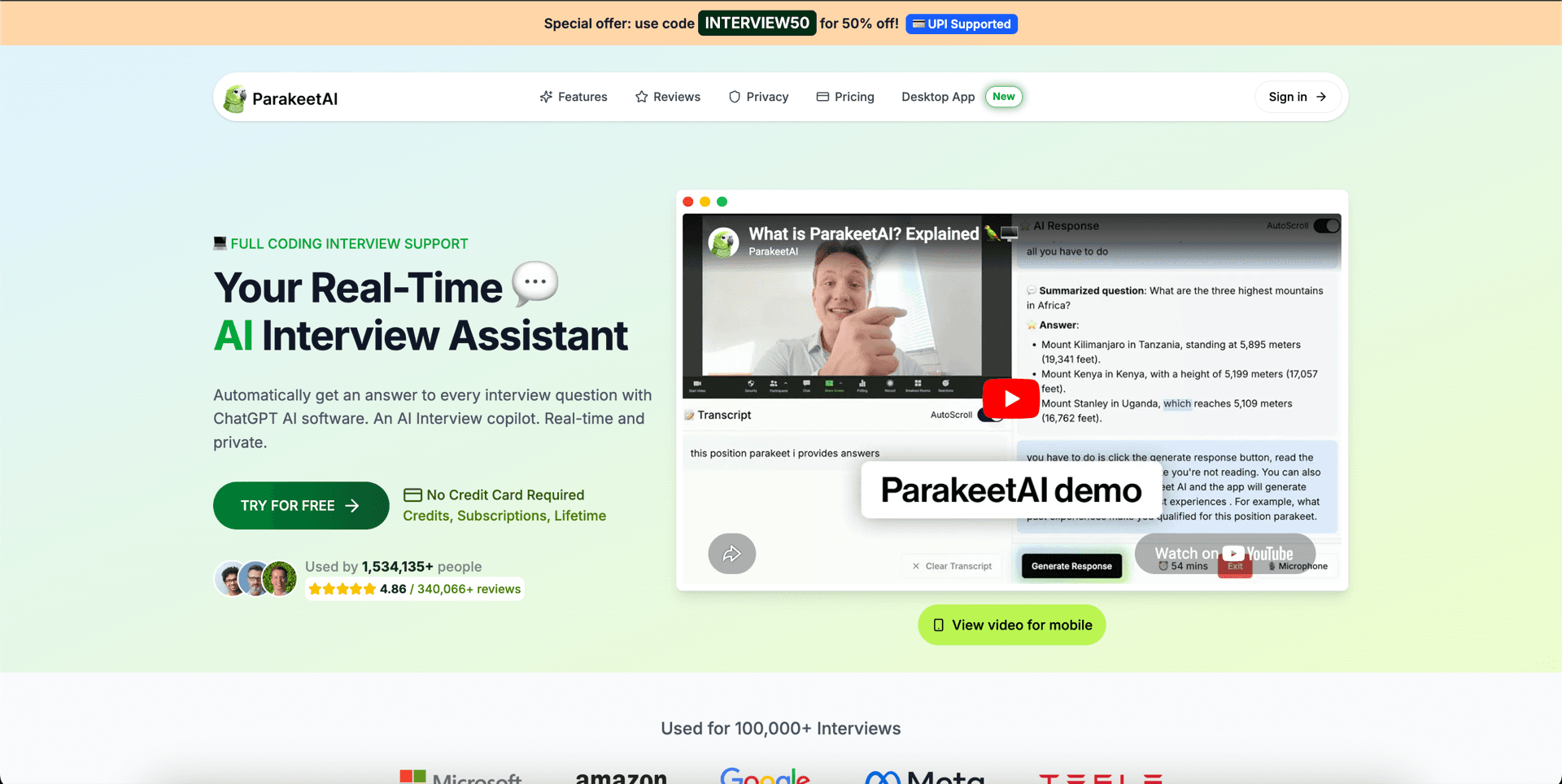
Parakeet AI is a browser tab. PhantomCode is a native Mac and Windows app built for live coding interviews — real-time, voice-aware, and invisible to screen capture. If you're comparing the two, this page is the short version of why people move.
What pushes engineers off Parakeet AI
Parakeet AI works for some interview formats, and it has a real user base. But four specific gaps keep showing up in the feedback we hear from engineers preparing for live, technical, screen-shared coding rounds.
Visible surface area — browser tab and a named process
Parakeet AI's web app lives inside a browser tab — a window like any other, plainly visible the moment you screen-share. And the desktop client doesn't close the gap: independent safety reviews report its process appears under the name "pmodule" in Windows Task Manager and macOS Activity Monitor, exactly where a proctored round or a cautious interviewer would look. For a tool whose whole promise is discretion, that's a lot of visible surface.
Generic ChatGPT layer
Parakeet AI is, at its core, a transcription wrapper that pipes interview audio into a general LLM. There is no live-coding-specific tuning, no on-screen problem capture, no language-aware code generator. It answers like a chatbot, not like a co-pilot that understands what a sliding-window problem actually needs.
Behavioral-strong, coding-weak
Where Parakeet AI shines is open-ended HR and behavioral questions — fast transcripts, fast answers. Where it falls down is the moment the interviewer pastes a LeetCode-style problem and waits for a working solution in 25 minutes. Engineers consistently report needing a second tool for the actual coding round.
Credit pricing you can't see before signing up
Parakeet AI meters usage in credits — a 30-minute interview session consumes credits from your balance — and the actual dollar prices are only revealed after you create an account. You can't comparison-shop, and mid-interview-season you're watching a credit balance instead of focusing on the round. PhantomCode publishes every price on a public pricing page, no login required.
Ready to Ace Your Next Interview?
Download now — invisible, undetectable, and works on every platform. Plans start at $19.
5 reasons engineers switch from Parakeet AI to PhantomCode
These are the differences that come up in every switch conversation. Not feature-list trivia — the parts that actually decide whether your tool helps you or hurts you in a live, screen-shared coding interview.
1. Native desktop — no browser to detect
PhantomCode is a native Mac and Windows app, not a tab. It does not live in Chrome, it does not need an extension, and it doesn't share the browser's exposure surface. Proctoring extensions that scan browser tabs will not find PhantomCode, because PhantomCode is not a browser tab. That single architectural choice removes an entire class of risk that browser-based assistants carry by design.
2. Built for live coding, not generic transcription
Parakeet AI ships you a transcript and a chat. PhantomCode ships you a co-pilot that watches the problem, hears the interviewer, and produces working code in 11 programming languages — Python, Java, C++, JavaScript, TypeScript, Go, Rust, C#, Kotlin, Swift, Ruby — with the structure interviewers expect. It doesn't guess at what a coding round wants. It was built for one.
3. 50+ spoken languages, with code-switching
PhantomCode handles real-time interviewer audio across more than 50 spoken languages — Arabic, English, Hindi, Mandarin, Tamil, Spanish, French, German, Portuguese, Japanese, Korean, Vietnamese, Indonesian, Turkish, Polish, Dutch, and many more — including bilingual code-switching modes for engineers who are interviewed in two languages at once. Parakeet AI's strength is transcription speed in English; PhantomCode's strength is meeting candidates wherever in the world they actually interview.
4. After-interview transcript — unique to PhantomCode
When the call ends, PhantomCode hands you a complete, structured transcript of what was asked, what you said, what was suggested, and where you got stuck. You debrief in five minutes instead of replaying half-remembered moments for an hour. This is the workflow Parakeet AI doesn't close — it gives you live captions and then disappears. PhantomCode treats every interview as something you should be able to learn from.
5. Invisible to screen recording — verified
PhantomCode is designed to stay off your screen-share. The window does not appear in screen recording, screen-sharing, or proctoring video — verified across Zoom, Google Meet, Microsoft Teams, and the major proctoring tools that capture the screen during live interviews. A browser-tab assistant cannot make that claim. PhantomCode can, and that's the single most-cited reason engineers move.
What Parakeet AI genuinely does well
We don't think a comparison is honest if it pretends the other side has nothing going for it. Parakeet AI has real strengths — they're just pointed at a slightly different problem than ours.
A large existing user base
Parakeet AI has shipped to a sizeable community of users — over a million claimed — and has the round-edges polish that comes from running at that scale. That's real, and it's a fair signal for general interview support.
Fast English transcription
If your interviews are mostly behavioral, mostly in English, and mostly without screen-share scrutiny, Parakeet AI's transcription is genuinely quick and competent. It's the part of the product that gets the most engineering attention.
A one-time-payment option
Parakeet AI offers a one-time purchase tier for buyers who don't want a subscription. PhantomCode offers one-time credit packs alongside monthly and yearly subscriptions too, but if subscription-aversion is your driving factor, that's a legitimate Parakeet AI advantage worth naming.
Switch in 5 minutes
Cancel Parakeet AI. Install PhantomCode. Be ready before your next call.
There's no migration step. Download the native Mac or Windows app, sign in, point it at your interview tool of choice, and run a 90-second practice round to confirm the audio and the on-screen capture both work. That's the entire onboarding. If you have an interview this week, you have time.
- 1. Download PhantomCode for Mac or Windows.
- 2. Sign in and pick your primary programming language and spoken language.
- 3. Run a quick practice round so you trust the real-time response feel.
- 4. Cancel Parakeet AI from your account dashboard whenever you're ready.
- 5. Walk into your next interview with a co-pilot that won't show up on screen-share.
Want a balanced, side-by-side comparison instead?
This page is the persuasive version. If you'd rather see the feature-by-feature, neutral-language comparison with a full table, pricing, and FAQ — that lives at our dedicated PhantomCode vs Parakeet AI page.
Frequently Asked Questions
- What is the best Parakeet AI alternative?
- PhantomCodeAI is the strongest Parakeet AI alternative for software engineers. It is a native Mac and Windows desktop co-pilot that stays out of screen recordings and process lists, generates working code in 11 programming languages, supports 50+ spoken languages with bilingual code-switching, and produces a full after-interview transcript — a feature Parakeet AI does not offer.
- Is Parakeet AI detectable during interviews?
- Parakeet AI's web app runs in a browser tab that is visible on screen-share. Its desktop client helps with screen-share, but independent safety reviews report the process appears as "pmodule" in Windows Task Manager and macOS Activity Monitor, where proctored rounds and cautious interviewers can spot it. PhantomCodeAI's overlay is excluded from screen capture at the OS level and does not appear in the dock, tray, or process list.
- How much does Parakeet AI cost?
- Parakeet AI uses credit-based pricing — a 30-minute interview session consumes credits — and shows its dollar prices only after you create an account. PhantomCodeAI publishes all pricing publicly: one-time credit packs that never expire, plus monthly and yearly subscriptions with unlimited interview-call credits while active.
- Is Parakeet AI good for coding interviews?
- Parakeet AI's strength is fast transcription and behavioral/HR answers. Engineers consistently report it is weaker on deep technical coding rounds — live DSA problems, system design, and SQL. PhantomCodeAI is purpose-built for those rounds: on-screen problem capture, optimal code with complexity analysis, and support across LeetCode, HackerRank, CodeSignal, and CoderPad.