Looking for an Exponent Alternative? PhantomCode is the engineer-first real-time copilot.
Exponent is a strong coaching and curriculum platform — especially for product managers and engineering managers. But if you're an IC engineer running a tight technical loop, the question is not just “how do I prepare for next week's round?” It is “what do I have when the interviewer pastes the prompt and the clock starts?” That gap is what PhantomCode was built to fill.
This page is the case for switching — or stacking. If you want a balanced feature-by-feature comparison, jump to /vs/exponent.
Why engineers prefer PhantomCode for technical interviews
Exponent is a respected brand in the interview-prep space. It is also a different product than what most engineers actually want during the technical loop. Four things show up in almost every conversation we have with engineers who started on Exponent and ended up looking for something else.
Coaching and prep — not live during the round
Exponent is a curriculum and a mock-interview marketplace. You watch lessons, you book a coach, you run a practice round on Tuesday for the real round on Thursday. The product is excellent at preparing you weeks ahead of time. It is not in the room with you when the actual interviewer dials in on Thursday afternoon.
PM-and-EM-first — engineering is the secondary track
Exponent built its name in product management and engineering management coaching. The PM track is deep — case studies, frameworks, behavioral drills, RICE and CIRCLES walk-throughs. The engineering track exists, but the catalog and coach roster skew heavily toward PM and EM. If your loop is four DSA rounds and a system design, you'll feel the imbalance.
Premium per-session pricing
A single 1-on-1 coaching session with a senior coach can run well over a hundred dollars, and a multi-week prep plan stacks fast. For engineers running a six-week loop with five companies, the math gets uncomfortable — especially when most of the value of any given mock fades within a couple of weeks of the real round.
Nothing live to lean on when the question lands
When the interviewer pastes the prompt into the doc and your mind goes briefly blank, Exponent is back at the curriculum tab in another window. There is no in-round assist, no live reasoning trail, no real-time language support. Whatever you absorbed in the prep weeks has to carry the round on its own.
5 reasons to switch (or stack) PhantomCode with Exponent
You don't have to pick a side. Plenty of engineers run an Exponent prep plan in the weeks before a loop and PhantomCode during the actual rounds. The two products live in different parts of the timeline — here is how PhantomCode fills the part Exponent doesn't reach.
- 01
Live during the round, not just before it
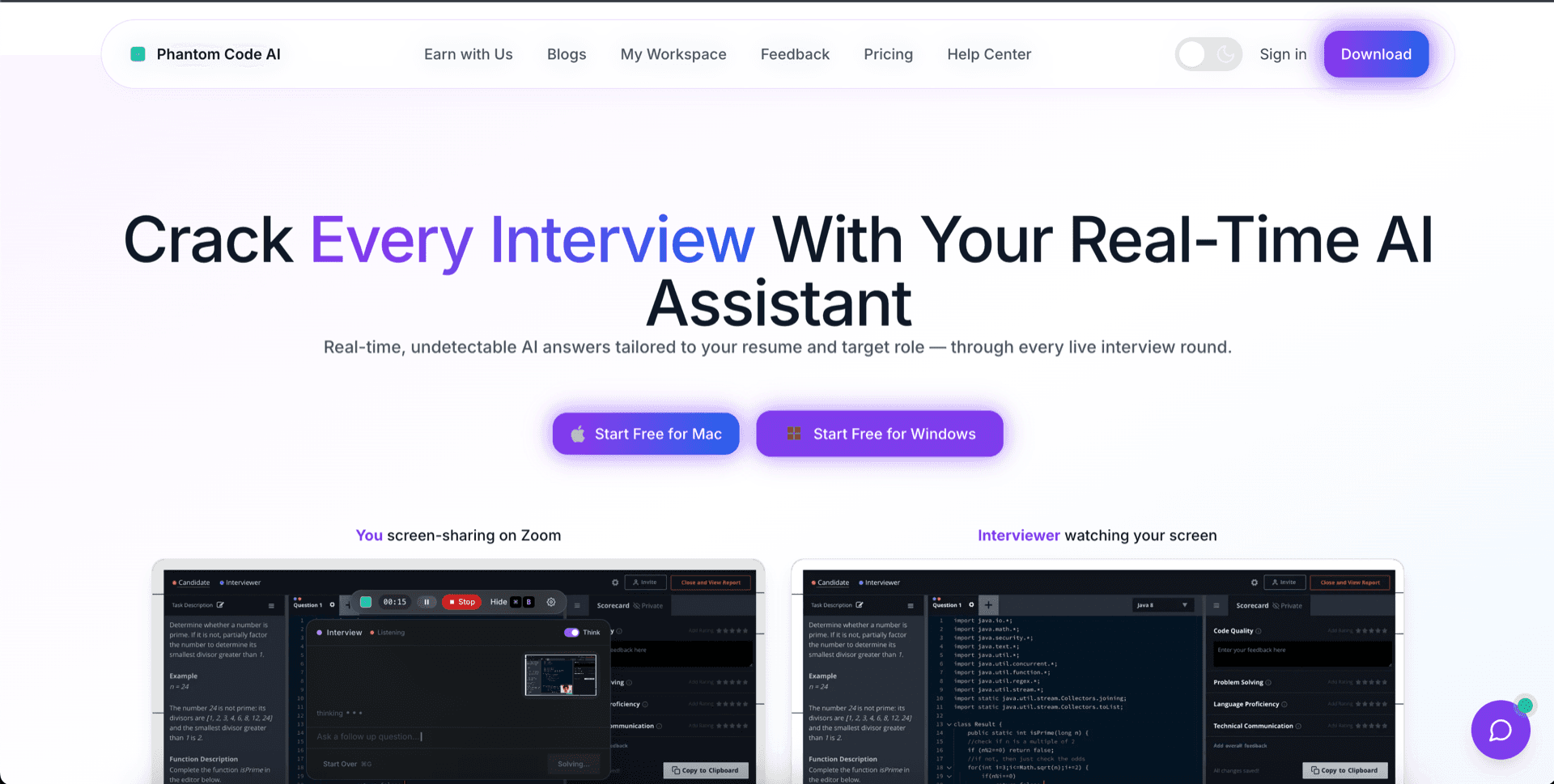
PhantomCode runs on your machine during the actual interview. It hears the question as the interviewer asks it, follows the clarifying back-and-forth, and surfaces a reasoning trail and code in real time. Exponent's product loop ends when the prep session ends. PhantomCode's loop begins when the real round starts. That is a fundamentally different category of tool — and for the 45 minutes that actually decide the offer, it is the one that matters.
- 02
Engineer-first design — DSA, system design, and coding
PhantomCode is built for the engineering loop end-to-end. Data structures and algorithms rounds with conversational follow-ups. System design rounds with capacity estimates, component diagrams, and trade-off discussions. Live coding rounds in a real editor with the ability to run and reason about code. The product was not retrofitted from a PM curriculum — every feature in it exists because an engineer hit a wall during a real round.
- 03
11 programming languages, in the editor, in the moment
PhantomCode supports the 11 languages engineers actually interview in — Python, JavaScript, TypeScript, Java, C++, C, C#, Go, Rust, Swift, and Kotlin — with idiomatic syntax, library awareness, and language-appropriate patterns. If your interviewer says “solve this in Go” halfway through a round you started in Python, the tool follows. Exponent's coaching model can talk about all of those languages in the abstract, but it is not writing or reasoning about your code in them while the round is live.
- 04
50+ spoken languages — global hiring loops, covered
PhantomCode listens and reasons in 56 primary spoken languages plus 6 bilingual modes — Arabic, English, Hindi, Mandarin, Tamil, Spanish, Portuguese, Japanese, Korean, French, German, Bengali, Vietnamese, Turkish, Polish, and many more. If your interviewer code-switches between Hindi and English, runs the round entirely in Mandarin, or asks the behavioral portion in Spanish, PhantomCode keeps up. Coaching platforms generally operate in English; the real interview pipeline does not.
- 05
An after-interview transcript on every round
Every PhantomCode session ends with a complete transcript of the round — the questions asked, your answers, the model's reasoning trail, the code you wrote, and the trade-offs you discussed. You can read it back the same evening to see exactly where the round wobbled and what to drill before the next loop. Exponent's mock interviews give you a coach's verbal feedback, which is valuable; PhantomCode gives you a written record of the real round, which is irreplaceable.
When Exponent still helps
We are not going to pretend Exponent is the wrong tool for everyone. There are three places where it is a genuinely good answer, and PhantomCode is not trying to replace it in any of them.
- PM-track coaching. If you are interviewing for a product role, Exponent's catalog of case studies, RICE and CIRCLES drills, and senior PM coaches is genuinely the best in the category. PhantomCode is not built for product rounds.
- EM behavioral prep. Engineering manager loops are heavy on behavioral and leadership stories — STAR-format drilling, conflict scenarios, trade-off narratives, hiring philosophy. Exponent has a deep bench of EM coaches who can workshop those stories with you in a way that no live-during-the-round tool can substitute for.
- Structured curriculum. If you have eight weeks before your first onsite and you want a guided learning path — lessons, problems, mocks, feedback, all sequenced — Exponent's curriculum structure is hard to beat. The right play is to use Exponent for the prep runway and PhantomCode for the rounds themselves.
Switch (or stack) in 5 minutes
You don't have to commit. Run them side by side on a mock and decide for yourself.
1.Download PhantomCode for Mac or Windows
Native desktop installer, no browser extension, no account-creation friction. Two minutes from click to running.
2.Pick your programming language
Python, JavaScript, TypeScript, Java, C++, C, C#, Go, Rust, Swift, or Kotlin. PhantomCode reasons and writes idiomatic code in whichever one your loop is using.
3.Pick your spoken language
English, Hindi, Mandarin, Tamil, Spanish, Portuguese, Arabic, Japanese, Korean, French, German — 50+ in total. Set it once and the copilot listens to the round in that language.
4.Run a mock round
Have a friend ask you a DSA or system design question, or talk through one out loud yourself. Watch PhantomCode follow the conversation in real time. Compare it to running the same mock through an Exponent session.
5.Read the transcript afterwards
You'll have a full record of the round — questions, answers, reasoning, code. That artifact is what you'll use to decide whether to keep PhantomCode in your loop alongside (or instead of) Exponent.
Want a balanced side-by-side instead? See the full PhantomCode vs Exponent comparison →
Frequently Asked Questions
- Is PhantomCode better than Exponent?
- For IC engineering loops, PhantomCode fills the gap Exponent doesn't reach: it runs live during the round, hearing the question and surfacing reasoning and code in real time. Exponent remains genuinely strong where its catalog is deepest — PM-track coaching, EM behavioral prep, and structured multi-week curricula. The two products live at different points on the same timeline.
- Can I use Exponent and PhantomCode together?
- Yes — that's a common pattern. Run an Exponent prep plan in the weeks before a loop, then use PhantomCode during the actual rounds, where it follows the conversation, writes idiomatic code in 11 languages, and leaves a transcript. The transcript also tells you what to drill next, which feeds back into whatever prep structure you're using.
- How much does PhantomCode cost compared to Exponent?
- A single 1-on-1 Exponent session with a senior coach can run well over a hundred dollars, and multi-week prep plans stack quickly. PhantomCode pricing starts from $19 / ₹1,599 for the Starter plan, with Monthly at $49 / ₹4,299 and Yearly at $199 / ₹19,999 — covering every round in a loop rather than a single mock.
- How hard is switching from Exponent to PhantomCode?
- There's no commitment to unwind — run them side by side on a mock and decide. Download the native Mac or Windows installer, pick your programming language and spoken language, have a friend ask a DSA or system-design question, and watch PhantomCode follow the conversation live. The transcript afterwards is the evidence you use to decide.
- Does PhantomCode work for PM or EM interviews like Exponent does?
- Honestly, no — PhantomCode is not built for product rounds, and Exponent's catalog of case studies, RICE and CIRCLES drills, and senior PM coaches is the best in that category. For EM loops, Exponent's behavioral coaching bench is similarly deep. PhantomCode's territory is the technical IC loop: DSA, system design, live coding, and the behavioral slots inside an engineering loop.
Ready to Ace Your Next Interview?
Download now — invisible, undetectable, and works on every platform. Plans start at $19.