Looking for an AlgoMonster Alternative? PhantomCode is for the live round, not just the prep.
AlgoMonster built one of the cleaner pattern-based DSA prep platforms on the market — structured roadmaps, curated problem sequences, the kind of repetition that turns two-pointer and monotonic-stack problems into reflexes. It is a prep tool, by design and by subscription model. The moment your interviewer says "share your screen," AlgoMonster is closed. PhantomCode is the co-pilot for the part you actually get scored on — the live 45 minutes when the camera is on, the clock is running, and a hint would change the outcome.
Why engineers add PhantomCode after AlgoMonster
The candidates who reach out to us almost always followed the same arc. They bought AlgoMonster four to six weeks before a loop, drilled the patterns, felt sharp on practice problems, and then walked into a real CoderPad or HackerRank session and froze on a problem that didn't cleanly map to one of the curated buckets. The prep platform did its job. The interview is a different surface entirely, and that surface needs different tooling.
Pattern drilling is necessary, not sufficient
Pattern-based prep gives you a vocabulary. The interview tests whether you can pick the right word, in the right order, while a senior engineer is watching and asking follow-up questions. Most real prompts are a hybrid — sliding window with a twist, BFS where the cost function changes, a graph that's really a DP. A curated problem sequence does not, by itself, fix the moment when your brain blanks at minute eight.
The real interview needs in-the-moment help
AlgoMonster has no presence during the live round — that is not a criticism, it is the product they built. But the live round is where compensation gets decided. An assistant that can hear the question, suggest the right pattern in two seconds, scaffold the code, and explain the complexity — without showing up on screen share — is a structurally different category of tool from a prep subscription.
Prep-only means a narrow surface
A modern interview loop is rarely just algorithms. There is a system design round, a behavioral round, often a SQL or domain round, and a final-stage manager conversation. AlgoMonster handles the DSA slice well; the rest of the loop is on you. PhantomCode covers the full live surface — coding, system design, and behavioral — in the meeting itself.
Subscription value drops on offer day
AlgoMonster is a monthly subscription you cancel after the loop. The investment pays off only if the practice converts in the live round. Stacking PhantomCode on top — or switching to it when the prep phase ends — protects that investment. The patterns you drilled finally have somewhere to land, in real time, while it counts.
5 reasons to switch (or stack) PhantomCode with AlgoMonster
1
Live during the interview, not just before it
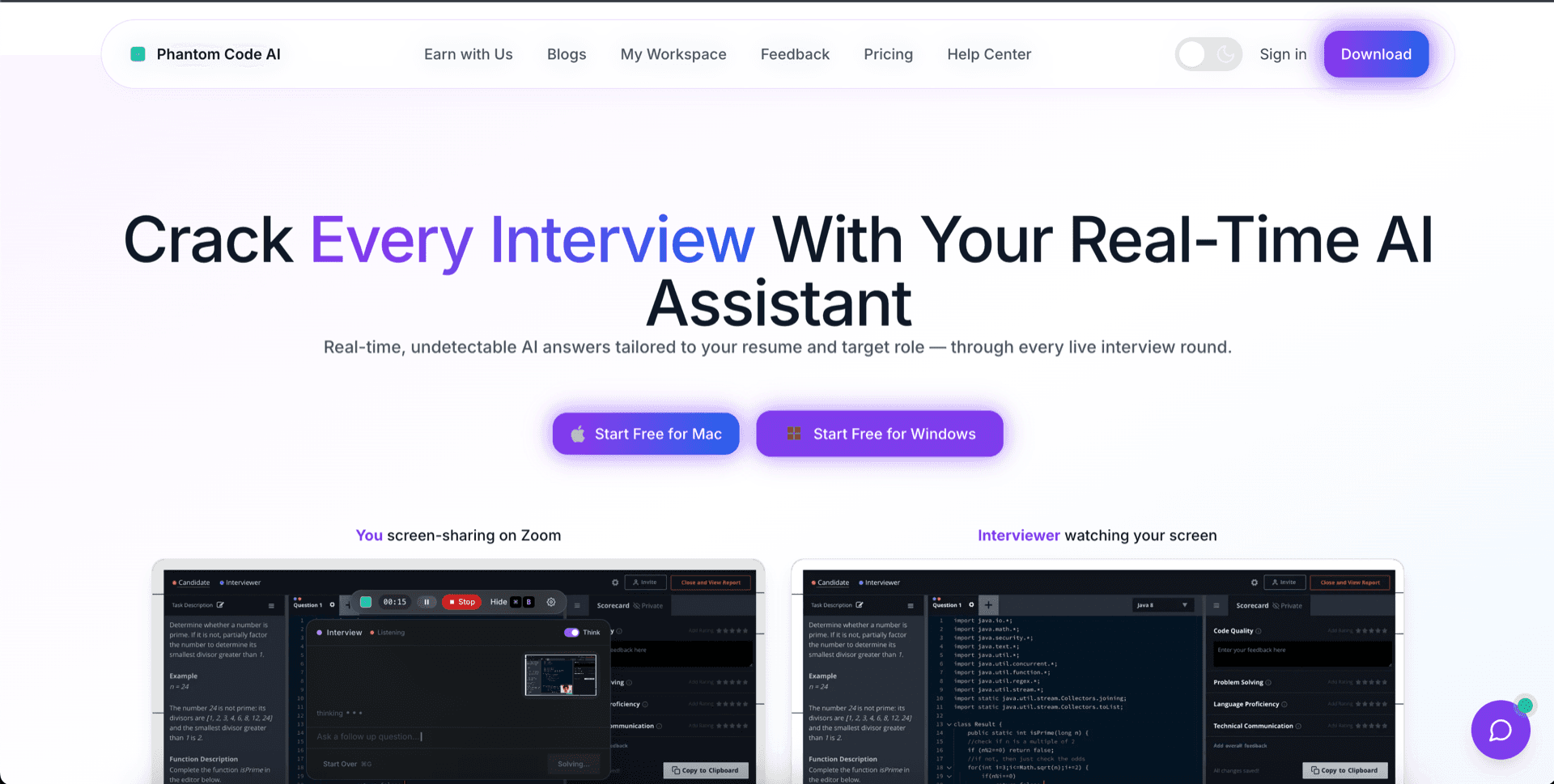
PhantomCode listens to the interviewer, parses the prompt as it's being spoken, and surfaces the right approach in the same window where you're typing. AlgoMonster is closed by the time the meeting starts. The whole premise of PhantomCode is the 45 minutes that AlgoMonster cannot help with — hint at minute eight, scaffold at minute fifteen, complexity walk at minute thirty.
2
Covers the full interview surface — coding, system design, behavioral
Most loops aren't one round. PhantomCode handles the algorithms screen with the depth AlgoMonster trained you for, then keeps going into the system design hour — capacity estimates, data partitioning, consistency trade-offs, diagram-friendly explanations — and the behavioral round, with STAR-shaped structure pulled from your own background. One tool, one window, every round.
3
11 programming languages with idiom-matching
Python, Java, C++, JavaScript, TypeScript, Go, Rust, Kotlin, Swift, C#, and Ruby — each with the idioms a senior engineer would actually write. Comprehensions in Python, streams in Java, slices in Go, ownership-aware collections in Rust. AlgoMonster's curriculum is solid across languages, but a curriculum cannot adapt to the exact accent of code your interviewer writes back. PhantomCode does, in the editor, line by line.
4
After-interview transcript that compounds your prep
Every PhantomCode session leaves a transcript: the question, the approach you took, the code, the trade-offs, the spots you stalled. That feeds straight back into your AlgoMonster practice — the next loop, you drill the patterns that actually came up, not the patterns the curriculum guessed would come up. Prep platforms cannot give you this; only a tool that was in the room can.
5
Invisible to screen recording
PhantomCode is a Mac and Windows native desktop application. When the interviewer asks you to share your screen, the assistant simply isn't in the frame — Zoom, Google Meet, Microsoft Teams, Loom, OBS, and proctoring tools all see your editor without it. AlgoMonster, being a browser-based prep site, would obviously be visible if you tried to keep it open. PhantomCode is built for the screen-shared call.
Voice-aware in 50+ spoken languages
Interviews aren't always in English. PhantomCode is voice-aware in 56 primary spoken languages — including Arabic, English, Hindi, Mandarin, Tamil, Spanish, Portuguese, French, German, Japanese, Korean, Vietnamese, Indonesian, Turkish, Polish, and Dutch — plus 6 bilingual modes for candidates who switch mid-sentence. AlgoMonster's lessons sit in English text. PhantomCode meets engineers where they actually interview, in the language they actually speak.
Ready to Ace Your Next Interview?
Download now — invisible, undetectable, and works on every platform. Plans start at $19.
When AlgoMonster still helps
We are not making the case that AlgoMonster is a bad product. It is a good product for what it sets out to do — pure pattern drilling four to six weeks before interviews. The roadmaps are organized, the explanations are clean, and the spaced repetition genuinely builds reflexes that show up later. If you are at the start of your prep and you want a structured curriculum that walks you from sliding window to graph theory to dynamic programming in a sensible order, AlgoMonster is a reasonable subscription to make for a month or two.
The honest read is that AlgoMonster and PhantomCode aren't really competitors in the same square — they live at different points of the interview lifecycle. Use AlgoMonster to get sharp. Use PhantomCode to convert that sharpness in the meeting. A lot of the strongest engineers we talk to keep both subscriptions live during a loop, then cancel AlgoMonster after the offer and keep PhantomCode for the next round of recruiter outreach.
Switch (or stack) in 5 minutes
- 1Keep your AlgoMonster subscription active through the prep phase — finish the patterns you started.
- 2Download PhantomCode for Mac or Windows from the homepage. Native installer, not a browser extension.
- 3Sign in, pick your primary spoken language, and choose your default programming language.
- 4Run a 5-minute warm-up against a LeetCode medium to get a feel for the overlay and voice mode.
- 5Schedule your next live round. PhantomCode stays out of screen capture and listens to the call automatically — your AlgoMonster prep finally lands where it counts.
Ready for the live round?
Mac and Windows native. Invisible to screen capture. Voice-aware in 50+ languages. Eleven programming languages with idiom-matching. The patterns you drilled finally have somewhere to land.
The short version
- AlgoMonster: pattern-based DSA prep platform, structured roadmaps, subscription model. Excellent four to six weeks before a loop.
- PhantomCode: live-round co-pilot. Mac and Windows native, invisible to screen capture, voice-aware in 50+ languages, 11 programming languages.
- Different lifecycle stages. Drill with AlgoMonster, then convert with PhantomCode in the meeting itself.
- If you can only run one tool when the offer is on the line, the live-round specialist is the one that affects the outcome.
Want a balanced comparison instead?
See the side-by-side: PhantomCode vs AlgoMonsterFrequently Asked Questions
- Is PhantomCode better than AlgoMonster?
- They aren't competitors in the same square. AlgoMonster is a good pattern-based DSA prep platform for the four to six weeks before a loop — organized roadmaps, clean explanations, real reflex-building. PhantomCode is a live-round co-pilot that works during the interview itself. If only one tool can run when the offer is on the line, the live-round specialist is the one that affects the outcome.
- Can I use AlgoMonster and PhantomCode together?
- Yes — that's the most common setup. Keep AlgoMonster active through the prep phase and finish the patterns you started, then run PhantomCode during the live rounds. Many of the strongest engineers keep both subscriptions live during a loop, cancel AlgoMonster after the offer, and keep PhantomCode for the next round of recruiter outreach.
- How much does PhantomCode cost compared to AlgoMonster?
- AlgoMonster is a monthly prep subscription most people run for a month or two and cancel after the loop. PhantomCode pricing starts from $19 / ₹1,599 for the Starter plan, with a Monthly plan at $49 / ₹4,299 and a Yearly plan at $199 / ₹19,999 — so you can size the spend to how long your interview cycle actually lasts.
- How hard is switching from AlgoMonster to PhantomCode?
- There's no migration — the two tools don't share data. Download the native Mac or Windows installer, sign in, pick your primary spoken language and default programming language, and run a five-minute warm-up against a LeetCode medium to get a feel for the overlay and voice mode. Your AlgoMonster prep stays useful; PhantomCode is where it lands.
- Does PhantomCode help when the interview problem doesn't match a drilled pattern?
- That's exactly the moment it's built for. Most real prompts are hybrids — sliding window with a twist, BFS where the cost function changes, a graph that's really a DP. PhantomCode listens to the interviewer, suggests the right approach in seconds, scaffolds the code, and explains the complexity, without appearing on screen share.