Looking for a Scaler alternative? PhantomCode is the real-time copilot, not the curriculum.
Scaler is a six-to-fifteen-month structured program with mentors, lectures, and a fee that runs into lakhs. PhantomCode is a desktop copilot that shows up during the actual coding round, hears the interviewer, reasons in real time, and hands you a transcript when the call ends. They are not the same product, and most engineers we hear from don't pick one — they sequence them.
This page is the persuasive case for switching to — or stacking on top of — Scaler. If you want a balanced, even-handed feature-by-feature comparison instead, jump to /vs/scaler.
Why engineers add PhantomCode after Scaler
Scaler builds the foundation. PhantomCode handles the round. They are different lifecycle stages, and treating them as competitors is the framing mistake that costs engineers either months of unused curriculum or a stack of lost rounds.
Scaler is the foundation phase
Scaler is structured curriculum — DSA, system design, low-level design, mock-based mentor sessions — sequenced over six to fifteen months. It is built for the months before you start interviewing, when you're rebuilding fundamentals from the ground up. That work is real and it pays off, but it pays off slowly.
PhantomCode is the round itself
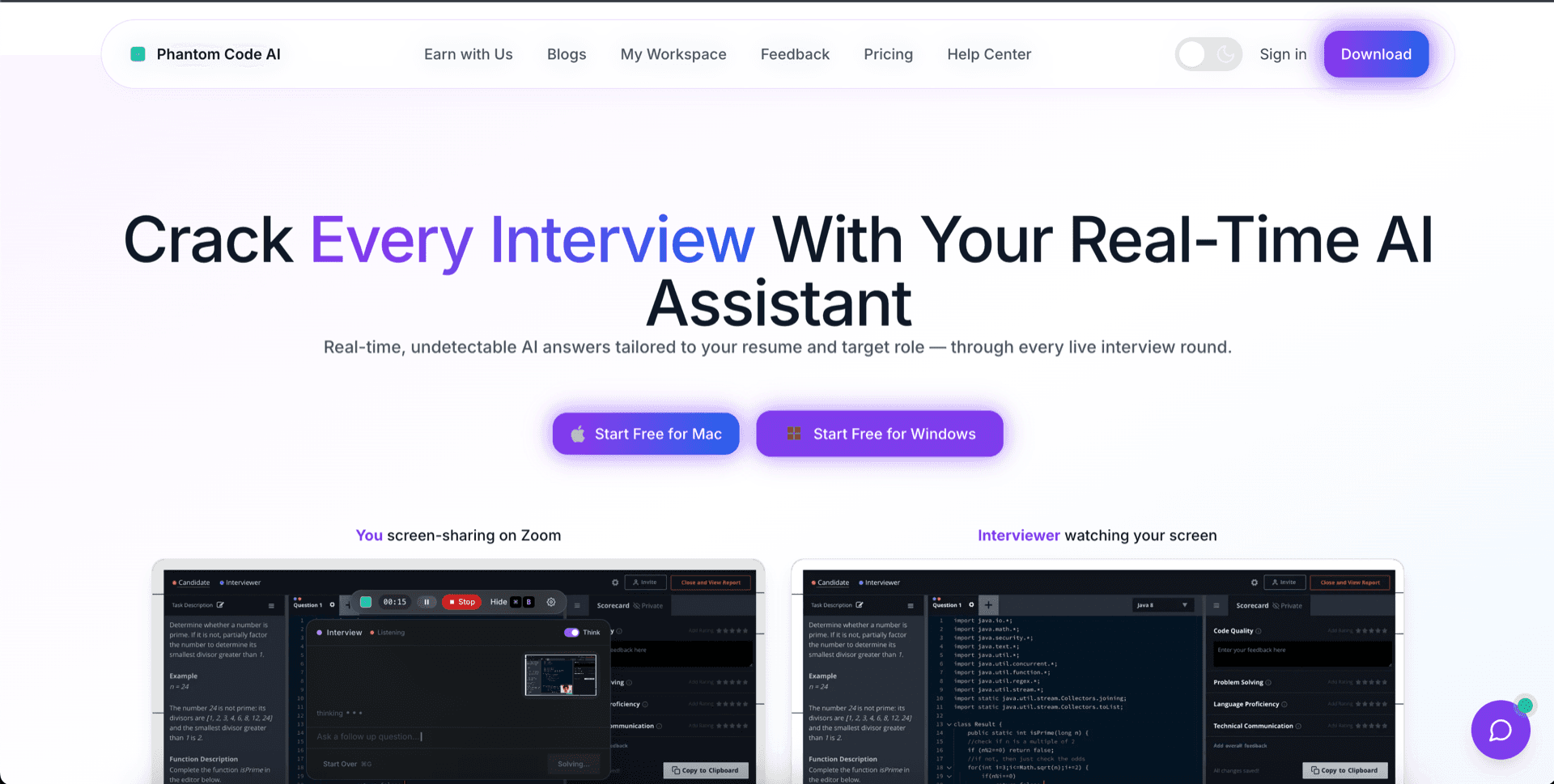
PhantomCode is the live tool that sits on your screen during the actual coding round. It hears the interviewer, reasons in real time, and helps you keep pace under pressure. It does not replace the months of practice — it shows up the day the recruiter schedules the loop.
Different lifecycle stages, not competitors
Most engineers we hear from don't pick one — they sequence them. Scaler for the build-up, PhantomCode for the rounds. The mistake is treating a six-month curriculum as if it were the same product as a real-time copilot. They solve different problems on different timelines.
And the price gap reflects that
Scaler runs anywhere from roughly ₹1 lakh to over ₹3 lakh depending on the program, paid upfront or financed across the program length. PhantomCode is a per-month subscription you only run during the few weeks you are actively interviewing. They are not on the same pricing surface, and they shouldn't be compared on it.
5 reasons to switch (or stack PhantomCode on top of Scaler)
You don't have to leave Scaler to add PhantomCode. If you're already enrolled, keep doing the curriculum work and run the copilot during the actual rounds. These are the five reasons engineers give for making the move — whether the move is a switch or a stack.
- 01
Zero curriculum time-cost — works on day 1
PhantomCode does not ask you to clear six months of evenings and weekends before it starts being useful. There is no syllabus, no cohort start date, no module-completion gate. Install it tonight, run it on a mock tomorrow, take it into Friday's onsite. The whole point of a real-time copilot is that the ramp is zero — the value is in the round, not in the months leading up to it.
- 02
Live during the actual interview, not before it
Scaler's value is delivered in lectures, mentor calls, and graded assignments — all of which happen before the interview. PhantomCode's value is delivered during the interview. It hears the question as the interviewer asks it, hears the clarifying question, hears the follow-up, and reasons alongside you in real time. That is a fundamentally different shape of help, and it is the shape that matters when the camera is on.
- 03
11 programming languages and 50+ spoken languages
PhantomCode reasons in 11 programming languages — Python, Java, JavaScript, TypeScript, C++, C#, Go, Rust, Kotlin, Swift, and Ruby — so whatever stack the round insists on, you're covered. On the spoken side, it understands 56 primary languages plus 6 bilingual modes, including Hindi, English, Tamil, Mandarin, Arabic, Bengali, Spanish, Portuguese, Japanese, Korean, French, and German. If your interviewer code-switches between Hindi and English mid-question, PhantomCode keeps up. A curriculum doesn't have to solve that problem; a live tool does.
- 04
An after-interview transcript on every round
Every PhantomCode session produces a complete transcript — the interviewer's questions, your responses, the model's reasoning trail, and the code. That is the artifact a curriculum cannot give you, because it is generated from your actual rounds, not from canned problems. You can review what tripped you up, see what the interviewer signalled they cared about, and drill the exact gap before the next loop. That feedback loop is tighter than any post-mock debrief.
- 05
Per-month subscription instead of lakhs upfront
PhantomCode is paid by the month. You turn it on for the four-to-eight-week window you are actively interviewing, you cancel when you sign the offer, and you walk away. There is no loan, no income-share clause, no multi-year financial commitment to a program you may stop attending three months in. For an engineer who already has fundamentals and just needs the rounds to land, paying ₹1L–3L+ upfront is the wrong shape of spend. A monthly subscription is the right shape.
When Scaler still pays off
Worth saying plainly. Scaler is good at things PhantomCode is not built to be good at. If you're a service-company engineer trying to break into product roles and your DSA is rusty, the structured curriculum genuinely rebuilds the muscle. Mentor sessions with senior engineers from FAANG-tier companies give you a feedback loop on your problem-solving that no live tool can replicate. The alumni network is real, the placement cell is real, and for a fresher or someone changing tracks, that scaffolding is worth paying for.
If your gap is “I cannot solve a medium graph problem from scratch,” Scaler is the right answer. If your gap is “I can solve the problem on my own desk but I freeze in the round,” PhantomCode is the right answer. Most engineers, honestly, have some version of both gaps — which is why stacking the two is the most common pattern we see.
Switch (or stack) in 5 minutes
You don't have to commit to anything. Run PhantomCode on your next mock, see whether it earns its place in your loop, and decide from there.
1.Download PhantomCode for Mac or Windows
Native desktop installer, no browser extension, no cohort signup. Two minutes from click to running.
2.Decide: switch or stack
If you're mid-Scaler and the curriculum is still earning its keep, stack. If you've already got the fundamentals and just need the rounds to land, switch the spend over to a monthly PhantomCode subscription.
3.Run it on your next mock
Open it during a self-recorded mock or a peer mock. Speak the question out loud. Pick your spoken language and your programming language in the settings.
4.Read the transcript afterwards
End the round and review the full transcript — questions, your responses, reasoning, code. This is the artifact Scaler debriefs cannot generate, because it comes from your actual rounds.
5.Cancel anytime
If it doesn't earn its place, cancel the subscription. No multi-year program, no income-share, no exit interview. That is the entire point of a per-month tool.
Want a balanced side-by-side instead? See the full PhantomCode vs Scaler comparison →
Frequently Asked Questions
- Is PhantomCode a replacement for Scaler?
- Only if your gap is the round, not the fundamentals. If you cannot solve a medium graph problem from scratch, Scaler's structured curriculum, mentor sessions and alumni network are the right answer. If you can solve it at your desk but freeze in the live round, PhantomCode is the right answer. Most engineers have some of both gaps — which is why stacking is the most common pattern.
- How does PhantomCode pricing compare to Scaler's fees?
- Scaler runs roughly ₹1 lakh to over ₹3 lakh depending on the program, paid upfront or financed. PhantomCode is a per-month tool — from $19 / ₹1,599 to start, $49 / ₹4,299 monthly, or $199 / ₹19,999 yearly — that you run only during the weeks you're actively interviewing and cancel when you sign the offer.
- Can I use PhantomCode while enrolled in Scaler?
- Yes — if you're mid-program and the curriculum is still earning its keep, stack rather than switch. Keep doing the lectures, mentor calls and assignments for the foundation work, and run PhantomCode during your actual mocks and interview rounds. The transcript it produces from real rounds is an artifact the curriculum cannot generate.
- How quickly does PhantomCode become useful?
- Day 1. There is no syllabus, cohort start date or module-completion gate: install it tonight, run it on a mock tomorrow, take it into Friday's onsite. The entire point of a real-time copilot is that the ramp is zero — the value is delivered in the round itself, not in months of build-up beforehand.
- Does PhantomCode handle Hindi-English interviews?
- Yes. PhantomCode understands 56 spoken languages plus 6 bilingual modes, including Hindi, Tamil, Bengali, Mandarin and Arabic — and it keeps up when an interviewer code-switches between Hindi and English mid-question. On the programming side it reasons in 11 languages, from Python and Java to Go, Rust and Kotlin, whatever stack the round insists on.
Ready to Ace Your Next Interview?
Download now — invisible, undetectable, and works on every platform. Plans start at $19.