Why switch
Looking for an Interviewing.io Alternative? PhantomCode is the always-on AI version.
Interviewing.io books you a human mock once a week. PhantomCode runs in the background of every real interview you take — no scheduling, no per-session fees, no waiting for a slot. If you came here searching for an alternative to Interviewing.io, this is the category jump.
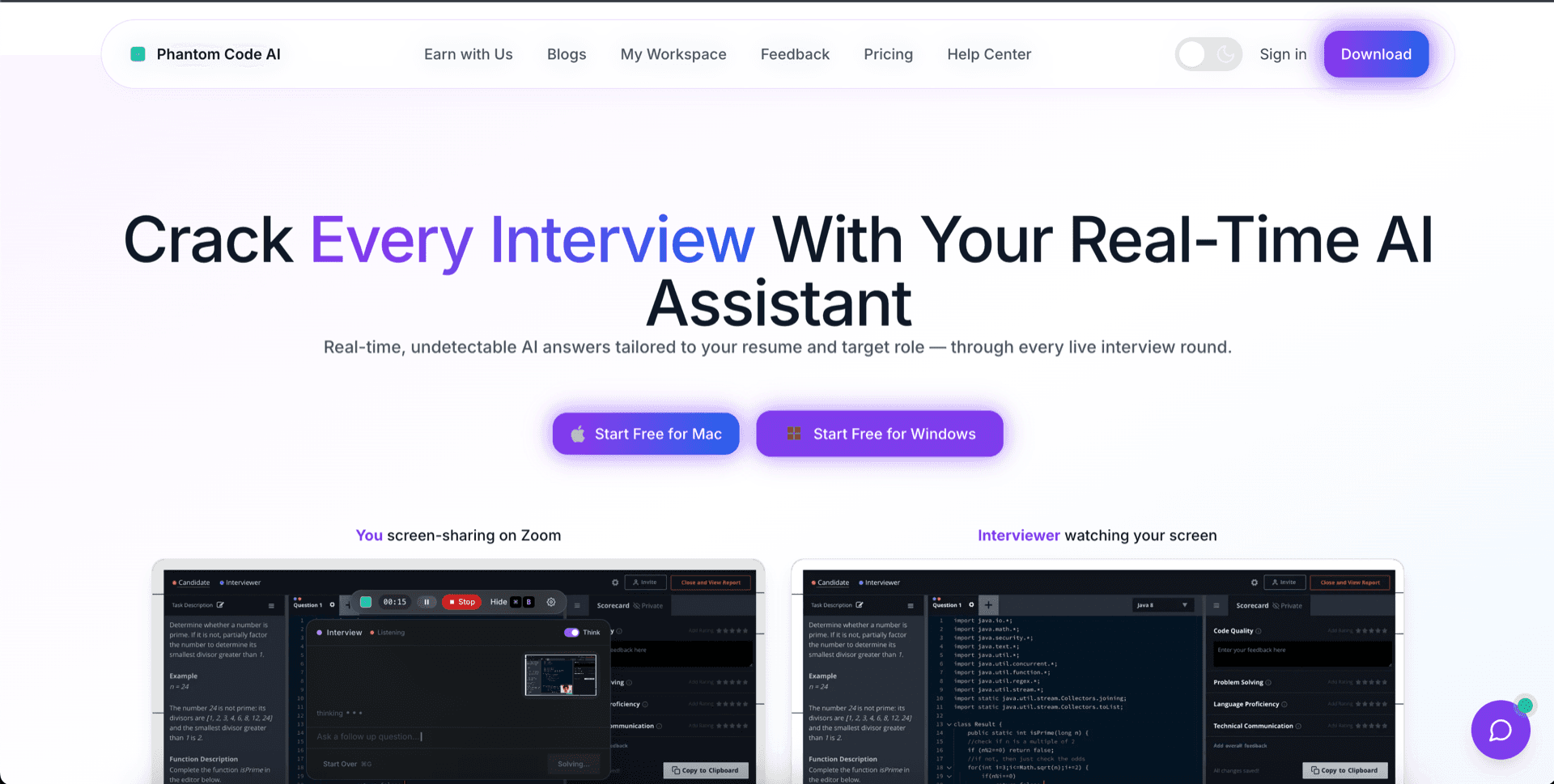
Why engineers stack PhantomCode on top of (or instead of) Interviewing.io
Interviewing.io built something genuinely useful: anonymous mock interviews with engineers from FAANG and adjacent companies. The feedback is unfiltered, the interviewers are real, and the practice is high-signal. The catch is the shape of the product. Mocks are weekly at best — interviewers have day jobs, slots are limited, and you're competing with every other candidate for the same calendar. By the time you find an open slot for the engineer you wanted, your real onsite is two days away.
Real interviews don't politely wait for your prep cycle to end. They cluster. You'll have one screen Tuesday, two onsites Thursday, a surprise system-design loop Friday. Practice is on a calendar; performance isn't. The hours that actually decide your offer are the hours when no human mentor is logged in.
Then there's the bill. Interviewing.io sessions run roughly $100 to $300+ per round depending on the interviewer's seniority. Three rounds a week for a month is real money — money spent on a service that, by design, switches off the moment your real interview begins. The interviewer gives feedback, the call ends, and on Monday morning you're alone again with a Google Meet window and a hard problem.
That's the gap PhantomCode fills. Same engineering brain, available the second the interview starts, priced as a flat monthly that wouldn't even cover one Interviewing.io session.
And the friction matters more than people admit. Booking a mock is itself a small project: pick a date, pick an interviewer level, hope the slot you wanted survives the next eighteen hours, get the calendar invite, plan your evening around it, find a quiet room, show up on time, do the round, sit through feedback, and only then come away with notes you'll try to act on by next week. That's a three-hour commitment for forty-five minutes of useful signal. Engineers in active loops simply don't have the cycles for that loop. PhantomCode swaps that whole protocol for one keyboard shortcut you press the moment your real interviewer says "let's start."
The deepest reason candidates come looking for an Interviewing.io alternative isn't the price or the slots, though. It's that the product is, by design, training wheels you have to take off the moment it counts. You can do twenty mocks and still freeze on round one of a real onsite, because the real round has none of the safety the mock had — no second chances, no debrief, no interviewer who's secretly rooting for you to figure it out. PhantomCode is the only tool you can keep on after the training wheels come off.
5 reasons to switch from Interviewing.io to PhantomCode
Not because human mocks are bad — they're useful. Because the things they can't do are exactly the things that decide the offer.
01 / Always-on, not scheduled
Real-time during the actual interview, not a slot booked next Tuesday
Interviewing.io needs a calendar match between you, the interviewer, and the platform. PhantomCode launches the moment your real interview does. The latency between "I'm stuck" and "I have a hint" drops from a week to a second. Interviewers don't reschedule; recruiters don't postpone the loop because you didn't get a mock in. The product that matches the shape of a real onsite is the one that's available the same day, at any hour, without a booking flow.
02 / Per-month, not per-session
One subscription covers an entire interview cycle
A single Interviewing.io session costs more than a full year of PhantomCode for most plans. Stacking five mocks costs a small laptop. PhantomCode is a flat monthly, so cost stops scaling with the number of interviews you take. Run twenty rounds in a month if you want — the price is the same as running two. That's the difference between paying per attempt and paying for unlimited attempts.
03 / The actual round, not just prep
Help where it counts — when an offer is on the line
Interviewing.io's job ends at the practice call. PhantomCode's job starts at the real one — DSA on LeetCode-style platforms, system design whiteboards, behavioural rounds, SQL, debugging, take-home OAs. Whatever's on the screen, it's reading. Whatever the interviewer is asking, it's hearing. That's a fundamentally different category of product. Think of mocks as the gym and PhantomCode as the gear you actually compete in.
04 / Transcript replaces mentor debrief
After-interview transcripts replace the human mentor recap
Interviewing.io's debrief is the interviewer's verbal feedback. Useful, but you're scribbling it down. PhantomCode saves a full transcript of every problem, every hint, every audio snippet — searchable, replayable, and ready for tomorrow's round. After two loops you have a private corpus of every question you've been asked, every solution you produced, and every place you stalled. That's a debrief that compounds, not one that disappears the moment the mentor logs off.
05 / 50+ spoken languages
Interview in the language you actually think in
Interviewing.io is functionally English-only — finding a Spanish, Hindi, Tamil, Mandarin or Arabic mock interviewer at your level on short notice is essentially impossible. PhantomCode listens and responds across 56 languages including English, Spanish, Hindi, Mandarin, Arabic, Portuguese, French, German, Japanese, Korean, Tamil, Telugu, Bengali, Marathi, Punjabi, Gujarati, Kannada, Malayalam, Urdu, Russian, Italian, Dutch, Polish, Turkish, Vietnamese, Thai, Indonesian, Filipino, plus six bilingual modes (English+Spanish, English+Hindi, English+Mandarin, and more). The interview round can be in your strongest language even when your interviewer is in another time zone.
Ready to Ace Your Next Interview?
Download now — invisible, undetectable, and works on every platform. Plans start at $19.
When Interviewing.io still helps
We're not going to pretend Interviewing.io is obsolete. It isn't. There are two specific situations where booking a paid human mock is clearly worth it:
- First-time exposure to real engineers. If you've never sat across from a senior FAANG engineer and explained your code while being challenged, that experience is genuinely valuable. The pressure of a live human pushing back on your tradeoffs is something AI simulations don't fully reproduce. Two or three Interviewing.io rounds early in your prep cycle pay that down quickly.
- Unfiltered written feedback. Interviewing.io interviewers leave detailed post-mock notes pointing at specific behaviours — the moment you went silent, the place you over-engineered, the bug you missed. That kind of human signal is hard to get anywhere else, and worth the per-session cost when you're trying to fix specific weaknesses.
Outside those two cases, the math leans hard the other way. Mocks tell you what to fix; PhantomCode helps you not need fixing in the first place. Most engineers we talk to do exactly that — a few Interviewing.io rounds for ground-truth feedback, then PhantomCode installed and quiet on the real interview day.
There's also a third case worth naming: senior engineers who specifically want to be challenged on tradeoffs. A staff-level system design conversation with a real principal engineer is a category of feedback that a desktop assistant cannot replace. If you're targeting L6 and above, a Interviewing.io session a fortnight is honestly money well spent — and PhantomCode still earns its keep on every coding round in the same loop.
Switch (or stack) in 5 minutes
You don't have to cancel anything. PhantomCode runs alongside whatever prep stack you already have — Interviewing.io, LeetCode, NeetCode, Pramp, your own notes. The install is one binary on macOS or Windows.
- 1Download PhantomCode. One desktop binary. Mac or Windows. Sub-90 seconds end to end.
- 2Sign in and pick a plan. Monthly or yearly. Cancel any time; refund policy applies.
- 3Run a self-mock first. Open a LeetCode tab, hit the shortcut, get used to the overlay. Two problems is enough.
- 4Keep your Interviewing.io subscription if you like. Use mocks for spaced practice and PhantomCode for the real round. The two don't conflict.
- 5Walk into the real interview with both. Practice gives you the muscle, PhantomCode gives you the safety net.
See the side-by-side feature, pricing and use-case breakdown at /vs/interviewingio.
Frequently Asked Questions
- Is PhantomCode better than Interviewing.io?
- They do different jobs. Interviewing.io books you anonymous human mocks with real FAANG-calibre engineers — unfiltered written feedback that is genuinely worth it early in prep, and for staff-level candidates who want pushback on tradeoffs. PhantomCode is the always-on AI that helps during the actual interview, when no mentor is logged in. For the round that pays the offer, PhantomCode is the one still running.
- How does PhantomCode pricing compare to Interviewing.io?
- Interviewing.io sessions run roughly $100 to $300+ per round depending on interviewer seniority, so a month of regular mocks is real money. PhantomCode starts at $19 / ₹1,599, with a $49 / ₹4,299 monthly subscription and a $199 / ₹19,999 yearly plan — a flat price that covers unlimited rounds, often less than a single mock session.
- Can I use Interviewing.io and PhantomCode together?
- Yes — you don't have to cancel anything. The stack most engineers settle on is a few Interviewing.io mocks early in the cycle for ground-truth human feedback, then PhantomCode installed and quiet on real interview day. Mocks build the muscle; PhantomCode is the safety net during the round itself. The two products never conflict.
- Does PhantomCode work if my interview isn't in English?
- Yes. PhantomCode listens and responds across 56 languages — including Spanish, Hindi, Mandarin, Arabic, Tamil, Portuguese, French, Japanese and Korean — plus six bilingual modes for code-switched interviews. Interviewing.io is functionally English-only: finding a Spanish or Mandarin mock interviewer at your level on short notice is essentially impossible, which makes multilingual loops the clearest case for switching.
- How long does it take to switch from Interviewing.io to PhantomCode?
- About five minutes. PhantomCode is one desktop binary for macOS or Windows — download, sign in, pick a plan, then run a quick self-mock on a LeetCode tab to get used to the overlay. There's no booking flow and no calendar match: from then on it launches the moment any real interview does.