Looking for an Interview Cake alternative? PhantomCode is for after the prep.
Most pages framed as “X alternative” assume you want to throw the original tool away. This one doesn't. Interview Cake is a strong, beginner- friendly DSA course. PhantomCode is a live, voice-aware co-pilot for the actual interview. They sit on opposite sides of the same loop — and the engineers who use both tend to do best.
If you want a balanced, side-by-side feature breakdown instead, jump to /vs/interview-cake.
Why engineers add PhantomCode after Interview Cake
The framing matters. Interview Cake teaches you the patterns. PhantomCode helps you execute them when it counts. They aren't competing for the same minute of your week — they're competing for different problems entirely.
Interview Cake teaches
Interview Cake is, at its heart, a curriculum. Plain-English walkthroughs of arrays, hashing, trees, dynamic programming, system-design fundamentals — the patterns that show up over and over in technical rounds. It's a great way to build the mental models from scratch, especially if you came up through a non-traditional path and the standard textbook treatments feel impenetrable.
PhantomCode helps you execute
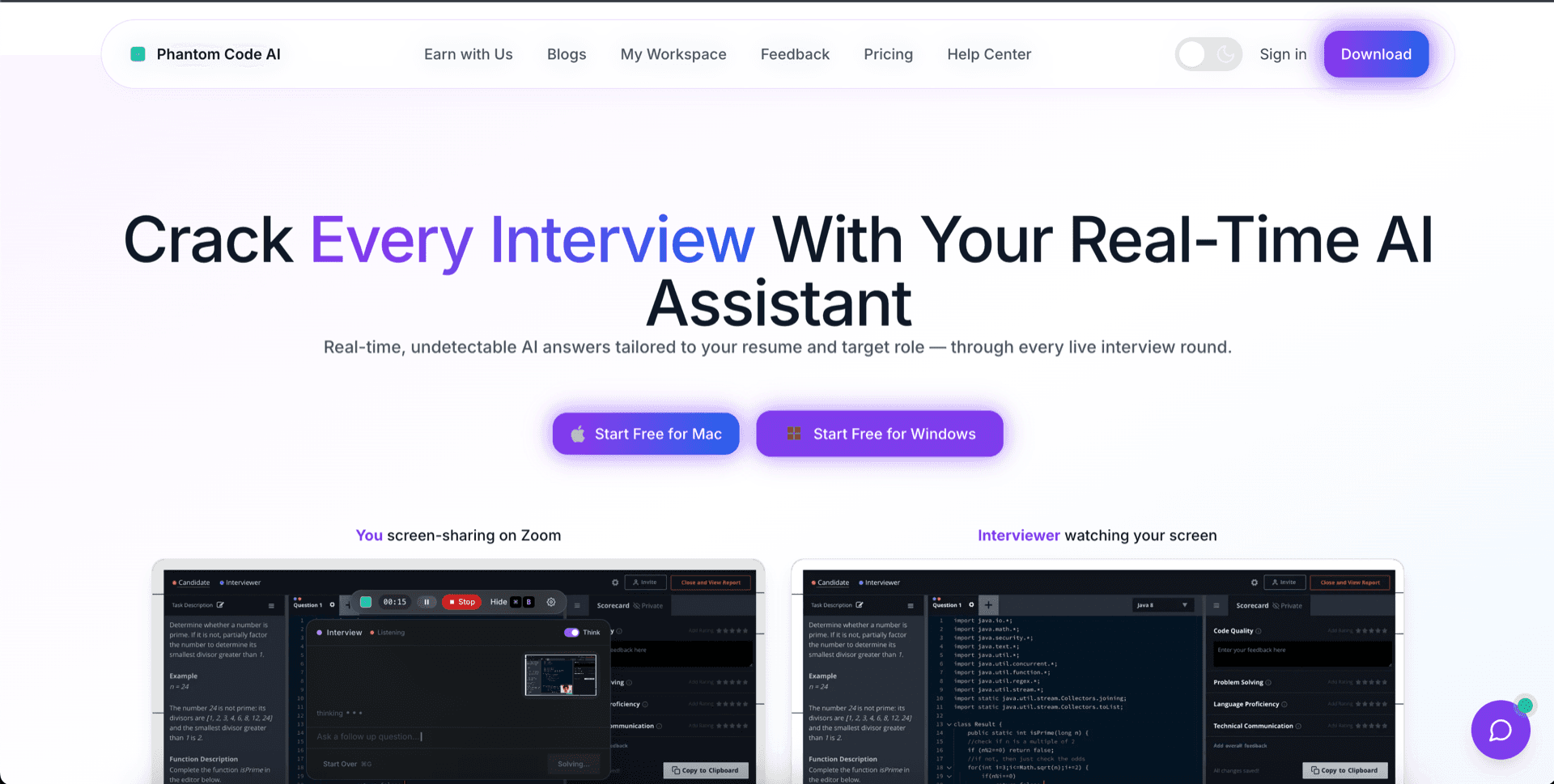
PhantomCode is not a course. It's a live, voice-aware co-pilot that runs on your machine during the actual round — listening to the interviewer, holding the problem state, and giving you a thinking partner the moment you blank. It assumes you've already done the learning work. It's there for the 45 minutes when learning isn't enough.
Sequential, not competitive
These two tools don't fight each other. Interview Cake belongs in the months before the interview — quiet evenings on the couch, working through pattern catalogues. PhantomCode belongs on the call itself. Most engineers we talk to who've used both describe it the same way: Cake got them ready, PhantomCode got them through.
5 reasons to switch — or stack
You don't have to pick a side. Some engineers replace Interview Cake outright because they've already done the foundational learning elsewhere. Others run both, with Cake during prep and PhantomCode during the round itself. Either way, here's what tips the decision.
- 01
Live, in the round — not a textbook before it
Interview Cake's whole model is text-based learning consumed asynchronously, often weeks or months before you actually interview. That's valuable. But it ends the moment the interviewer says "share your screen" and pastes a problem you didn't drill. PhantomCode is the opposite — it's silent during the prep months, then activates live during the round itself. It hears the question as it's spoken, holds the constraints, and stays with you while you think out loud. The lesson and the live moment are different problems. PhantomCode is built for the second one.
- 02
Full interview surface coverage — not just DSA
Interview Cake's catalogue is dominated by classic data-structures-and-algorithms questions, with a smaller helping of system-design primers. That maps to one slice of the modern technical loop. PhantomCode covers the whole surface engineers actually face today: DSA rounds, system design, behavioral and culture-fit questions, language-specific deep-dives in the eleven languages we support, debugging tasks, and follow-up clarifications mid-round. When the interviewer pivots from a graph problem to "tell me about a time you disagreed with a tech lead," you don't suddenly lose your tool.
- 03
After-interview transcript on every round
When you finish a chapter on Interview Cake, you have a chapter completed. When you finish an interview using PhantomCode, you have a complete transcript — every question the interviewer asked, every response you gave, the model's reasoning trail, and the code you wrote. That artifact is gold for your next loop. You can see exactly where you stumbled, which patterns you reached for, what the interviewer signalled they cared about. Interview Cake is read-only learning. PhantomCode generates a debrief you can study from.
- 04
11 programming languages — your stack, not theirs
PhantomCode answers in eleven programming languages: Python, JavaScript, TypeScript, Java, C++, C#, Go, Rust, Swift, Kotlin, and Ruby. If your team interviews you in Go and you learned the patterns in Python, PhantomCode bridges that gap on the fly. Interview Cake's content is largely centered on a smaller subset of teaching-friendly languages, which is fine for learning the concept — but the language you actually code in during the round is not always the language you learned the pattern in.
- 05
50+ spoken languages — the round in your tongue
PhantomCode listens and reasons in 56 primary spoken languages plus 6 bilingual modes — including Arabic, English, Hindi, Mandarin, Tamil, Spanish, Portuguese, Japanese, Korean, French, German, Bengali, Vietnamese, Turkish, and Polish, among many others. If your interviewer code-switches between Hindi and English mid-round, or runs the entire conversation in Mandarin, PhantomCode keeps up. Interview Cake is an English-language course; PhantomCode is a global live tool. Different jobs, different shapes.
When Interview Cake still pays off
Worth saying clearly. If you're in the first three to six months of learning data structures and algorithms from scratch — especially if you came in through a bootcamp, a self-taught path, or a non-CS degree — Interview Cake is one of the better paid options out there. The plain-English explanations are the real product. A lot of free LeetCode-style content assumes you already know what a heap is, which is exactly the gap Cake closes.
Where it stops being enough is when you transition from learning to performing. Reading about the sliding-window technique on a Tuesday night is one problem. Reaching for it under stranger's eyes, with a 45-minute timer, while the interviewer asks follow-up questions in a language other than English, is a completely different problem. PhantomCode is the tool for the second one. Stack them.
Switch — or stack — in 5 minutes
You don't have to cancel anything. Run PhantomCode against your next mock and decide for yourself whether it earns a spot next to (or in place of) the prep tool you've been using.
1.Download PhantomCode for Mac or Windows
Native desktop installer. No browser extension, no awkward setup. Two minutes from click to running on your machine.
2.Keep your Interview Cake login open
Don't cancel anything yet. The point is to compare the two against the actual job each is meant to do — prep vs round — not against each other on prep alone.
3.Run a mock with a friend, in your strongest spoken language
Have them ask the question out loud. PhantomCode picks it up live. Pick your spoken language in the settings if it isn't English — Hindi, Mandarin, Tamil, Spanish, Arabic, and 50+ others are supported.
4.End the mock and read the transcript
You'll have a complete record of the conversation, the reasoning, and the code you wrote. Use it to drive your next Interview Cake study session — work the patterns you stumbled on, skip the ones you nailed.
5.Stack — or switch
If they're solving different problems for you, keep both. If PhantomCode plus a free DSA resource gets you where you need, switch. Either decision is reasonable. We're confident enough in the comparison to recommend you actually run it.
Want a balanced side-by-side instead? See the full PhantomCode vs Interview Cake comparison →
Frequently Asked Questions
- Is PhantomCode better than Interview Cake?
- They solve different problems. Interview Cake is one of the better paid options for learning DSA from scratch — its plain-English explanations are the real product. PhantomCode assumes the learning is done and helps you perform live: reading about sliding windows on a Tuesday night and reaching for the technique under a 45-minute timer are completely different problems.
- Can I use Interview Cake and PhantomCode together?
- Yes — that's the framing of this whole page: stack, don't replace. Interview Cake belongs in the months before the interview; PhantomCode belongs on the call itself. The transcript from each PhantomCode round then drives your next Cake study session — work the patterns you stumbled on, skip the ones you nailed.
- How much does PhantomCode cost compared to Interview Cake?
- PhantomCode pricing starts from $19 / ₹1,599 for the Starter plan, with a Monthly plan at $49 / ₹4,299 and a Yearly plan at $199 / ₹19,999. Because the two tools cover different phases — prep versus the live round — engineers usually budget them separately rather than choosing between them.
- How hard is switching from Interview Cake to PhantomCode?
- You don't have to cancel anything. Download the native Mac or Windows installer — about two minutes from click to running — keep your Interview Cake login open, and run a mock with a friend asking the question out loud in your strongest spoken language. Then read the transcript and judge each tool against the job it's actually meant to do.
- Do I still need Interview Cake if I use PhantomCode?
- If you're in the first three to six months of learning data structures and algorithms from scratch, yes — no copilot replaces foundational learning, and Cake's explanations are exactly the gap-closer for that stage. If you've already done the fundamentals elsewhere, PhantomCode plus a free DSA resource may be all you need. Either decision is reasonable.
Ready to Ace Your Next Interview?
Download now — invisible, undetectable, and works on every platform. Plans start at $19.