Looking for an UltraCode AI Alternative? Here's why engineers are switching to PhantomCode.
UltraCode AI built a real product — invisible from the dock, invisible from the tray, invisible from screen-share. That part works. The problem is everything around it: one pricing tier, audio-only input, no public proof of who is actually using it, and no transcript when the interview ends. If you're comparing tools right now and UltraCode is on your shortlist, this page is for you. We'll lay out the wedge honestly, walk through the five concrete reasons engineers move to PhantomCode, and acknowledge what UltraCode does well so you can make the call yourself.
The decision you're making isn't between two interchangeable AI overlays. It's between a single-tier, single-input product and a layered product that treats interviewing as a workflow with a before, a during, and an after. Both philosophies are coherent. One of them costs $899 to find out whether it fits your specific situation. The other costs less than dinner to start, scales as you scale, and refuses to lock you in until you're ready.
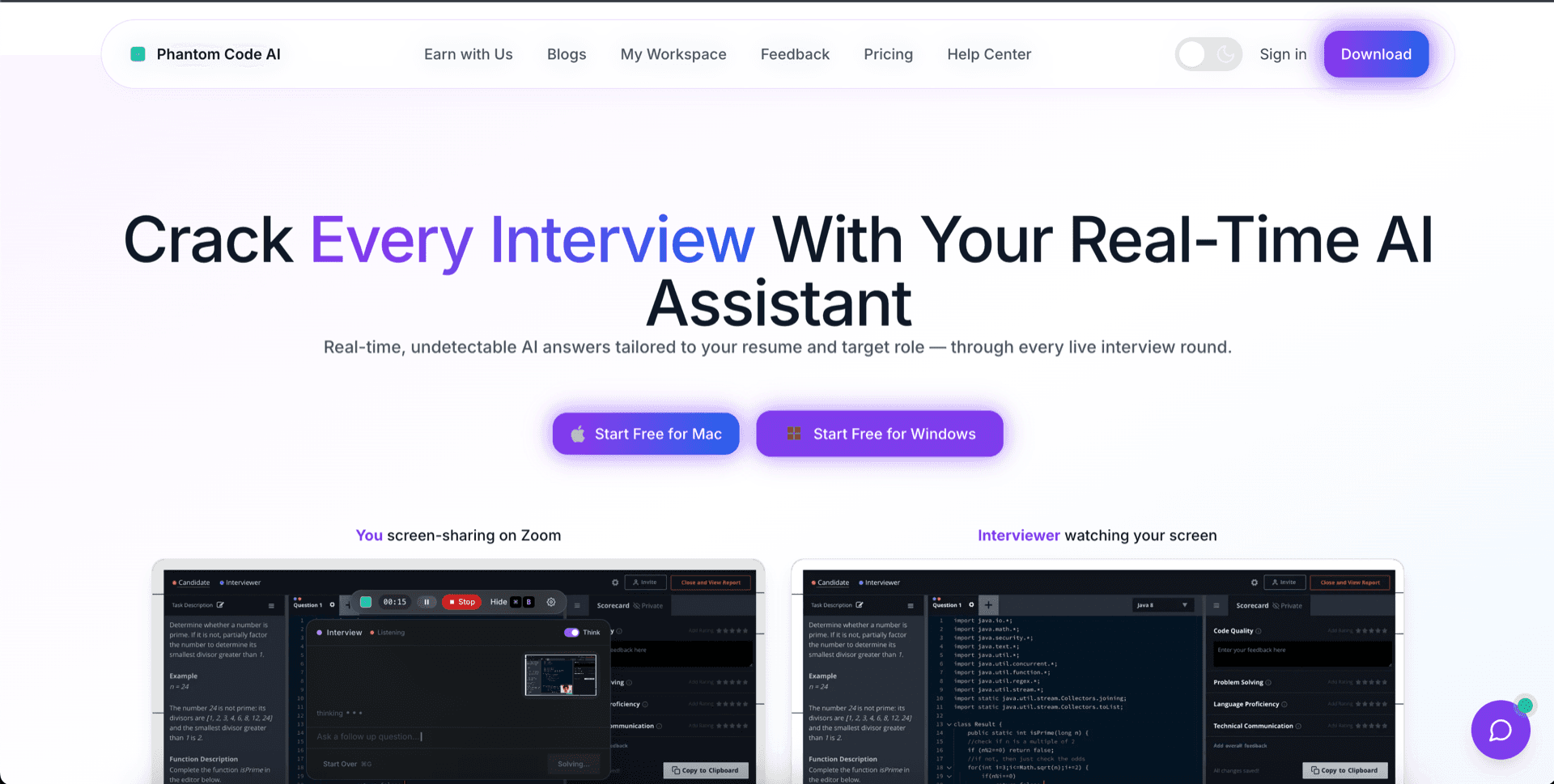
Why engineers leave UltraCode AI
The pattern is consistent across the engineers we've onboarded from UltraCode: the friction isn't the technology, it's the commercial and product decisions wrapped around it. Four issues come up every time.
- The $899 upfront barrier. UltraCode sells one plan: $899, paid up front, lifetime. There is no monthly tier, no trial credit pack, no "use it for one loop and decide." You commit $899 before your first technical screen — before you've confirmed the overlay renders correctly on your second monitor, before you've tested it against the exact coding platform your interviewer uses, before you know whether the AI's answer style matches how you actually explain trade-offs out loud. That's a lot of money to put down on a tool you haven't held in your hands yet.
- Audio-only is a hard ceiling. UltraCode listens. That's the entire input surface. There is no screenshot capture, no text input, no way to paste a stack trace, no way to grab a code snippet from a shared editor. If your interviewer pastes a 40-line Python function and asks "what does this do?" — UltraCode can't see it. If the question is a LeetCode problem rendered as a screenshot inside a Zoom whiteboard — UltraCode can't read it. Voice is one channel. Real interviews use three.
- No documented user proof. You can search for UltraCode AI testimonials, case studies, named offer reports, Reddit AMAs from real users — and you will struggle to find them. There are no public success stories tied to identifiable engineers. For a $899 lifetime purchase, that's an unusually thin trust surface. PhantomCode publishes named testimonials, ratings, and offer write-ups; you can verify before you pay.
- No transcript after the round. When the interview ends, UltraCode ends with it. There's no record of what was asked, what the AI suggested, or what you said in response. You can't review your own performance, can't debrief with a friend over the actual content, and can't carry forward what you learned to the next loop. The post-interview is where the compounding happens — and UltraCode skips it.
None of these are dealbreakers in isolation. Together they describe a product philosophy that prioritizes simplicity for the seller over flexibility for the engineer. That's a fair tradeoff to make, but it's the wrong one for the majority of candidates who are running multiple interview loops, switching between platforms, and navigating offers in markets where English isn't the default technical language.
5 reasons to switch to PhantomCode
1. Flexible pricing — try monthly first, go yearly if you love it.
PhantomCode lets you start with a $19 credit pack or a $49/month monthly subscription. Run it through one interview cycle. If the overlay behaves on your machine, the AI's answer style matches yours, and the multi-modal capture works against your target platform — then upgrade to a $199/year yearly plan. You're not gambling $899 on a product you haven't validated. You're paying in proportion to how much you trust the tool, with the option to commit fully once you're sure.
2. Multi-modal input: voice + screenshot + text.
Real interviews don't live in one channel. PhantomCode captures the interviewer's voice, lets you screenshot the coding pane to grab pasted code, diagrams, error messages, or whiteboard problems, and accepts direct text input when you want to type a clarifying note or paste a snippet. Three input modes mapped to how interviews actually flow. UltraCode hears one of those three.
3. After-interview transcript — review and improve.
PhantomCode keeps a structured record of every session: the questions, the audio-derived dialogue, the AI's suggestions, your responses. After the round you can re-read what was asked, see where the AI nudged you, and identify the spots where your verbal explanation was weaker than your code. This is the difference between treating each interview as a one-shot and treating it as a feedback loop. UltraCode doesn't persist a transcript — what was said during the round is gone the moment the round ends.
4. 11 programming languages with idiom-matching.
PhantomCode answers in your language's idioms — Python comprehensions and dunder methods, Go's explicit error returns and channel patterns, Rust's ownership-aware solutions, Java's streams, TypeScript's discriminated unions, plus C++, C#, Kotlin, Swift, Ruby, and JavaScript. The output reads the way a senior engineer in that ecosystem would actually write it, not a generic transliteration that gets caught the moment your interviewer asks "why this approach?"
5. 50+ spoken languages — interview in the language you think in.
PhantomCode captures and understands interviewer dialogue across more than fifty spoken languages — Arabic, Bengali, English, French, German, Hindi, Indonesian, Italian, Japanese, Korean, Mandarin, Marathi, Polish, Portuguese, Punjabi, Russian, Spanish, Swahili, Tamil, Telugu, Thai, Turkish, Ukrainian, Urdu, Vietnamese, and dozens more, plus six bilingual modes for engineers whose interviews mix two languages mid-sentence. If you're interviewing for a role where the technical screen happens in something other than American English, this matters more than any other feature on this page. UltraCode's audio-only model with a narrow language scope leaves a lot of engineers stranded.
Ready to Ace Your Next Interview?
Download now — invisible, undetectable, and works on every platform. Plans start at $19.
What UltraCode does well
We're not going to pretend UltraCode is a bad product. Two things genuinely work, and you should weigh them.
- Invisibility track record. UltraCode hides from the dock, hides from the tray, and stays out of screen-share. That's the table-stakes feature for any tool in this category, and they deliver it. PhantomCode delivers the same outcome — both tools sit in the same category on this dimension. If invisibility were the only criterion, it'd be a coin flip.
- Simple positioning. UltraCode is easy to explain: one tier, one input, one promise. There's no pricing matrix to decode, no feature menu to scroll through. For some engineers that simplicity is the whole appeal — they want to pay once, install, and never think about it again. That's a legitimate preference, and if it describes you exactly and you're comfortable with audio-only, UltraCode is internally coherent.
The honest framing: UltraCode is the right tool for engineers who want a single audio-only purchase and never look at it again. PhantomCode is the right tool for engineers who want flexibility on price, multiple input modes for unpredictable interview formats, a record of what happened, and language coverage that matches the global engineering market.
Switch in 5 minutes
- Download PhantomCode for macOS or Windows.
- Sign in and start with a $19 credit pack — no upfront commitment.
- Open it before your next mock or real interview. Press the hotkey, capture voice plus screenshot, and watch the answer appear in the overlay.
- Review the transcript afterward to see what you got right and where you stalled.
- If it works, upgrade to $49/month monthly or $199/year yearly — still less than the $899 single tier UltraCode offers.
Want the side-by-side feature matrix? See the full PhantomCode vs UltraCode AI comparison.
Frequently Asked Questions
- Is PhantomCode better than UltraCode AI?
- On invisibility they sit in the same category — UltraCode hides from the dock, tray and screen-share, and PhantomCode delivers the same outcome. Everywhere else the gap is wide: PhantomCode adds screenshot and text input alongside voice, keeps a transcript of every round, covers 50+ spoken languages, and lets you start small instead of committing $899 before your first technical screen.
- How does PhantomCode pricing compare to UltraCode AI's $899?
- UltraCode AI sells exactly one plan: $899, paid upfront, lifetime — no monthly tier, no trial pack. PhantomCode starts with a $19 credit pack, runs $49/month as a subscription, and tops out at $199/year. You pay in proportion to how much you trust the tool, and every tier costs less than UltraCode's single one.
- Why does multi-modal input matter in a live interview?
- Because real interviews use three channels, not one. When an interviewer pastes a 40-line Python function and asks what it does, or renders a LeetCode problem as a screenshot inside a Zoom whiteboard, audio-only tools can't see it. PhantomCode captures voice, screenshots the coding pane, and accepts direct text input — mapped to how interviews actually flow.
- Does UltraCode AI keep a transcript after the interview?
- No — when the interview ends, UltraCode ends with it. There's no record of what was asked, what the AI suggested, or what you said. PhantomCode keeps a structured record of every session, so you can re-read the round, spot where your verbal explanation was weaker than your code, and carry the lesson into the next loop.
- How do I switch from UltraCode AI to PhantomCode?
- Download PhantomCode for macOS or Windows, sign in, and start with a $19 credit pack — no upfront commitment. Run it through one mock or real interview with voice plus screenshot capture, review the transcript afterward, and upgrade to $49/month or $199/year only once the tool has proven itself on your machine.