Looking for a Yoodli alternative? PhantomCode handles the interview round Yoodli doesn't.
Yoodli grades your speech in advance — filler words, pace, eye contact. PhantomCode is the co-pilot during the live, screen-shared coding round itself — real-time hints, working code, an invisible window. They're not the same tool. Most engineers use both.
Why engineers reach for PhantomCode after Yoodli
Yoodli is a communication coach. You record yourself answering a question, and Yoodli grades the result — filler words like “um” and “like,” speaking pace, eye contact, sentence variety, the shape of your answer. It's a polished tool, and the feedback is genuinely useful for behavioural prep, presentations, and elevator pitches.
Then your real interview starts. The recruiter shares a screen, pastes a LeetCode-style problem, and asks you to think out loud while you write code in 25 minutes. At that exact moment, Yoodli has nothing to say. It's not built to. It's a post-hoc grader, not a live assistant. No real-time hints. No code generation. No technical context. By design.
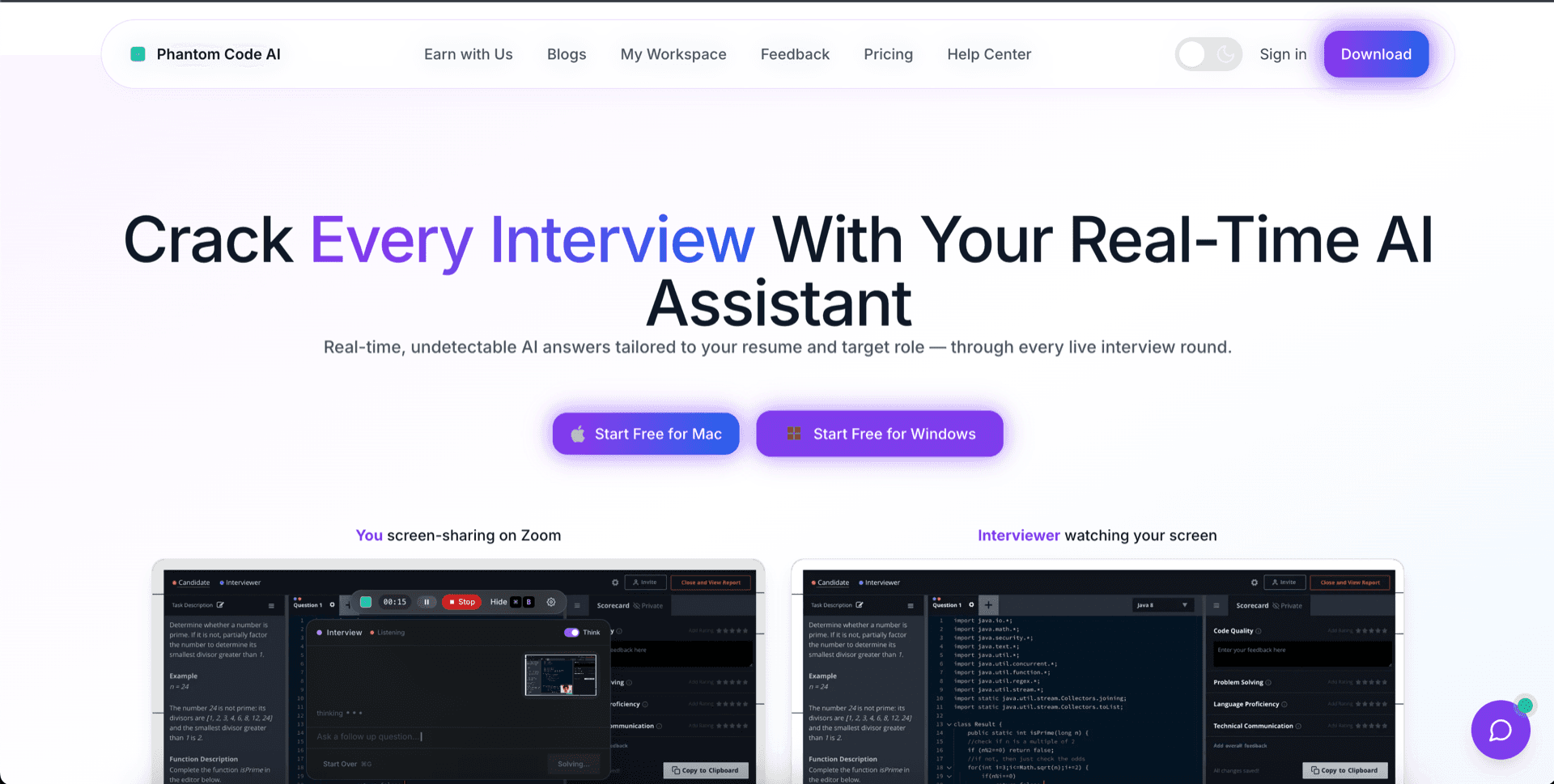
That's the gap PhantomCode fills. Different category, different stage of the funnel. Yoodli sands the rough edges off your speech in the weeks before the call. PhantomCode is the silent pair-programmer during the call itself — invisible to the screen-share, listening to the interviewer, generating working code in your stack, and handing you a transcript at the end. They aren't competing for the same minute on your calendar. They're covering different minutes.
The mistake we see engineers make is treating “Yoodli vs PhantomCode” like a binary. It isn't. Yoodli is the equivalent of a vocal coach you visit before a performance. PhantomCode is the teleprompter and the technical reference that quietly stays with you during the performance. A vocal coach doesn't need to do what a teleprompter does, and a teleprompter doesn't need to do what a vocal coach does. Anyone arguing one should replace the other has misread the job description.
The other thing worth saying plainly: a coding interview isn't graded on filler words. It's graded on whether the code compiles, whether the trade-offs are sensible, whether the system-design diagram survives ten minutes of interviewer pushback. Polished speech is a tax on the floor of your performance, not the ceiling. Yoodli raises that floor. PhantomCode lifts the ceiling. Both matter — they just matter for different reasons, on different days, in different rooms.
Ready to Ace Your Next Interview?
Download now — invisible, undetectable, and works on every platform. Plans start at $19.
5 reasons engineers add PhantomCode to their Yoodli setup
These aren't reasons to drop Yoodli. They're the reasons Yoodli alone isn't enough once the live, screen-shared, code-on-the-clock round actually arrives.
1. Real-time during the round, not feedback after it
Yoodli is replay-based. You speak, it scores. PhantomCode is live. It hears the interviewer's question the moment it's asked, parses what's on your screen, and surfaces a structured answer — including working code — within seconds. There's no “review session” afterwards because the help arrives during the interview, not after it. For the 25 minutes that decide the offer, that timing difference is the entire product.
2. Built for coding and system design, not generic speech
Yoodli wasn't designed for technical interviews. It can transcribe a behavioural answer, but it doesn't understand a sliding window, a graph traversal, or an LLD class diagram. PhantomCode does. It generates working solutions in 11 programming languages — Python, Java, C++, JavaScript, TypeScript, Go, Rust, C#, Kotlin, Swift, Ruby — handles system design with diagrams and trade-off discussion, and structures answers the way interviewers expect. It's a coding co-pilot, not a public-speaking trainer.
3. Invisible to screen recording — by design
Yoodli isn't hiding from anything; it's a webapp you run before the interview, alone in your room. PhantomCode runs during the interview, on a screen-share, and stays off the recording. The window doesn't appear in screen capture, screen sharing, or proctoring video — verified across Zoom, Google Meet, Microsoft Teams, and the major proctoring tools. That's the property no browser-based or in-call tool can match, and it's the single most-cited reason engineers install PhantomCode for live rounds.
4. 50+ spoken languages — for interviewers who aren't in English
Yoodli's coaching is centred on English speech. PhantomCode handles real-time interviewer audio across more than 50 spoken languages — Arabic, English, Hindi, Mandarin, Tamil, Spanish, French, German, Portuguese, Japanese, Korean, Vietnamese, Indonesian, Turkish, Polish, Dutch, Italian, Bengali, Telugu, Marathi, Gujarati, Punjabi, Urdu, Filipino, Thai, Malay, and many more — including bilingual code-switching modes for engineers being interviewed in two languages at once. If your hiring panel speaks Mandarin, Hindi, or Tagalog, that matters.
5. After-interview transcript — with the technical content intact
Yoodli's post-session report grades how you spoke. PhantomCode's post-session transcript captures what was actually said and built — the question, the constraints, the code that was suggested, the trade-offs that came up, the part where you got stuck. You debrief in five minutes instead of replaying half-remembered moments for an hour, and the technical content is preserved instead of summarised away. That's a different artifact for a different purpose.
When Yoodli still helps — keep using it
We don't want anyone uninstalling Yoodli on our account. It's good at what it does. Here are the moments it earns its place in your prep stack — none of which PhantomCode is trying to replace.
If you're early in your prep, weeks out from the actual loop, and you're working on the soft-skill layer — how you tell a STAR story, how you compress a project recap into ninety seconds, how you hold eye contact through a tough question — Yoodli is exactly the right tool to be using, and a coding co-pilot would be the wrong one. The split is mostly about timing.
Communication-skill polish
If you trail off, mumble, or speak too fast under pressure, Yoodli's feedback loop is the cleanest way to fix it. Record, review, adjust, repeat. It's structured practice for the part of an interview that's about how you sound, not what you say.
Filler-word reduction
Yoodli counts your “um”s, “like”s, and “you know”s and shows you the trend over time. For a behavioural round or an exec presentation where filler words quietly dominate the impression, that's a genuinely useful coaching layer.
Presentation and pitch prep
If you're prepping a demo day pitch, an internal town-hall talk, or a recorded video answer for a hiring loop, Yoodli is the right tool. Pace, eye contact, sentence variety — those are the metrics that move you from “competent” to “polished.” PhantomCode doesn't touch that work.
Stack them, don't switch
Stack Yoodli and PhantomCode in 5 minutes.
Yoodli for the week before the interview. PhantomCode for the interview itself. There's no migration, no “pick a side,” no overlap to untangle — they live at different points in your prep timeline. Set them up once and forget the seams.
A pattern that works for most engineers: Yoodli for an hour every evening through the prep week, focused on whatever question type feels weakest — STAR stories, project recaps, “tell me about yourself,” salary negotiation language. Then PhantomCode in the background during the actual coding loop, recording the technical content, surfacing real-time hints, and handing back a clean transcript afterwards so the next round of Yoodli practice has real material to work with. The two tools end up feeding each other, instead of competing.
- 1. Use Yoodli through the week to record practice answers and tighten filler words, pace, and eye contact.
- 2. Download PhantomCode for Mac or Windows the day before the interview.
- 3. Sign in and pick your primary programming language and spoken language.
- 4. Run a quick practice round so the real-time response feel is familiar.
- 5. Walk into the interview with Yoodli's polish baked in and PhantomCode quietly riding shotgun.
Want a balanced, side-by-side comparison instead?
This page argues for stacking the two. If you'd rather see a feature-by-feature, neutral-language comparison with a full table, pricing, and FAQ — that lives at our dedicated PhantomCode vs Yoodli page.
Frequently Asked Questions
- Is PhantomCode better than Yoodli?
- It's the wrong binary — they do different jobs. Yoodli is a vocal coach you visit before the performance: filler words, pace, eye contact. PhantomCode is the technical reference that quietly stays with you during it: live hints, working code, an invisible overlay. A coding interview is graded on whether the code compiles, not on filler-word counts — each tool covers its half.
- Should I use Yoodli and PhantomCode together?
- Yes — stack them, don't switch. The pattern that works for most engineers: Yoodli for an hour each evening through the prep week, focused on the weakest question type, then PhantomCode in the background during the actual loop. Its transcript even hands your next Yoodli session real material to practice with, so the two tools feed each other.
- Can Yoodli help during a live coding interview?
- No — by design. Yoodli is a post-hoc grader: you record an answer, it scores the result. It has no real-time hints, no code generation and no technical context, and it doesn't understand a sliding window or a graph traversal. The moment a recruiter pastes a LeetCode-style problem and starts the clock, that's PhantomCode's job.
- How much does PhantomCode cost?
- Plans start from $19 / ₹1,599 for a one-time Starter pack, with a monthly subscription at $49 / ₹4,299 and a yearly plan at $199 / ₹19,999 — no lifetime tier. Since Yoodli covers the prep weeks and PhantomCode covers interview day, the stack prices as two small tools insuring different parts of the same loop.
- How do I set up the Yoodli and PhantomCode stack?
- About five minutes, the day before your interview. Keep using Yoodli through the week to tighten filler words and pacing; then download PhantomCode for Mac or Windows, sign in, pick your primary programming and spoken languages, and run a quick practice round so the real-time response feel is familiar. There's no migration and no overlap to untangle.