Looking for a Big Interview Alternative? PhantomCode is the real-time, in-the-round copilot.
Most pages framed as “X alternative” assume the original product is broken and you should burn it down. This one doesn't. Big Interview is a competent behavioral curriculum with strong video lessons. PhantomCode is a live, voice-aware copilot for the actual technical round. They live on opposite ends of the same interview lifecycle, and most engineers we talk to who use both end up keeping both.
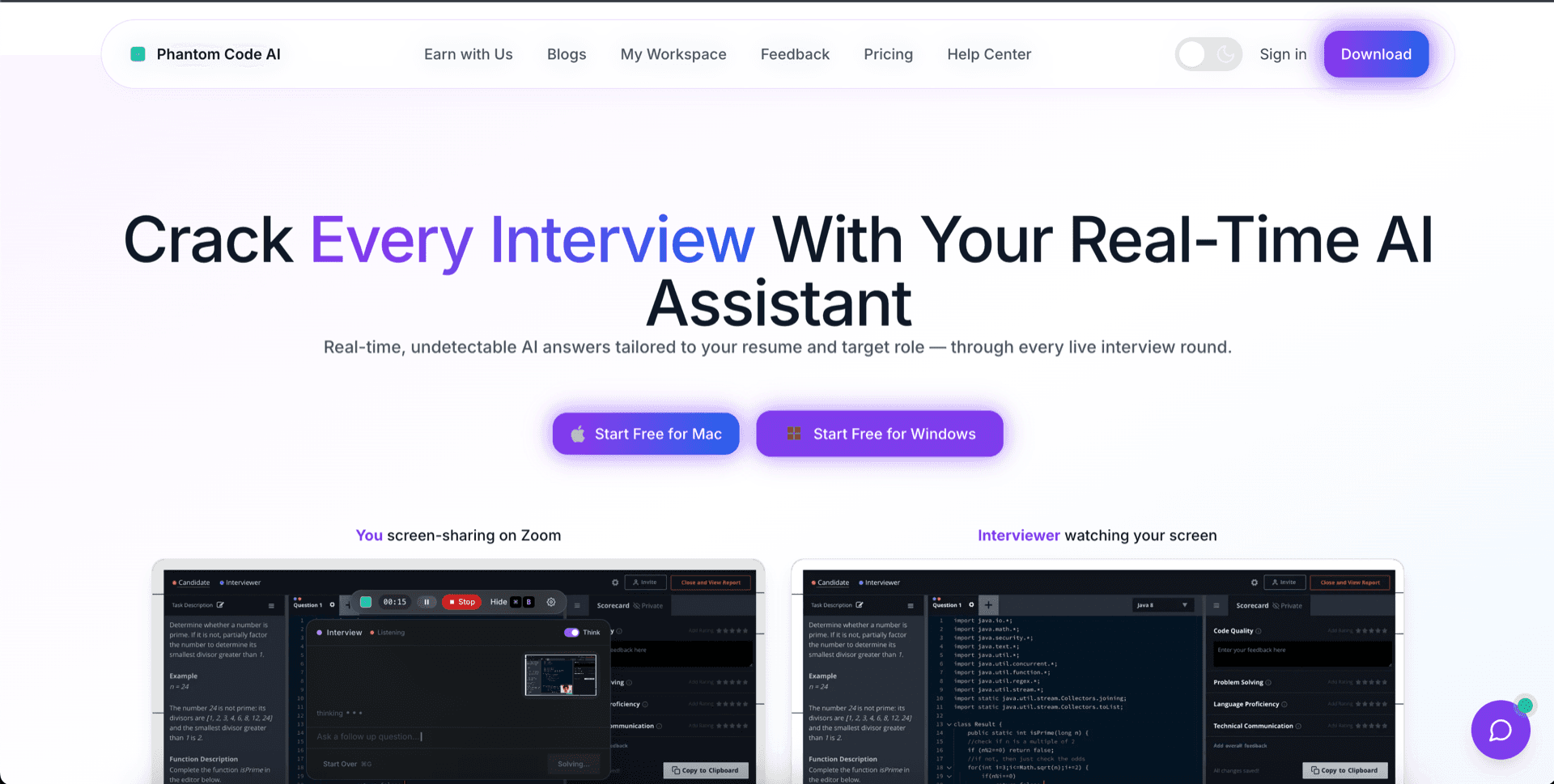
If you want a balanced, side-by-side feature breakdown rather than the persuasion pitch, jump to /vs/big-interview.
Why engineers move past Big Interview for the actual interview
The thing Big Interview does best is upstream of the round. Curriculum, video lessons, behavioral drilling, recording-and-reviewing your own answers — that's a real product, and it's well executed. The trouble starts when you treat that curriculum as the whole solution, because the technical round itself is a different problem with a different shape.
Curriculum is upstream
Big Interview is consumed in advance. Quiet evenings on the couch, weeks before the loop. You watch a lesson, drill an answer, record yourself, move on. By design, none of it is in the room when your interviewer says “share your screen and walk me through this graph problem.”
The live round needs in-the-moment help
When you blank twenty minutes into a 45-minute coding round, no amount of past curriculum is reachable in the moment. You need a thinking partner that hears the question as it's spoken, holds the constraints, and helps you find the next step without taking the keyboard. That's a different category of product.
Coding depth lags behavioral strength
Big Interview's behavioral library is the polished part. The coding-and-system-design depth is thinner — which is fine if behavioral is your weak link, but a problem if you're an experienced engineer whose actual risk is freezing on a DP problem in front of two staff engineers from Stripe.
5 reasons engineers switch — or stack
You don't have to pick a side. Some engineers replace Big Interview outright because their behavioral game is already solid and they need a coding-first product instead. Others run both: Big Interview during the curriculum months, PhantomCode during the live round. Either decision is reasonable. Here's what tips it.
- 01
Real-time during the round — not prep-only beforehand
Big Interview's entire model is upstream. You log in on a quiet evening, watch a video lesson on tell-me-about-yourself, record a practice answer, get rubric-style feedback, repeat. That's a perfectly reasonable shape for behavioral conditioning. But the moment your real interviewer pastes a problem and starts the screen-share timer, Big Interview is done — its job ended hours or weeks earlier. PhantomCode is silent during prep and activates the moment the round begins. It listens to the interviewer through the system audio you already use, holds the problem state in memory, and stays beside you while you think out loud. Prep-only and live-during are different categories of tool entirely.
- 02
Coding and system-design depth where Big Interview lags
Big Interview's strongest material is behavioral — STAR-format storytelling, executive presence, recording-and-reviewing answers. The technical and coding modules exist, but they're treated as one section among many in a generalist curriculum, not the heart of the product. For a senior backend engineer prepping for a five-round Google or Meta loop, that ratio is upside-down. PhantomCode is built coding-first: graph traversals, sliding window, DP, distributed system trade-offs, schema design, language-specific idioms in Python, Go, Rust, TypeScript, Java, C++, C#, Swift, Kotlin, Ruby, and JavaScript. The behavioral round is one slot of five; the technical rounds are the rest.
- 03
50+ spoken languages — the round in your tongue
PhantomCode listens and reasons in 56 primary spoken languages plus 6 bilingual modes — including Arabic, English, Hindi, Mandarin, Tamil, Spanish, Portuguese, Japanese, Korean, French, German, Bengali, Vietnamese, Turkish, Polish, Indonesian, Thai, and many more. If your interviewer code-switches between Hindi and English mid-round, or runs the entire conversation in Mandarin, PhantomCode keeps up. Big Interview's video curriculum is overwhelmingly English-first — fine for U.S.-based behavioral coaching, less helpful when you're interviewing for a Bangalore, Tokyo, or Berlin team in a language the curriculum doesn't speak.
- 04
After-interview transcript on every round
When you finish a Big Interview lesson you've finished a lesson. When you finish a real interview using PhantomCode you have a complete transcript — every question the interviewer asked, every response you gave, the model's reasoning trail, and the code you wrote in the round. That artifact is gold for your next loop. You can see exactly where you stumbled, which patterns you reached for, what the interviewer signalled they cared about, and where you talked too much or too little. Big Interview's mock-recording feature is closed-loop and self-graded; PhantomCode's transcript is a debrief of the actual round you just survived.
- 05
Pricing that doesn't scale with your interview activity
Big Interview's monthly subscription adds up fast — and the cruel part is that it scales with calendar time, not with how much you actually use it. If you spread your prep over four months across two job searches you pay four months. If you blitz the curriculum in two weekends you still paid the month. PhantomCode's pricing is built for spiky interview activity rather than long-tail subscription. You expense it during the loop, not for the year you spent thinking about leaving your current job.
When Big Interview still pays off
Worth saying clearly. There are three cohorts where Big Interview earns its subscription regardless of what we ship — and we'd rather be honest about that up front than pretend our tool replaces theirs in every situation. It doesn't.
First-time interviewer? The video curriculum is genuinely good.
If you've never done a structured interview loop before — first job out of school, first move from contractor to full-time, first time at a company that runs five separate rounds — Big Interview's curriculum gives you the shape of the thing. What is a behavioral round actually testing? What does "executive presence" mean for a staff engineer interview? Why do recruiters keep saying "impact"? The video lessons answer those, and that frame matters before you sit down for round one.
Structured behavioral training is its core strength
STAR-format storytelling, recording yourself answering tell-me-about-a-time questions, reviewing the recording, tightening the narrative — that loop is genuinely effective for behavioral rounds, and Big Interview built its product around it. PhantomCode is not trying to replace that. We don't ship a behavioral video library. If you want structured drilling on "tell me about a conflict with a coworker" with rubric feedback, Big Interview is one of the more polished options on the market.
Video-curriculum learners get more from it than text learners
If you learn well from talking-head video, walkthrough explanations, and an instructor pacing you through a curriculum, Big Interview meets you where you are. Not everyone learns that way — some engineers prefer text patterns or live mock interviews — but for the cohort that does, the production value is real and the structure is honest.
How to stack them — different lifecycle stages
The cleanest way to think about Big Interview and PhantomCode is as two products addressing two different phases of the same job search. They aren't competing for the same thirty minutes of your week. They're competing for nothing — they cover non-overlapping parts of the loop.
1.Months out: use Big Interview for behavioral curriculum
Tell-me-about-yourself, conflict stories, leadership examples, recording-and-reviewing your STAR answers, building the muscle memory for the soft side of the loop. This is what Big Interview was built for and the part it does well.
2.Weeks out: drill technicals with whatever you trust
LeetCode, NeetCode, Designing Data-Intensive Applications, your favorite system-design playlist — whatever pattern resource you already trust. Big Interview's technical depth is not where its production budget went, so we wouldn't lean on it as your sole DSA prep.
3.Day-of: install PhantomCode for the live round
Native desktop app, two minutes from download to running. Picks up the interviewer's voice through the system audio you already use for the call. Listens, holds the problem state, surfaces the next step when you blank — without taking the keyboard from you.
4.After: read the transcript and feed it back into prep
PhantomCode generates a complete debrief of every round — questions, answers, reasoning, code. Use it to drive your next study session. The patterns you stumbled on become the next week's drill list. The rounds you nailed get to rest.
5.Decide whether to keep Big Interview running
After a couple of loops, the question of whether you still need a separate behavioral curriculum subscription becomes empirical. Some engineers keep both indefinitely. Some retire Big Interview once their STAR stories are crisp. Either is reasonable — make the call from data, not advertising.
Want a balanced comparison?
If this page felt too persuasion-heavy and you'd rather see a side-by-side feature breakdown, read the full PhantomCode vs Big Interview comparison →
Frequently Asked Questions
- Is PhantomCode better than Big Interview?
- They do different jobs. Big Interview's behavioral video curriculum is genuinely good — polished lessons, STAR drilling, rubric-style feedback — and PhantomCode doesn't try to replace it. But its coding and system-design depth is thinner than its behavioral strength, and it has no presence during the live round. PhantomCode is coding-first and runs while the interview is happening.
- Can I use Big Interview and PhantomCode together?
- Yes — they cover non-overlapping parts of the loop. The clean stack: Big Interview months out for behavioral curriculum, your trusted DSA resources weeks out, PhantomCode on the day of the round, and its transcript afterwards to drive the next study session. After a couple of loops, whether to keep both becomes an empirical question.
- How much does PhantomCode cost compared to Big Interview?
- Big Interview is a monthly subscription that scales with calendar time — spread your prep over four months and you pay four months, whether or not you used it heavily. PhantomCode is built for spiky interview activity, with pricing from $19 / ₹1,599 for the Starter plan, $49 / ₹4,299 Monthly, and $199 / ₹19,999 Yearly.
- How hard is switching from Big Interview to PhantomCode?
- There's nothing to migrate — the two products don't overlap in data or workflow. PhantomCode is a native desktop app, about two minutes from download to running, and it picks up the interviewer's voice through the system audio you already use for the call. You can keep Big Interview running alongside it or retire it once your STAR stories are crisp.
- Does PhantomCode replace Big Interview's behavioral video lessons?
- No. PhantomCode doesn't ship a behavioral video library, and structured record-and-review drilling is Big Interview's core strength — especially for first-time interviewers who need the shape of the loop explained. What PhantomCode adds is in-the-moment help during the real round, including behavioral questions, plus a transcript of what was actually asked.
Ready to Ace Your Next Interview?
Download now — invisible, undetectable, and works on every platform. Plans start at $19.