Looking for a Formation Alternative? PhantomCode is the always-on senior+ copilot.
Formation runs a real program. Senior+ mentor reviews, structured behavioral framing, an arc of mocks that bend toward the company you're targeting — for engineers going after their first staff or principal loop, the cohort delivers. The catch is when the loop actually starts. Mentor reviews are weeks behind you. The mock is over. The Stripe interviewer is on the screen and the question just landed. That's the moment PhantomCode is built for.
This page is the persuasive case for switching to — or stacking onto — Formation. If you want a balanced, even-handed feature-by-feature comparison instead, jump to /vs/formation.
Why engineers stack PhantomCode after Formation
Premium prep helps. We're not here to argue otherwise. But the live round still needs in-the-moment help — and a mentor review can't be there during your real Stripe loop. Four patterns show up in almost every conversation we have with an engineer who's come off a Formation cohort and is still searching for an edge in the actual interview.
Mentor reviews can't be there during your real loop
Formation's flagship value is the mentor review session — a senior+ engineer dissects your mock weeks before the real call. That's genuinely useful prep. But on the actual day, when the question pivots, the interviewer pushes back on your design, or the system-design clock runs out, the mentor isn't on the call. You are. Alone.
Premium pricing, paid up front
Formation's senior tracks are priced like a bootcamp — into the thousands of dollars, often paid as a single commitment before you've seen a single mentor session. That's a bet on a long arc, not a tool you can pull off the shelf the week before a Stripe loop.
Quality varies by which mentor you draw
Mentor-driven programs are only as good as the mentor on the other end of the Zoom. Some mentors are sharp, current, and dialed into the company you're targeting. Others are coasting on a five-year-old FAANG title. Formation does its best to match, but the variance is real and you're paying premium either way.
Long lead time before you see results
The Formation arc is multi-week to multi-month — applications, cohort placement, mentor scheduling, mock cycles. If your recruiter just dropped a Stripe onsite on you for two weeks from now, the Formation pipeline doesn't bend to that timeline. You need something that's there tonight.
5 reasons to switch (or stack)
You don't have to pick one. Plenty of engineers run Formation for the prep arc and PhantomCode for the live round. But if you're evaluating where the next dollar of your interview budget goes, here's the case.
- 01
Live during the round — not weeks before it
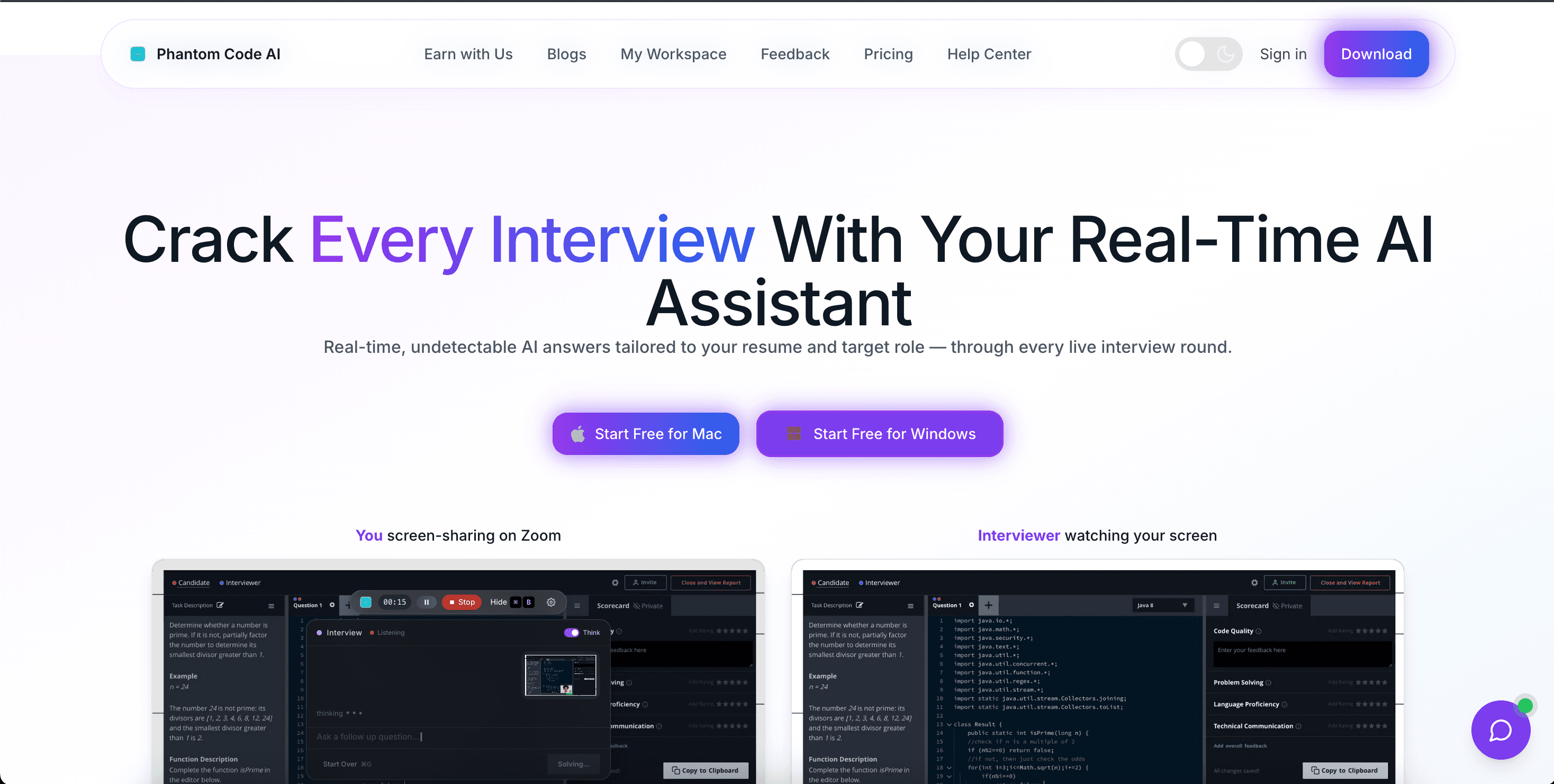
PhantomCode is on your machine when the interviewer hits join. It hears the question as it's spoken, follows the clarifying back-and-forth, and surfaces senior+ reasoning in the moment — design tradeoffs, edge cases, complexity analysis, the follow-up question the interviewer is about to ask. Formation gives you the prep arc. PhantomCode gives you the round itself. Most engineers who've sat through a senior+ loop will tell you the gap between knowing the answer and producing it under camera-on pressure is the entire game.
- 02
Per-month cost — not $1000s up front
PhantomCode is a per-month subscription you can run for the four to eight weeks you're actively interviewing and cancel clean once you've signed. Compared to a Formation cohort priced in the thousands and paid as a single commitment, it's a different category of spend. You can stack PhantomCode on top of a Formation track and still be meaningfully cheaper than a second cohort — and you don't have to predict your interview timeline a quarter in advance.
- 03
After-interview transcript replaces the mentor debrief
Every PhantomCode session generates a complete transcript — every question, every clarifying turn, the model's reasoning trail, and the code you wrote. After the round, you can read what actually happened: where you stumbled, what the interviewer signalled they cared about, which design decision the rubber-band of follow-ups was actually probing. That's the same loop a Formation mentor walks you through in a debrief — except you have it on every round, including the real ones, not just the mocks Formation watches. For engineers who've already burned through their cohort hours, the transcript is the debrief that keeps coming.
- 04
11 programming languages with idiom-matching
PhantomCode reasons in 11 programming languages — Python, Java, C++, JavaScript, TypeScript, Go, Rust, Swift, Kotlin, Ruby, and C# — and matches the idiom of whichever one you opened the editor in. If your interviewer hands you Java for a system-design coding portion and you're a Python primary, PhantomCode doesn't drop you back to Python and ask you to translate. It writes Java the way a senior Java engineer would. Formation's mentor pool covers the languages its mentors happen to know — and you don't always get to pick.
- 05
Invisible to screen recording during the live round
PhantomCode is a native macOS and Windows desktop app whose window does not appear in screen recording or screen sharing. We've verified the behavior across Zoom, Google Meet, Microsoft Teams, and the QuickTime/OBS family of recorders. There's no dock icon and no tray notification. That's what makes a live in-the-round copilot actually viable — a tool you can read while sharing your full screen, without it being on the share. Formation doesn't ship anything in this category, because Formation isn't trying to be in the room during the call. PhantomCode is.
When Formation still pays off
Worth saying plainly. There are three scenarios where the Formation cohort is the right call, and PhantomCode isn't a substitute — it's a stack-on.
- Your first senior+ loop. If you've never sat through a staff or principal interview before, the format itself is the obstacle — system design scope, behavioral leveling rubrics, scope-of-influence questions. A mentor who's been on the other side of that table walks you through what the rubric is actually measuring. That's a structural understanding no copilot replaces.
- Mentor introduction value. Formation's mentor network is real, and warm intros out of a cohort do happen. If you're targeting a specific company and the right mentor lands in your queue, that relationship can outlast the cohort and outvalue the tuition.
- Structured behavioral framework. The behavioral side of senior+ loops is where most strong engineers leak signal — scope, leadership, ambiguity, influence. Formation drills this with a framework and feedback. PhantomCode helps in the moment with phrasing and structure, but the muscle memory you build over a cohort is a different thing.
If you're in one of those buckets, run Formation. And then run PhantomCode on top of it the week the loops actually start.
Switch (or stack) in 5 minutes
You don't have to commit. Run PhantomCode on a single mock and decide for yourself.
1.Download PhantomCode for Mac or Windows
Native desktop installer, no browser extension, no account-creation friction. Two minutes from click to running.
2.Open it during your next mock — Formation or otherwise
Hit record on QuickTime or OBS, share your screen on a fake Zoom, and confirm the PhantomCode window doesn't show up in the recording. Run a real coding question through it.
3.Speak the question out loud — or have your mentor ask it
PhantomCode picks it up live. Senior+ reasoning surfaces in real time — design tradeoffs, edge cases, the follow-up the interviewer's likely to push on next.
4.End the round and read the transcript
You'll have a full record of the conversation, the reasoning trail, and the code. It's the same shape as a Formation mentor debrief — except you have it on every round, including the real ones.
5.Stack — or switch
Most engineers stack: Formation for the prep arc, PhantomCode for the live round. If the trial doesn't sell you, keep what you have. We're confident enough in the comparison to recommend you actually run it.
Want a balanced side-by-side instead? See the full PhantomCode vs Formation comparison →
Ready to Ace Your Next Interview?
Download now — invisible, undetectable, and works on every platform. Plans start at $19.