
Language support changes the value of a mock interview. If you think in Hindi, Japanese, French, or another language, an English-only tool adds extra strain before the coding starts. Here are five platforms to compare by spoken language, transcription, coding-language coverage, feedback, and interview fit. A broader overview of AI mock interview tools can help you understand how these practice workflows differ.
We read the 44 most recent Trustpilot reviews of Final Round AI and all 7 Trustpilot reviews of Huru, 51 reviews in total. Final Round AI carries a 2.9-star average across 277 reviews, with only 1 of the 44 we read citing a speech-recognition problem. Huru holds a 3.9-star average across 7 reviews, and none mentioned its stated Spanish, French, German, or Portuguese support. Marketed language coverage rarely appears in either review record, making a live transcript the clearest evidence of how a tool handles a given language.
Table of Contents
- Phantom Code AI
- Final Round AI, Broadest Stated Language and Accent Coverage
- Huru, Multilingual Feedback Beyond Transcription
- Devana, Voice-First Practice for Selected Programming Languages
- DevInterview.AI, Focused Coding-Language Coverage With Scored Results
- Comparison Table: Language, Transcription, and Interview Fit
- FAQ
- Conclusion
1. Phantom Code AI
Phantom Code AI is an invisible desktop assistant for coding, system design, and behavioral interviews. It listens to the session, transcribes speech, recognizes the problem type, and gives guidance while you practice.
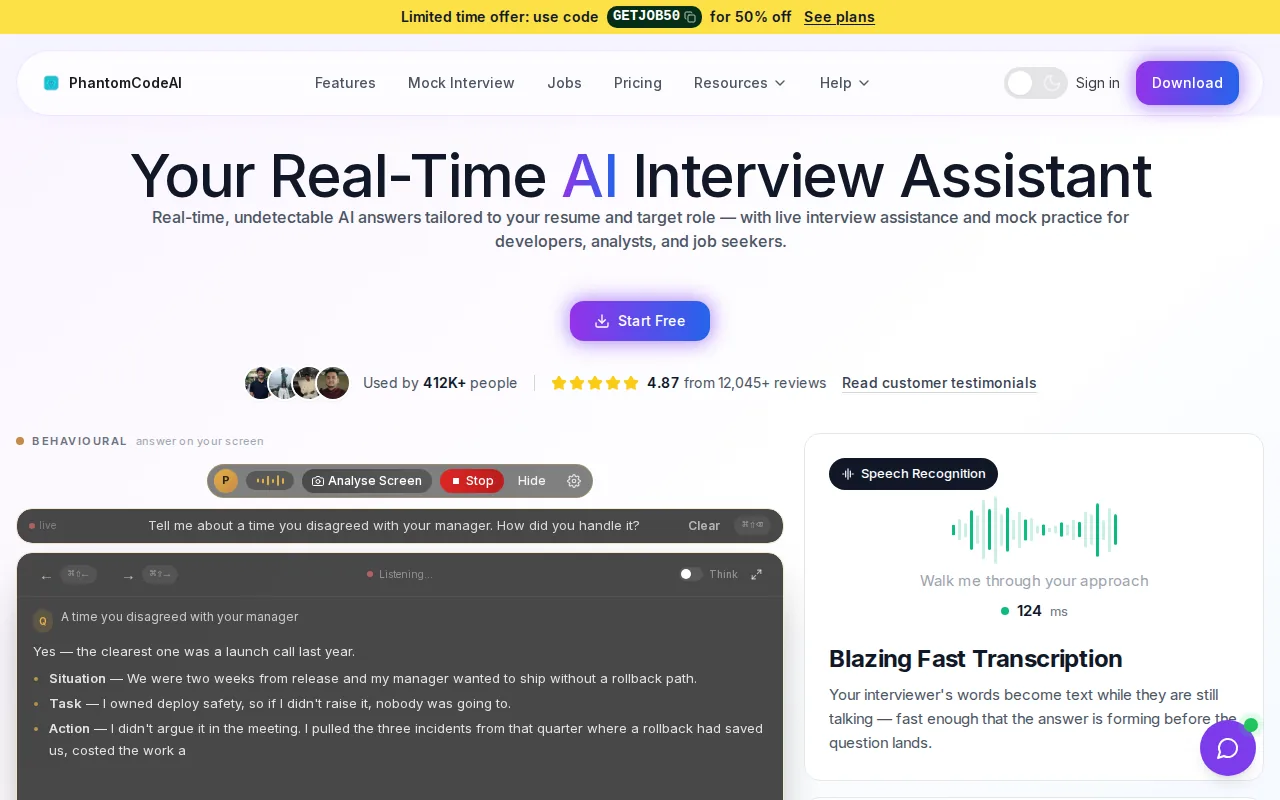
For engineers who need multilingual support with live help, Phantom Code AI is the strongest match in this shortlist. Its stated coverage reaches 91 spoken languages. It also pairs that breadth with live transcription and AI feedback, which is a rare combination in this category. Its broader AI for job interviews in 50+ languages coverage is especially relevant when you want to rehearse technical explanations in the language you use most naturally.
That matters during a system design round. You may explain a cache policy in your first language, switch terms into English, and still need a clean record of the discussion. A live transcript gives you something to inspect later. You can check where your answer became vague, where you skipped a trade-off, or where you stopped explaining while coding.
Phantom Code AI also fits several interview formats. A DSA session may need hints about edge cases. A system design session may need prompts about scale or failure recovery. A behavioral round may need help keeping a STAR answer focused.
Engineers who want to study the workflow in more detail can review how an AI interview assistant works. The key distinction is timing: feedback arrives during the round, rather than only after you finish.
The main caveat is that you should check your target employer's rules before using any AI assistant in a live hiring interview. For practice, though, Phantom Code AI gives multilingual candidates a way to rehearse the same pressure they expect to face. If you are comparing tools with ChatGPT, review the permitted workflow for live interviews before testing either one in an employer process.
2. Final Round AI, Broadest Stated Language and Accent Coverage
Final Round AI is a strong option to consider when accent and language breadth are your first filter. Its stated coverage includes 91 languages and accents, while real-time transcription is listed for more than 26 languages.
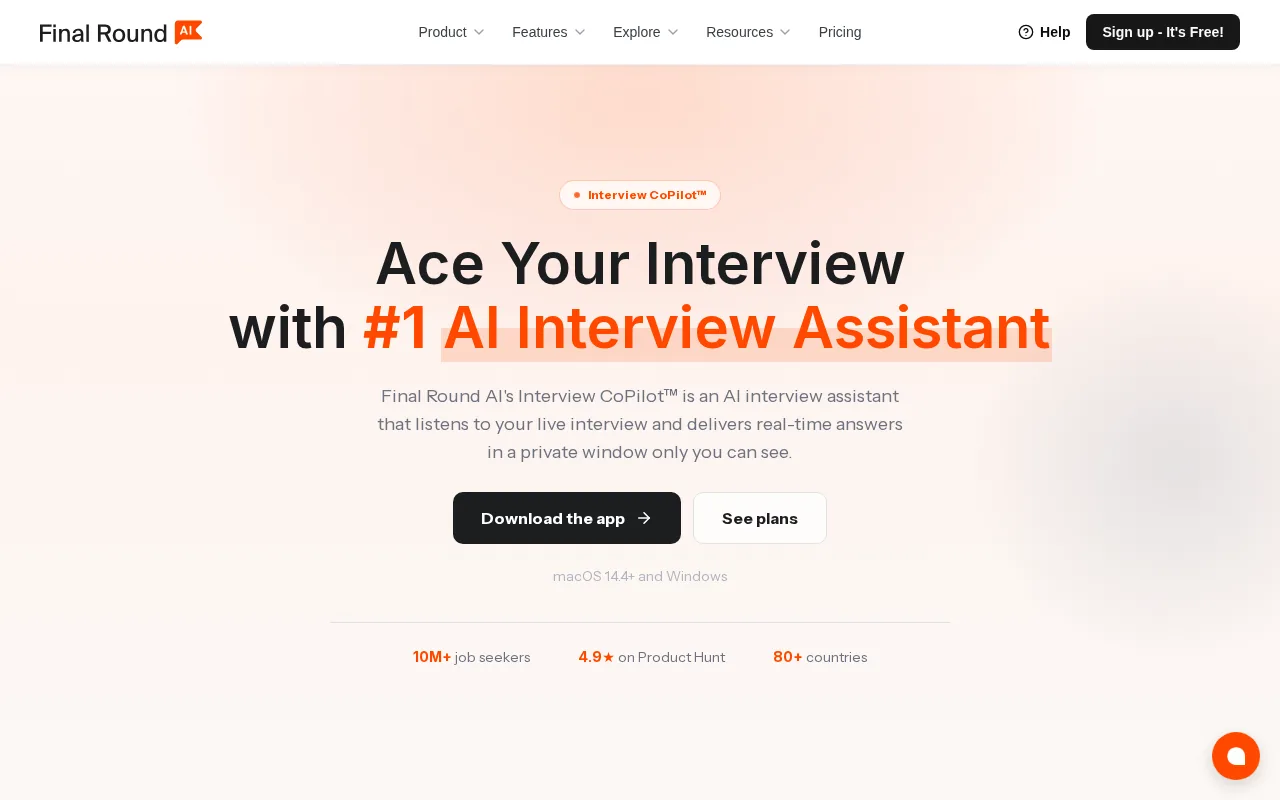
That makes it useful for candidates who want the interview prompt to feel closer to the speech patterns they hear at work. A software engineer preparing for an interview with a global team may care about accent handling as much as written translation.
Still, the comparison needs a careful line between broad language claims and the full practice workflow. A platform may recognize many languages yet provide limited feedback in some of them. Before paying, test a sample session with the exact language and accent you plan to use.
Final Round AI has a free plan, which can make that test easier. Use it to check whether the transcript keeps technical terms intact. Words such as “idempotency,” “eventual consistency,” and “amortized” can expose weak recognition faster than casual conversation.
Its limitation in this comparison is the gap between stated language coverage and the specific mix Phantom Code AI presents: broad language support plus live transcription and AI-driven interview guidance. If you mainly want language and accent reach, Final Round AI belongs on your test list. If you prefer a more live, in-the-round practice workflow, compare it with the Big Interview alternative as well. If you want one practice loop that also records and critiques your performance, compare the full workflow rather than the language count alone.
3. Huru, Multilingual Feedback Beyond Transcription
Huru is a useful pick for candidates who care about spoken delivery in several languages. It states support for 13 languages, including French, Japanese, Hindi, and Korean.
Its feedback goes beyond a transcript. The reported review covers answer content and relevance. It also looks at speech and grammar, suggests corrected alternatives, and scores vocal tone, pitch, and energy.
That focus can help when your answer is technically sound but hard to follow. Imagine explaining a distributed queue while speaking too fast. A delivery review may show that your pauses, tone, or sentence structure made the explanation harder to track.
Huru fits behavioral practice especially well. You can rehearse an answer about a failed release, then inspect whether the response stays tied to your role and outcome. The same review can help you cut filler words or replace a vague sentence with a clearer one.
For engineers comparing mock interview platforms by language support, the trade-off is coverage. Huru's stated language count is much smaller than Phantom Code AI's 91 languages. Its feedback detail may still appeal to candidates whose language is supported and whose main weakness is delivery rather than live coding.
Don't assume a speech score proves technical correctness. Pair this kind of practice with code execution or a focused review of complexity, edge cases, and system trade-offs.
4. Devana, Voice-First Practice for Selected Programming Languages
Devana is built around spoken practice. It uses a voice-first AI interviewer and a runtime compiler, so you can talk through a solution while the code runs in an isolated environment.
The listed programming languages include Python, TypeScript, JavaScript, Java, and C++. That gives Devana a clear fit for engineers who want to practice both verbal reasoning and executable code in a common language. For repeatable setup across those sessions, see how to configure language-specific code snippets during mock sessions.
The voice format is its main point of difference. A session can interrupt when your logic is unclear, ask for a missing constraint, or push you to explain a design choice. That feels closer to a live technical screen than silently solving a problem in an editor.
For example, suppose you propose a queue for a notification service. A good practice round should make you explain delivery guarantees, retry behavior, and what happens when a worker fails. Speaking those choices aloud exposes gaps that a text-only problem set may leave hidden.
Devana's free tier includes three full interviews each month. That can work for a candidate who wants a small number of structured voice sessions rather than daily reps.
The caveat is language scope. Pick it when runtime execution and spoken coding are your bottleneck. Pick another tool when your first need is broad native-language coverage.
5. DevInterview.AI, Focused Coding-Language Coverage With Scored Results
DevInterview.AI targets software engineers who want a live voice interviewer, a code editor, and a scored result after the session.
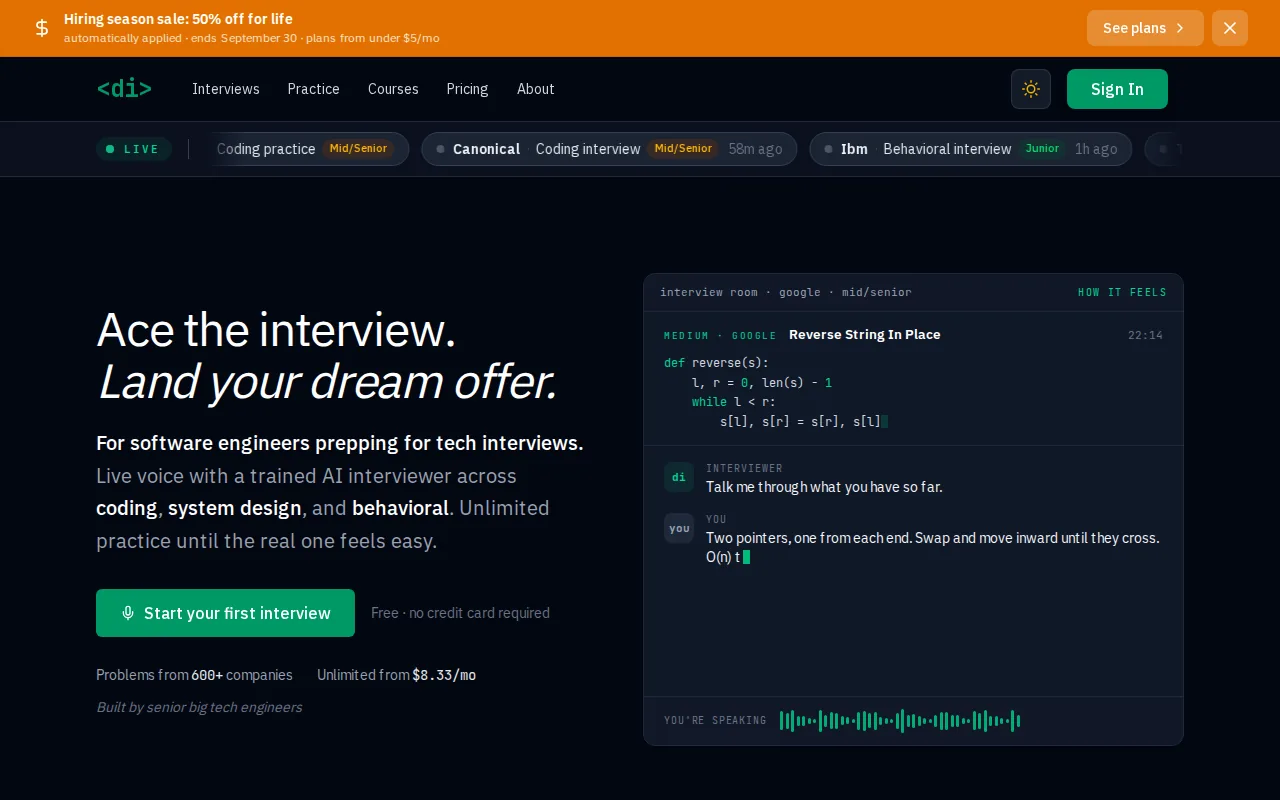
Its stated coding-language list includes Python, Java, C++, JavaScript, C#, Scala, and Go on the product pages. Another comparison source summarizes five languages, so check the current product page before you choose it for a specific language. That difference is a good reminder to verify feature pages directly.
The session format is clear. You talk through the approach while typing, then receive scores for problem solving, code quality, language proficiency, and communication. The result also includes a hire-style verdict and areas to fix.
This structure suits engineers who want a repeatable scorecard. After a session on sliding window problems, you can focus the next round on explaining invariants before writing code. For a system design session, you might instead work on trade-offs and failure modes.
The first mock is free with no card required. Paid terms can change, so confirm them before subscribing. The free session is best used as a test of microphone quality, voice recognition, question level, and the usefulness of the review.
DevInterview.AI is less suited to someone whose first filter is broad spoken-language support. Its strength is focused technical practice with scored results. If you want more guidance on debugging unfamiliar code, these live debugging interview strategies can help you set a clear goal before starting a mock.
Comparison Table: Language, Transcription, and Interview Fit
Language count is useful, but it can't decide the purchase by itself. Compare the full practice loop: what you can speak, what gets transcribed, what code can run, and what feedback arrives after the round.
| Platform | Stated language or coding coverage | Transcription or voice format | Best fit | Main limit |
|---|---|---|---|---|
| Phantom Code AI | 91 spoken languages | Live transcription with AI guidance | Multilingual coding, system design, and behavioral practice | Check employer rules before live use |
| Final Round AI | 91 languages and accents | Real-time transcription listed for 26+ languages | Accent and language breadth | Test support in your exact language |
| Huru | 13 languages | Speech-focused AI feedback | Delivery, grammar, and behavioral answers | Smaller stated language range |
| Devana | Five listed programming languages | Voice-first interviewer with runtime compilation | Spoken coding practice with executable code | Limited stated language scope |
| DevInterview.AI | Product pages list seven coding languages; another source lists five | Live voice, editor, and scored review | Structured coding practice | Verify the current list before subscribing |
The market data is uneven. Many platforms publish an interview format but don't list supported languages. That makes a short trial more useful than a generic feature chart. Ask one question in your target language, read back the transcript, and inspect whether technical terms survive intact.
For broader interview preparation, a study tool can complement mock sessions by turning personal notes into practice exams and flashcards. It won't replace a voice interview, but it can help you review concepts before the timed round.
FAQ
Which mock interview platform supports the most languages?
Phantom Code AI and Final Round AI both state coverage of 91 languages, but their feature mix differs. Phantom Code AI pairs that language breadth with live transcription and AI guidance. Final Round AI lists 91 languages and accents, with real-time transcription stated for more than 26 languages. Test your exact language before choosing.
Does language support include coding languages?
No, spoken-language support and programming-language support are separate checks. A tool may understand your spoken Hindi or French while running code only in Python or JavaScript. When you compare mock interview platforms by language support, confirm both lists. Then test technical words, code syntax, and the feedback language in one session.
What should multilingual software engineers test first?
Test transcription accuracy before judging the rest of the mock interview. Say a short explanation about time complexity, then mention a system design trade-off and a code variable. Check whether the transcript preserves those terms. After that, test feedback quality and confirm that your preferred programming language runs correctly.
Is live transcription useful in a coding mock interview?
Yes, live transcription helps you review how you reasoned, not only whether your code worked. You can spot long pauses, missing clarifying questions, or a point where your explanation became unclear. It also helps multilingual candidates see whether technical vocabulary was captured correctly during the round.
Which platform is best for multilingual technical interview practice?
Phantom Code AI is the best fit when you need broad spoken-language coverage, live transcription, and guidance across coding, system design, or behavioral practice. Devana and DevInterview.AI may fit better when runtime coding or scorecards matter more than language breadth. The right choice depends on your weakest interview skill.
Conclusion
Start with Phantom Code AI if you need one practice tool that combines broad language support, live transcription, and interview guidance. Run one mock in your preferred spoken language, review the transcript, and use the gaps you find to set the focus for your next round.