An AI interview assistant can help you think through a coding problem, test a system design choice, or tighten a behavioral answer while the clock is running. But it won't replace your judgment. The best use is support: hear the question, spot the problem type, suggest a path, then help you explain the decision in your own words.
For software engineers, Phantom Code AI is built around that full interview loop. It supports coding, system design, and behavioral preparation instead of stopping at algorithm puzzles.
We reviewed the public feature pages of 12 named AI interview assistants surfaced in 2026 search results and comparison roundups. Seven of the 12, including Final Round AI, Natively, Interview Sidekick, ExtraBrain, Interview Coder, Linkjob AI, and AceRound, state explicit support for coding, system design, and behavioral rounds. The other five, including Interview Solver, Leetcode Wizard, CTRLpotato, and Beyz AI, list coding as the main feature and either skip system design or leave out behavioral prep entirely. Scope still splits close to evenly across the market, so checking what a tool actually covers before an interview loop matters more than assuming it handles every round type.
Table of Contents
- What Is an AI Interview Assistant?
- How an AI Interview Assistant Works in Real Time
- How It Supports Coding, System Design, and Behavioral Interviews
- What an AI Interview Assistant Can and Cannot Do
- How to Use One for Effective Interview Preparation
- Frequently Asked Questions
- Conclusion
What Is an AI Interview Assistant?
An AI interview assistant is software that listens to an interview, turns speech into text, identifies the question type, and produces guidance while you work. Some tools act like mock interviewers. Others act as a quiet co-pilot during a live technical round.
The output may be a hint, a code approach, a complexity check, a system design trade-off, or a suggested structure for a behavioral response. The assistant does not make the decision for you. You still need to judge if the answer fits the prompt.
That distinction matters. An assistant can suggest a hash map solution for a two-sum problem. You must still explain why the lookup step changes the time cost, test duplicate values, and adjust if the interviewer changes the requirement.
Current tools vary a lot in scope. A review of assistants aimed at software engineers found that many focus on coding alone. The broader group covered areas such as practice interviews, live prompts, audio support, or video-call integrations. Phantom Code AI is positioned for the full set of coding, system design, and behavioral rounds.
Interview use also depends on the employer's rules. Some companies allow AI during a work-like coding exercise. Others ban outside help. Read the instructions before a live round, and ask when the policy is unclear. A tool that helps during an approved mock interview may be improper during a restricted assessment.
The phrase “large language model” describes the type of model that often powers these assistants. These models generate text by working from patterns learned across large collections of text. That makes them useful for suggestions, but it also explains why their output needs review.
How an AI Interview Assistant Works in Real Time
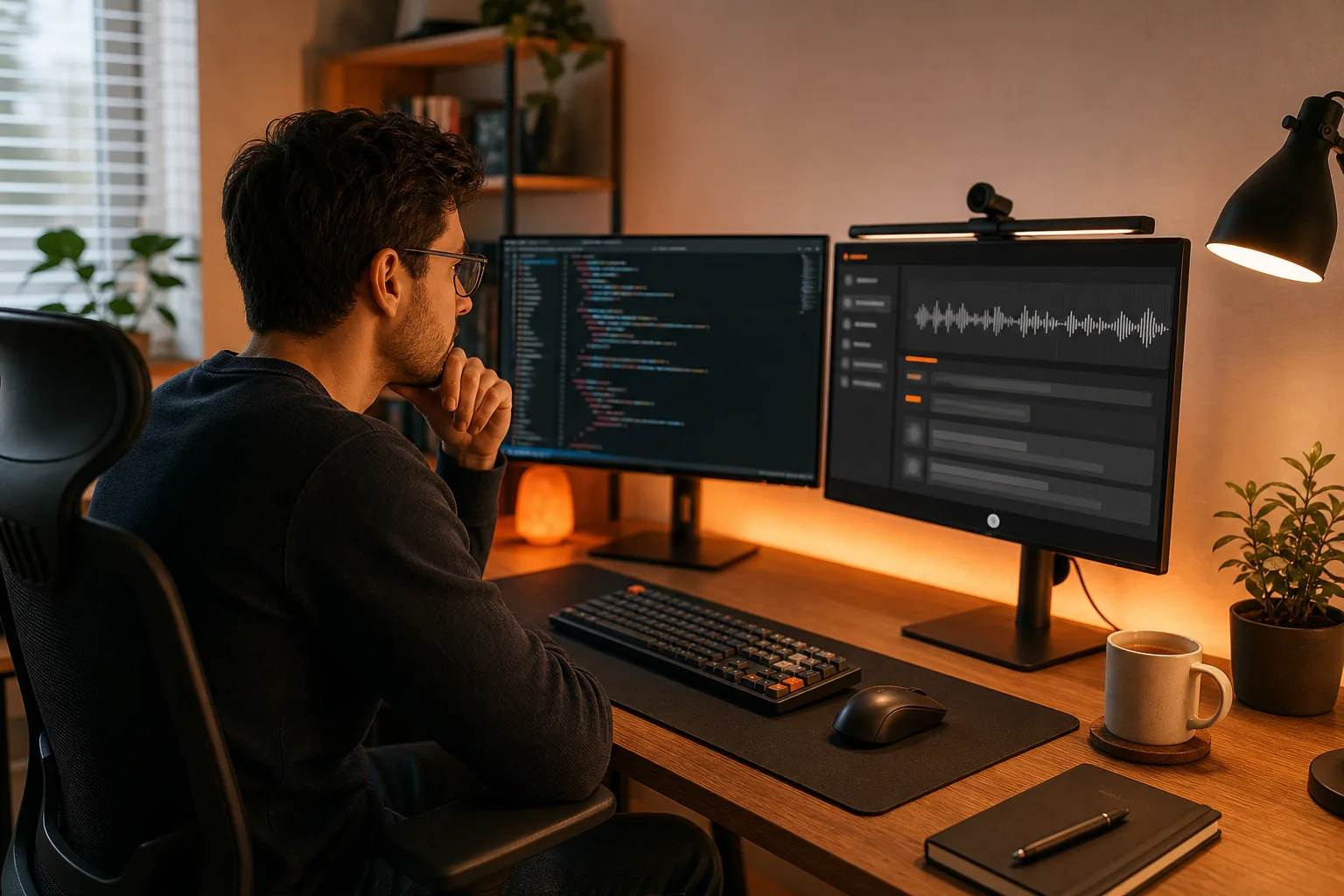
A live AI interview assistant usually follows a short chain. It captures audio or text, transcribes the question, classifies the task, and sends useful context to a language model. The model then returns guidance that appears in an app, overlay, or other workspace.
For example, an interviewer might ask, “How would you prevent duplicate events in a payment system?” The assistant may recognize a system design question and surface ideas about idempotency, event keys, retries, or storage. You still need to ask about traffic, failure modes, and the system's data guarantees.
Speech quality matters. A transcript that turns “quorum” into an unrelated word can send the answer in the wrong direction. Technical terms, accents, interruptions, and fast speech all test the transcription layer. Some tools also keep a time-aligned record after the session, which helps you review where your reasoning broke down.
| Stage | What the assistant does | What you still need to do |
|---|---|---|
| Capture | Receives interview audio, typed text, or a visible prompt. | Check that the capture method follows the interview rules. |
| Transcription | Turns spoken questions into text. | Correct key terms when the transcript is wrong. |
| Recognition | Labels the task as coding, design, or behavioral. | Confirm the label before acting on the suggestion. |
| Guidance | Returns a hint, outline, code idea, or trade-off. | Test the idea and explain it in your own words. |
| Review | May save a transcript or response trail. | Turn weak moments into the next practice drill. |
Platform fit changes the experience. Some assistants work through a browser window. Others connect with meeting tools such as Zoom, Google Meet, or Teams. A browser overlay can be easy to start, but you need to know what appears when you share a screen.
In a review of live tools, screenshot-based workflows stood apart from audio assistants. A hotkey can capture a visible coding prompt and return a proposed solution in a hidden window. That may help with a narrow algorithm round, but it will not hear a follow-up question about memory use or explain a design trade-off.
Privacy is another part of the system. Audio may pass through more than one service before you see the answer. Before a session, check what gets recorded, where transcripts are kept, and whether the employer permits it. An assistant should reduce mental load, not add a policy risk.
How It Supports Coding, System Design, and Behavioral Interviews
An AI interview assistant is most useful when its guidance matches the round. Coding needs algorithm checks. System design needs questions and trade-offs. Behavioral work needs structure without making your answer sound scripted.
Coding interviews
During a coding round, the assistant can help identify a likely pattern. It may point toward a sliding window, graph search, heap, stack, or dynamic programming approach. It can also help check edge cases and time complexity after you have formed a plan.
Imagine a prompt that asks for the longest substring without repeated characters. A useful assistant should help you reason toward a moving window and a set or map. It should not tempt you to paste code you cannot trace. If the interviewer asks what the map contains after each step, you need a clear answer.
Phantom Code AI is aimed at this kind of spoken, live problem solving. Its coding interview support can sit beside the round while you work through the prompt and explain the result. For a narrower view of that workflow, see the AI coding interview assistant for real-time coding rounds.
System design interviews
Design rounds test how you frame an open problem. The assistant can remind you to define users, traffic, latency, storage, failure handling, and consistency needs. It can also surface trade-offs when you compare a queue with direct requests or a relational store with a key-value store.
Say the prompt is a file-sync service. A useful session should push you to discuss conflict resolution, upload size, retry behavior, metadata, and access control. It should not hand you a polished diagram that you cannot defend. The value is in the questions it helps you ask.
System design practice also benefits from a post-session transcript. You can mark the point where you skipped scale assumptions or changed your data model without explaining why. That review turns a vague feeling of “I was not clear” into a specific drill.
Behavioral interviews
Behavioral support works best as a structure check. The assistant can remind you to state the situation, explain your action, and show the result. It can flag answers that spend too long on team context or never make your own role clear.
Prepare stories about ownership, conflict, failure, and cross-team work. Keep the facts yours. If an assistant drafts a smooth answer from your resume, check every detail before you use it. A hiring manager may ask a follow-up that exposes a story you do not know well.
A useful test is simple: can you close the assistant and give the answer again? If not, you used it as a script rather than as practice. An AI interview assistant should help you build recall and judgment, not hide their absence.
What an AI Interview Assistant Can and Cannot Do
An AI interview assistant can reduce the work of listening while you solve. It can keep a transcript, suggest a starting point, remind you to state assumptions, and give you a record for later review. Phantom Code AI also focuses on guidance across the full loop, which helps engineers avoid preparing for coding while ignoring design or behavioral rounds.
It cannot know the interviewer's unstated intent with certainty. It may miss sarcasm, misunderstand a constraint, or suggest a familiar pattern that does not fit the problem. A fluent answer can still be wrong. You remain responsible for checking the code and defending the design.
The same limit applies to behavioral answers. A model can spot that your story lacks a result. It cannot decide which parts of your career best show judgment, ownership, or growth. Those details need to come from you.
There is also an ethics limit. Do not use hidden assistance where the employer bans it. Do not record private discussions without permission. An assistant may be suitable for a mock interview, a permitted AI-assisted coding round, or solo preparation. It may be unsuitable for a timed assessment with strict rules.
Research on interview AI often frames the central issue as balance. Candidates may need to show how they work with modern tools, yet they still need to understand and explain the output. Assistance is acceptable only when it fits the stated rules and does not misrepresent your work.
Watch for these failure signs:
- You copy code before stating an approach.
- You cannot explain a variable's purpose.
- You accept a design without checking scale or failure cases.
- You read a behavioral answer word for word.
- You use the tool in a round that forbids outside help.

How to Use One for Effective Interview Preparation
The strongest use of an AI interview assistant is repeated practice with review. Do not wait until the day of a live interview. Use it to expose gaps while there is still time to fix them.
Start with a baseline round
Pick one coding problem, one system design prompt, and one behavioral question. Set a time limit for each. Speak aloud, because silent answers hide gaps in your reasoning.
Save the transcript or write down the moments that felt weak. Look for patterns. Perhaps you rush into code, skip capacity estimates, or describe team conflict without saying what you did.
Give the assistant useful context
Provide the role level, target language, job description, and interview type when the tool allows it. For behavioral work, add facts from your own experience. Do not paste confidential employer data or private customer information.
For system design, state the assumptions you want to test. A prompt such as “challenge my consistency choice and ask follow-ups about failure recovery” gives better practice than “help me with system design.”
Use hints in stages
Ask for a nudge before asking for a full solution. First request the likely pattern. Then ask what edge case deserves attention. Only after that should you inspect sample code.
This order keeps your brain in the loop. It also makes review easier. You can see whether the problem was recognition, implementation, or explanation.
Review the session like an interviewer
After the round, read the transcript from the first unclear moment. Mark each assumption. Check the code against a small example. For design, write down one reason for each major choice.
For behavioral answers, cut claims that lack proof. Replace “I improved the process” with the action you took and the result you can defend. Never invent an outcome because a model suggested one.
Repeat under changing pressure
Change the problem wording, add a follow-up, or switch the programming language. A memorized answer can look strong once and fall apart when the prompt changes. Real preparation means staying clear when the path is unfamiliar.
Phantom Code AI fits this routine when you want one workspace for coding, design, and behavioral practice. Start with a mock round, review the weak points, then use the next session to test one specific improvement.
Frequently Asked Questions
What does an AI interview assistant do?
An AI interview assistant listens to or receives an interview prompt, turns it into usable context, and suggests guidance. Depending on the tool, that may include coding hints, system design questions, behavioral structures, or a post-interview transcript. You still need to check the answer and explain the reasoning yourself.
Can I use an AI interview assistant during a real interview?
You can use one during a real interview only when the employer allows it. Some teams want to see how candidates work with AI. Others ban outside assistance or recording. Ask about the policy before the round, and use the tool freely only in approved mock sessions or permitted exercises.
Is an AI interview assistant useful for system design?
Yes, an AI interview assistant can help with system design by prompting you about scale, latency, storage, consistency, and failure recovery. Its best role is to challenge missing assumptions. Do not accept a ready-made architecture without knowing why each component exists and what trade-off it creates.
Can an AI assistant help with behavioral interviews?
An AI assistant can help you structure behavioral answers and spot missing details. It can remind you to explain your action and result. It cannot supply authentic career examples. Build stories from your own work, then use the tool to practice follow-up questions without reading a script.
What is the best way to prepare with one?
The best method is to run short timed mocks, ask for limited hints, and review the transcript afterward. Track one weakness per session, such as unclear assumptions or weak complexity explanations. Phantom Code AI is a fit for engineers who want this practice to cover coding, system design, and behavioral rounds.
Conclusion
Choose an AI interview assistant that supports the rounds you actually need, then use it to sharpen judgment rather than hide gaps. For software engineers preparing across the full loop, Phantom Code AI is a sensible place to start. Run one timed mock this week, review where your explanation broke down, and repeat that round until the reasoning is yours.