
Most AI interview assistants pick one thing and stop there. A coding helper. A behavioral coach. A mock practice tool. What software engineers actually need is something that covers the whole loop: the DSA round, the system design deep-dive, and the behavioral STAR questions, all in one session. Here are the 11 best AI interview assistants right now, ranked by what they actually do.
Table of Contents
- 1. Phantom Code AI (Our Top Pick) — Invisible Real-Time Coding Interview Copilot
- 2. Final Round AI — Multi-Stage Interview Support for Mid to Senior Engineers
- 3. Interview Coder — Stealth Coding Help for Intensive Technical Rounds
- 4. Cluely — Live Answer Generation Across Any Interview Format
- 5. LockedIn AI — Versatile Support for Engineers and Product Managers
- 6. Sensei AI — Structured Live Answers With a Coaching Overlay
- 7. Beyz AI — Tone Coaching and Live Translation for Second-Language Candidates
- 8. Hedy — Privacy-First On-Device Coaching Without Auto-Answer
- 9. ShadeCoder — Stealth Coding Guidance for Beginners to Experienced Devs
- 10. Linkjob AI — Unlimited Usage With Balanced Live Support
- 11. Orion — Pre-Interview Narrative Builder for Structured Story Prep
- Side-by-Side Comparison: Features, Pricing, and Best-Fit Use Cases
- How to Choose the Right AI Interview Assistant for Your Situation
- Frequently Asked Questions
- Conclusion
1. Phantom Code AI (Our Top Pick) — Invisible Real-Time Coding Interview Copilot
Phantom Code AI is the only tool in this comparison that listens to your interview audio, transcribes it in real time, detects the problem type, and then fires guidance for coding, system design, or behavioral questions without you lifting a finger to classify the round yourself. That breadth is rare. Most tools in this space handle coding or behavioral, not both.
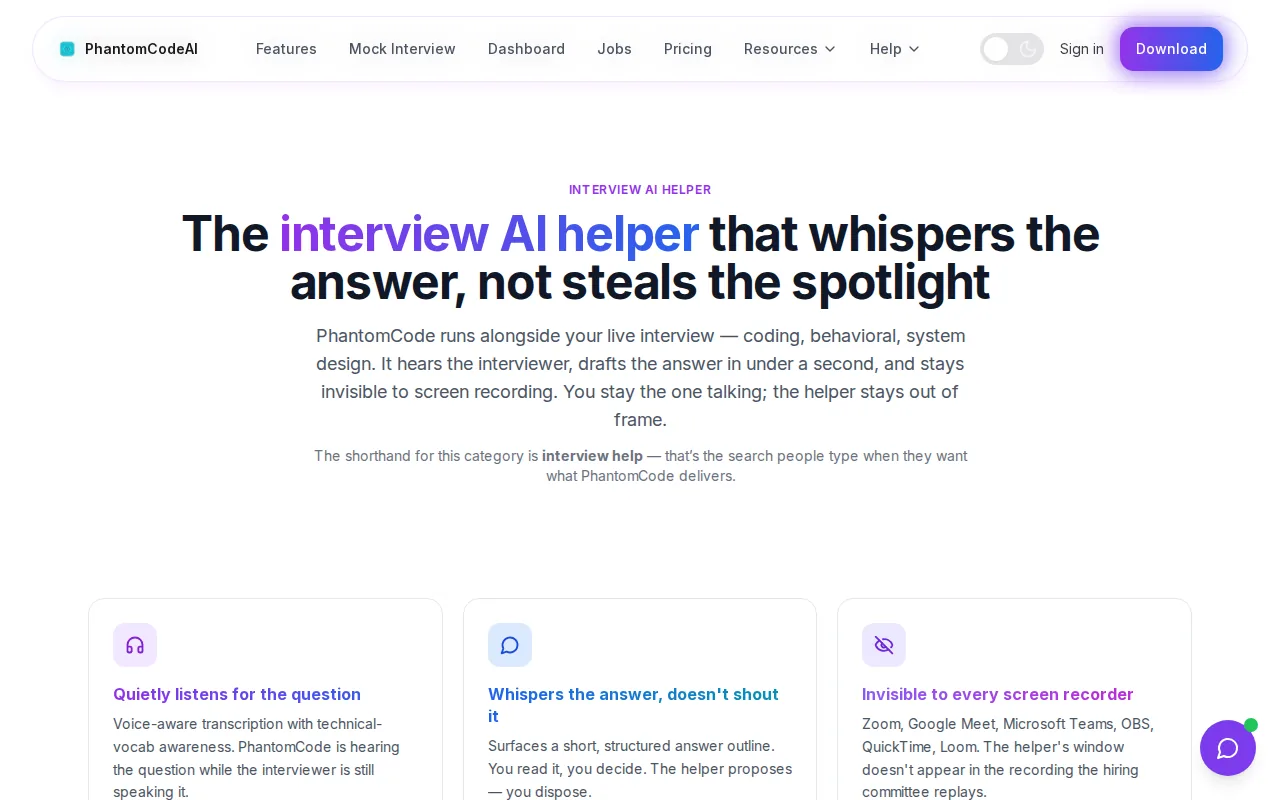
The desktop app runs invisibly. It does not appear during screen shares, does not show up in Zoom or Google Meet capture, and leaves no visible icon during a live session. That matters practically: the interviewer at FAANG companies sees your code editor, not a floating overlay eating half your screen.
What makes it the top pick for engineers specifically is the problem-type recognition. Let's say your interview pivots from a graph traversal question to a system design question about rate limiting. Phantom Code AI detects that shift and adjusts its guidance automatically. You do not switch modes or click anything. That's the operational advantage over tools that require you to pre-select your interview type before the session starts.
It works across HackerRank, LeetCode-style online assessments, and any video conferencing platform. Behavioral guidance follows STAR structure. Coding solutions come with complexity analysis. System design responses include component trade-offs.
The honest limitation: because it does real-time audio processing, a slow or unstable internet connection can introduce latency. On-device transcription (no cloud upload) would solve that, though the current architecture prioritizes response quality. If data privacy during the session is your top concern, factor that in.
2. Final Round AI — Multi-Stage Interview Support for Mid to Senior Engineers
Final Round AI is a full interview platform that covers mock practice, live copilot support, resume building, and post-interview analytics in one subscription. It is built for candidates going through complete interview loops, particularly at companies where behavioral and technical rounds alternate.
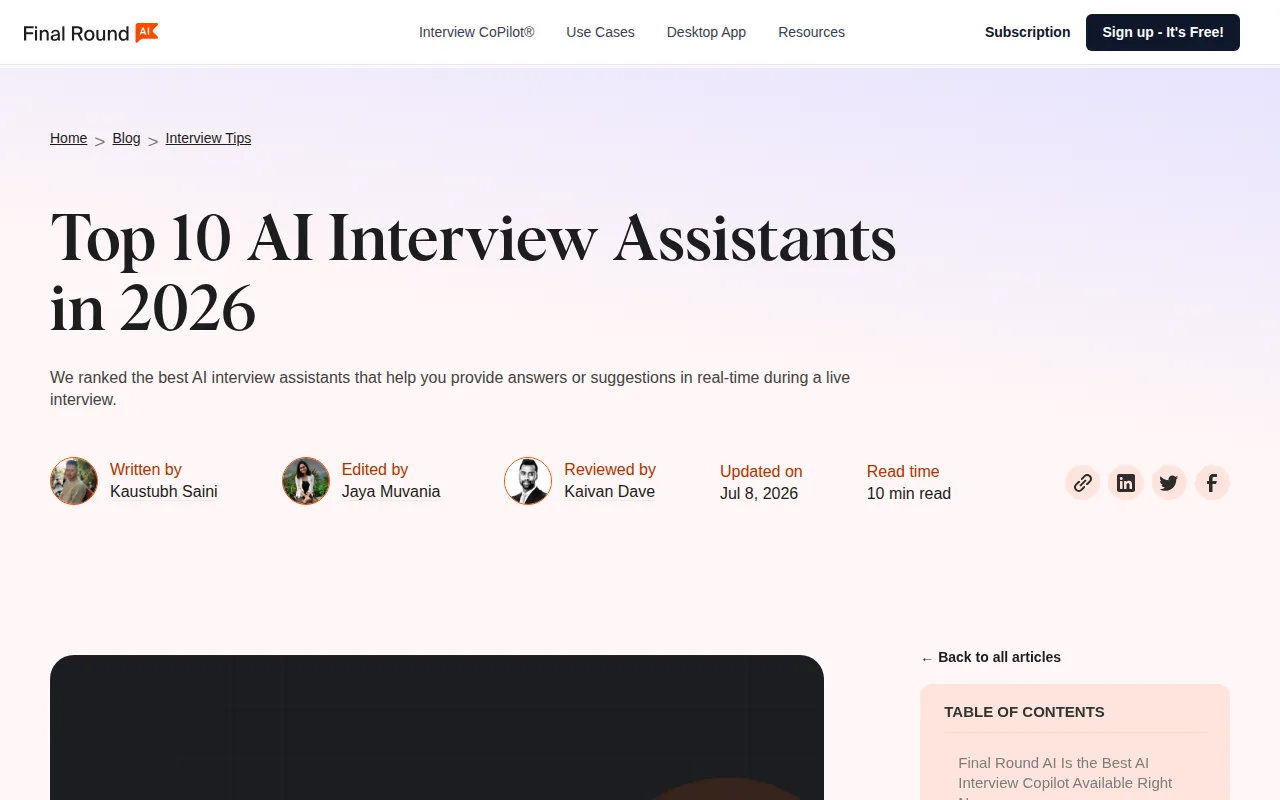
The mock interview mode is genuinely strong. You upload your resume and a target job description, and the platform generates role-specific questions, then gives structured STAR-framework feedback on your answers. Candidates preparing for FAANG product or senior engineering roles consistently report that the mock questions feel realistic, not generic. The live transcription accuracy is also technically solid, handling accents and variable audio environments better than most competitors.
The live Interview Copilot runs quietly during Zoom, Meet, or Teams sessions and supports multiple languages, making it one of the broader multilingual options in the field. Stealth Mode, however, is locked behind the Pro and God Mode tiers.
Pricing is the real friction. The monthly plan caps the number of copilot sessions, which bites fast if you are actively interviewing across multiple companies. The annual plan drops the per-month rate significantly, but requires an upfront commitment. User reviews note billing complaints as a recurring theme alongside otherwise positive feedback on mock interview quality.
It fits mid-level to senior candidates who want one tool for prep and live support, and who interview infrequently enough that the session cap is not a problem. If you need deep algorithmic coding assistance, a more specialized tool will serve you better in that specific round.
3. Interview Coder — Stealth Coding Help for Intensive Technical Rounds
Interview Coder is the most narrowly focused tool in this list. It does one job: real-time coding assistance during live technical interviews, with a stealth overlay designed to stay invisible to screen recording and monitoring tools. There is no behavioral coaching layer, no system design module, and no mock interview feature. It is a coding round tool, full stop.
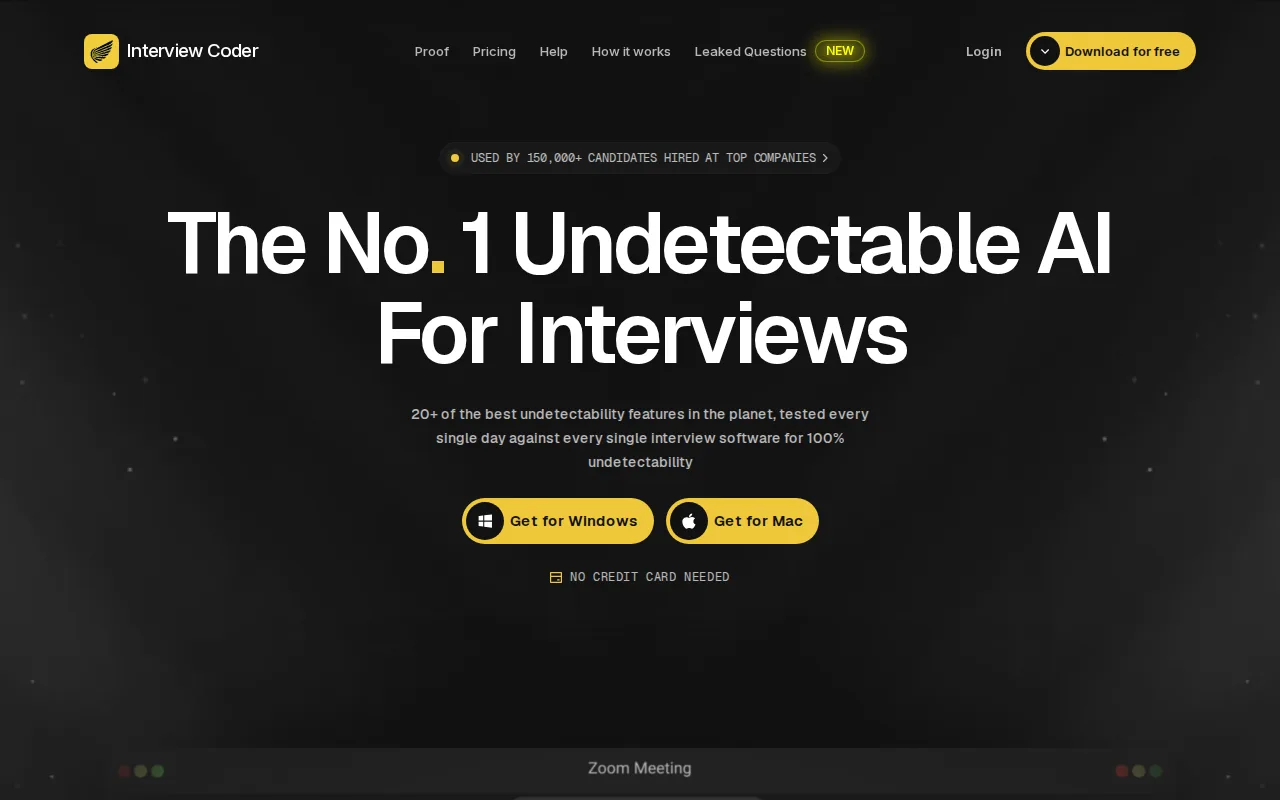
The overlay captures screenshots of the coding problem, processes them alongside audio context, and returns solutions with explanations. It works across LeetCode-style problems on HackerRank, CoderPad, and similar platforms. The stealth mechanism uses low-level rendering so the overlay does not appear in the shared screen frame.
The price is steep. Pro runs $299/month, and the lifetime plan sits at $799. That positions it as a tool for candidates with a specific, urgent need and the budget to match.
Two things to weigh honestly. First, independent reviews report that the "100% undetectable" claim does not hold against newer macOS and Zoom permission models. Second, behavioral detection systems work on candidate response patterns, not screen pixels. A candidate who pauses identically before answering "what's your name?" and "explain database sharding" raises a flag regardless of what's on screen. Interview Coder is best for mid-level to senior engineers with intensive coding-round schedules, not for full interview loops.
4. Cluely — Live Answer Generation Across Any Interview Format
Cluely started as a general meeting assistant and expanded into interview support. It runs a native desktop overlay that listens to audio and watches your screen during any video call, then feeds structured answers through an invisible window. The overlay genuinely does not appear in Zoom, Google Meet, or Teams screen shares, which is its core technical pitch.
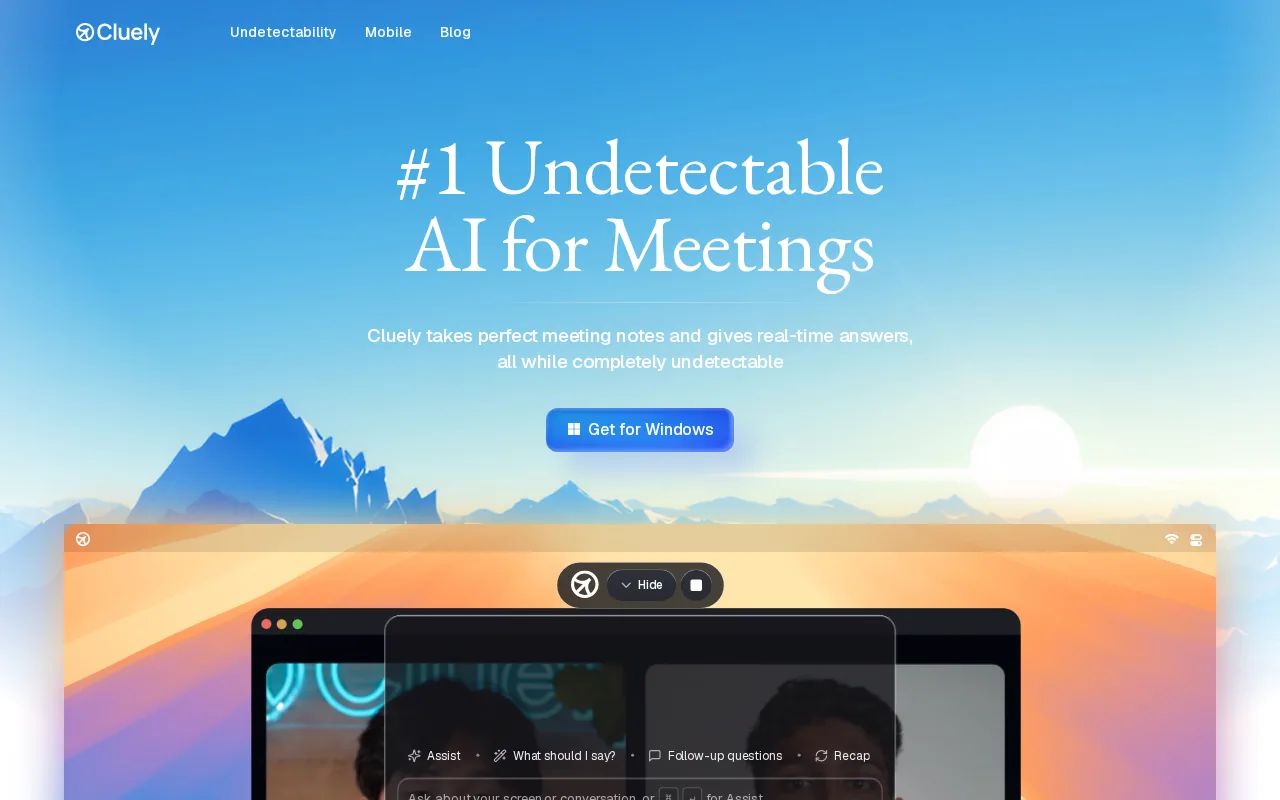
The free Starter tier gives you basic access. Paid tiers scale up to unlimited responses and screen-share invisibility features, with pricing available on the Cluely site. That pricing structure is revealing: invisibility is the premium upsell, not the default.
The privacy situation is the most important caveat in this entire list. A mid-2025 data breach reportedly exposed more than 83,000 user records, including full interview transcripts and screenshots. That is not a minor incident for a tool that listens to your most sensitive career conversations. The breach happened because all audio and session data lives on Cluely's cloud servers.
Cluely also has a brand recognition problem from a detection standpoint. Its "cheat on everything" launch marketing made it the named target for behavioral detection vendors. Behavioral detection systems score multiple signals per interview and have specifically flagged tools like Cluely in their documentation. The overlay may stay invisible in the video stream, but the candidate's response latency pattern is still legible to those systems.
Best for candidates who want live answer generation across any interview format and have weighed the privacy and detection risks clearly.
5. LockedIn AI — Versatile Support for Engineers and Product Managers
LockedIn AI covers a wider range of interview formats than most stealth tools. It handles technical questions, behavioral discussions, system design, and project management scenarios. The desktop app captures system audio so it works across Zoom, Teams, Meet, and Webex without requiring any browser extension. It also integrates directly inside VSCode and Cursor, which means engineers can get coding help without switching windows during a live technical assessment.
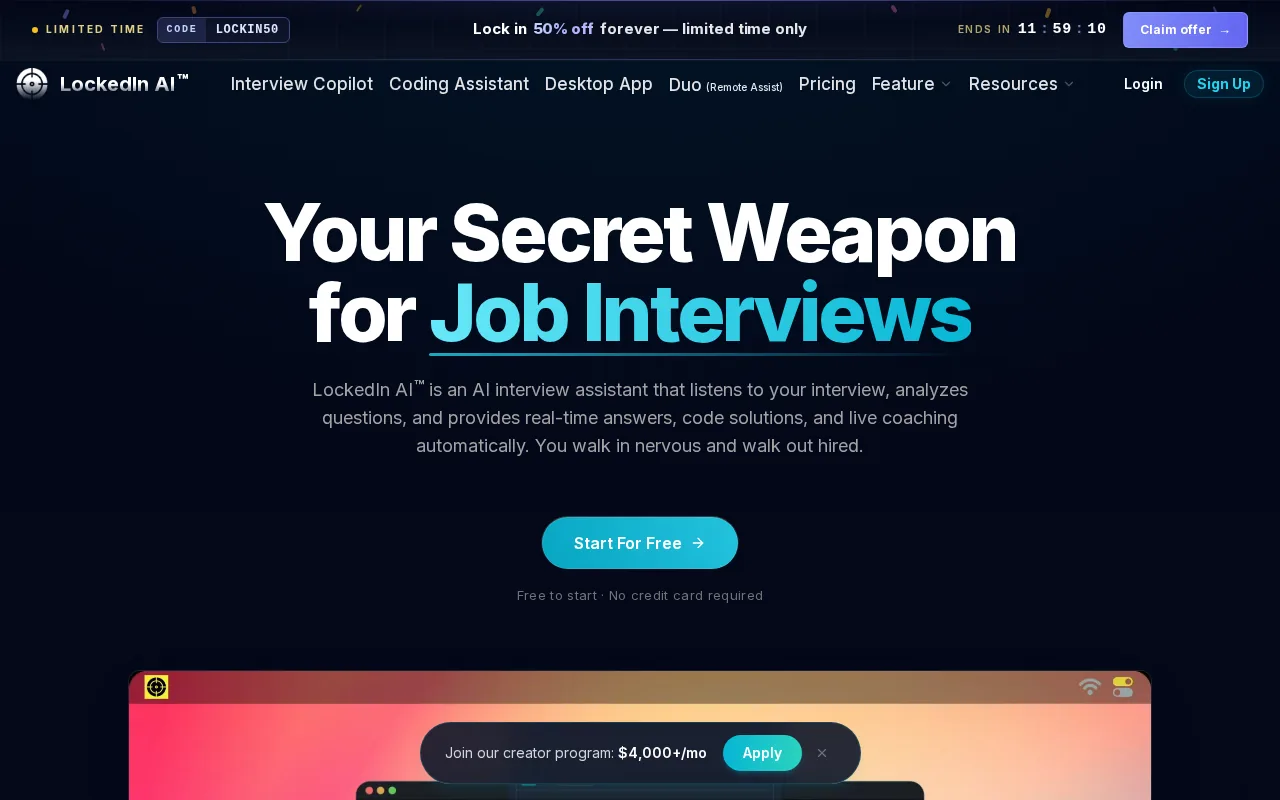
The LockedIn Duo feature is a standout. You can invite a trusted friend to join your private session as a remote helper. They see your screen, hear the interview audio, and send you text guidance in real time. They never appear on the call. That is a genuinely different model from standard AI-only copilots.
Pricing varies by tier; a free plan exists with limited access to core features. The stealth mode situation has a nuance worth knowing: the browser-based version can be visible to interviewers, while the desktop app version stays hidden. You get full stealth only on the desktop app with the higher tier.
Best for mid-level professionals who move between engineering and PM interviews, or anyone who wants the Duo remote-assist feature as a backup option.
6. Sensei AI — Structured Live Answers With a Coaching Overlay
Sensei AI sits closer to the coaching end of the spectrum than pure stealth tools. It generates structured answers live, formatted automatically using frameworks like STAR, and analyzes the interviewer's question for tone, context, and keyword signals before the answer appears. The hands-free mode lets you stay focused on the interviewer without clicking anything.
The product markets sub-1-second latency and claims "fully undetectable" operation. As with several tools in this list, independent reviewers note that the undetectability claim needs more scrutiny against newer platform permission models. Use it with that caveat in mind.
You can try Sensei free with 15-minute sessions. The Pro plan runs $89/month, or drops to $24/month when billed annually. That annual plan is a meaningful discount, and the unlimited sessions structure avoids the per-session cap problem that makes Final Round AI frustrating for active job seekers. Sensei supports 30+ languages and integrates with Zoom, Teams, and Google Meet.
It fits candidates who want coaching-style structured answers rather than raw code solutions, particularly for behavioral and mixed-format rounds.
7. Beyz AI — Tone Coaching and Live Translation for Second-Language Candidates
Beyz AI is built around communication quality, not just answer content. It tracks tone, pacing, filler words, and STAR structure in real time during sessions. For candidates interviewing in a second language, its live translation layer reduces the listening-load problem: you hear the question more accurately, which frees mental bandwidth for the actual answer.
The IQB Interview Question Bank contains a library of validated questions organized by role, company, and difficulty. Unlike a static list, the bank connects to the live coaching engine, so feedback on your answer references the specific question you just attempted. It covers both LeetCode-style technical problems and behavioral modules, which is rarer than it sounds at this price point.
Beyz integrates with Zoom, Meet, and Teams. Pricing runs around $49.99/month, dropping to roughly $24.99/month on a semi-annual plan. A 15-minute free trial is available for new users.
The visibility limitation to note: Beyz does not guarantee full screen-share invisibility the way dedicated stealth tools do. If staying hidden during a monitored session is your top concern, that matters. But if you want communication coaching and language support more than pure stealth, Beyz is the most purpose-built option in this list for that specific need. For engineers putting together their overall job application package, resources like strong software engineer cover letter examples pair well with interview coaching tools like this one.
8. Hedy — Privacy-First On-Device Coaching Without Auto-Answer
Hedy is the one tool in this comparison that runs speech recognition entirely on your device. No audio gets uploaded to a cloud server. That is not a marketing claim. It is an architectural choice that separates Hedy from every other assistant here, all of which rely on cloud processing. For engineers who work on sensitive projects or interview at companies with strict data policies, that difference is material.
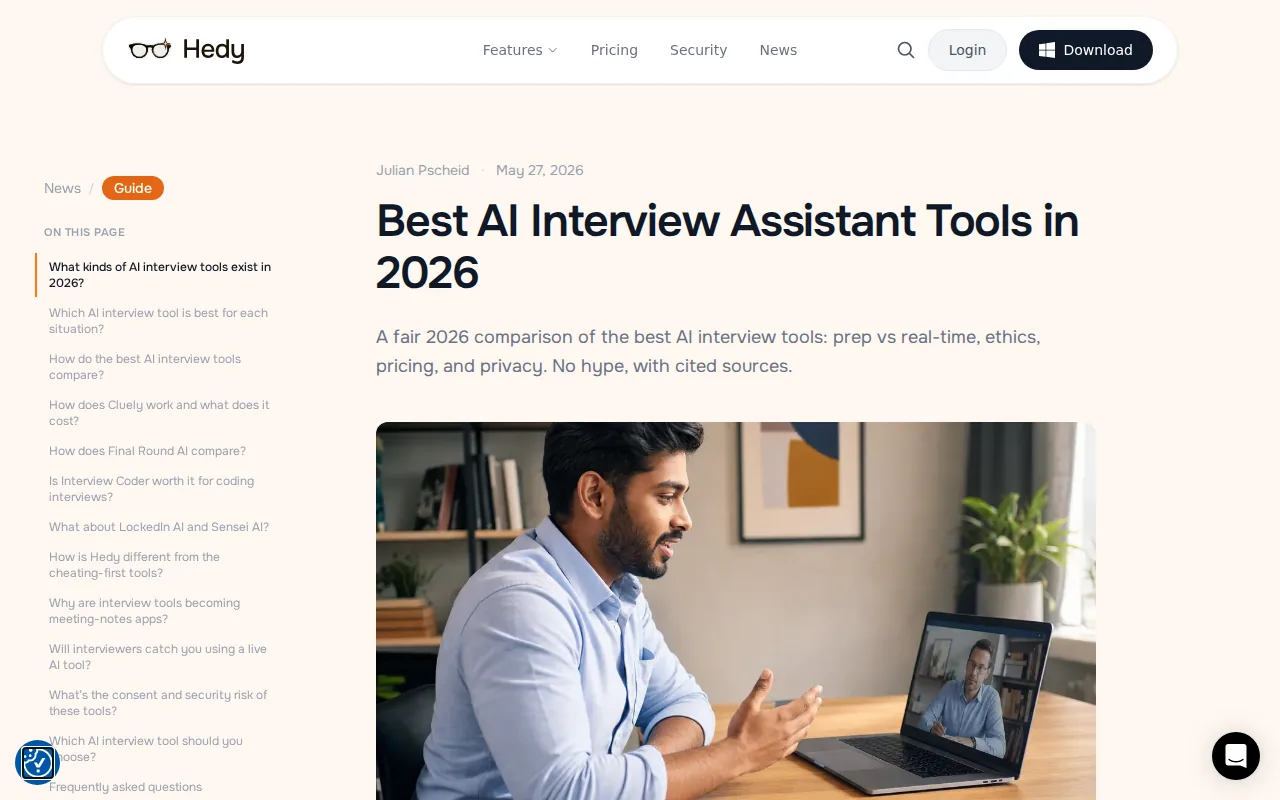
The trade-off is intentional. Hedy does not auto-generate answers and feed them to you mid-interview. It coaches you toward your own material, points you at the right framework, and helps you structure what you already know. That puts it firmly on the preparation and ethical coaching side of the line, not the stealth auto-answer side.
Hedy's free tier gives you 5 hours per month, which is enough for regular mock practice without paying anything. Paid plans unlock more session time. For candidates who are uncomfortable with the risks that come with cloud-dependent stealth tools, Hedy is the clearest ethical alternative in this field.
It is not for candidates who want a tool that generates answers live and hides them from the interviewer. That is not what Hedy is designed for, and the product is honest about that. Best for engineers who want genuine prep and confidence without the data exposure risk.
9. ShadeCoder — Stealth Coding Guidance for Beginners to Experienced Devs
ShadeCoder is a native desktop app focused on coding interview rounds. It reads screenshots of coding problems, including diagrams and visual prompts, reasons through them, and returns structured solutions with follow-up explanations. The multimodal reasoning means it handles more than text-only problems, which matters for roles that include architecture diagrams or data model questions.
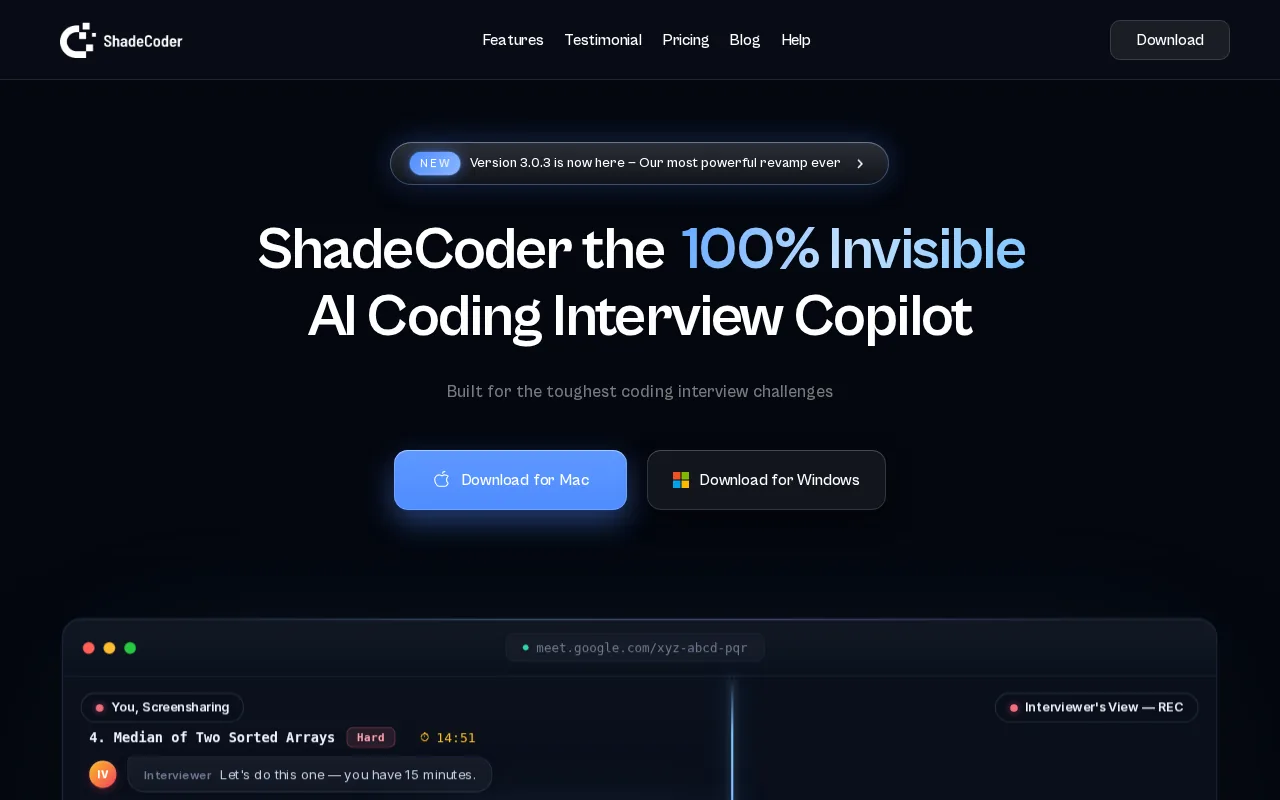
The stealth mechanism uses global hotkeys and a screen-share-proof overlay. It stays invisible on Zoom, Google Meet, and CoderPad. Operation is keyboard-driven so there are no visible mouse movements that might tip off an observant interviewer.
Pricing: the free plan gives you 5 credits/month, which is functionally minimal. Pro Weekly runs $39, Pro Monthly is $69, and a lifetime plan is available at a one-time cost listed on their site. ShadeCoder's free tier is near-useless for real preparation, though the monthly plan is competitive with other coding-focused tools.
It works for beginners who need structured solution explanations as much as for experienced engineers who want to cross-check edge cases under pressure. The structured output format, with explanations attached, makes it more useful for learning than raw code-paste tools. But like Interview Coder, it does not extend to behavioral or system design rounds.
10. Linkjob AI — Unlimited Usage With Balanced Live Support
Linkjob AI offers real-time assistance across coding, behavioral, and system design rounds with no strict session caps on its standard plans. That unlimited structure is its clearest differentiator. Tools like Final Round AI meter sessions aggressively. Linkjob lets you run practice and live sessions without watching a counter tick down.
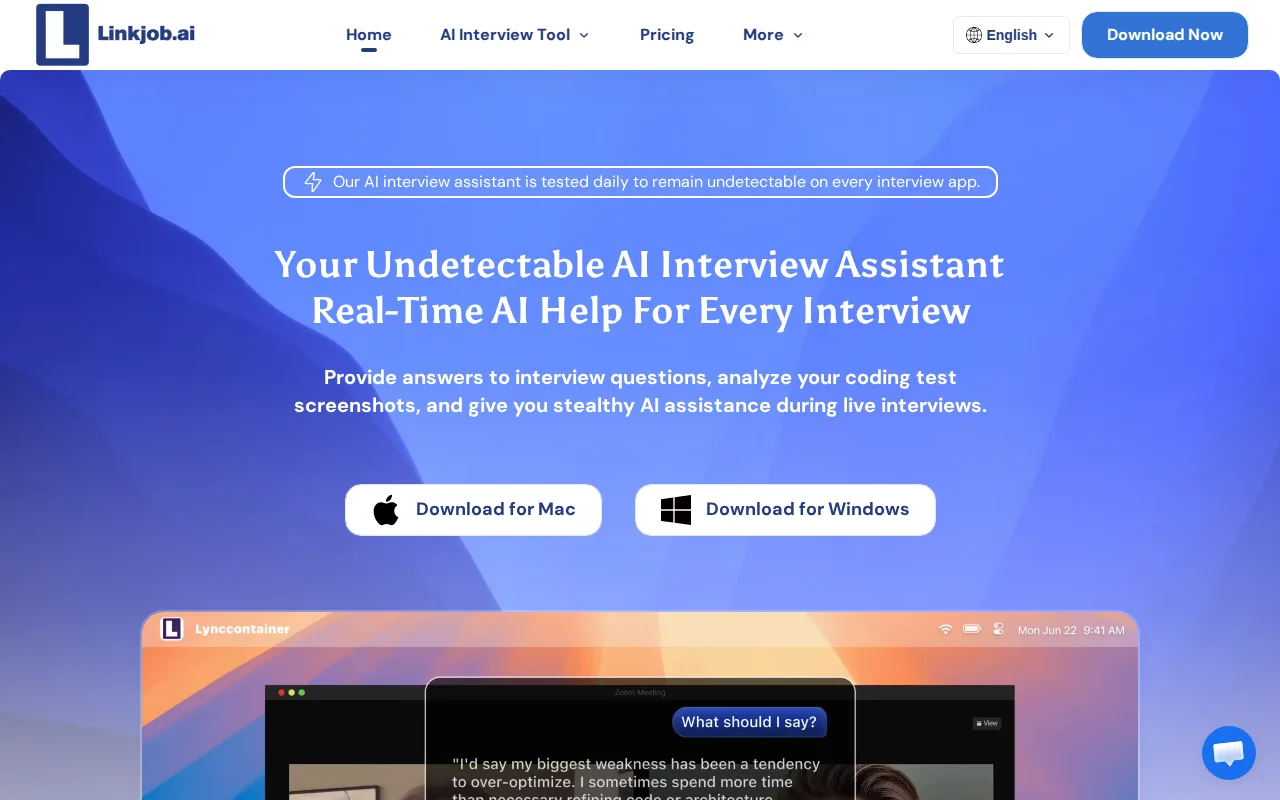
The desktop app runs as a translucent floating window. It does daily testing across platforms to confirm stealth status. It supports multiple languages and claims no visible interface elements during screen-sharing sessions. The response system personalizes answers from your uploaded resume and job description, so replies reference your specific background rather than generic talking points.
The behavioral coaching depth is lighter than tools built specifically around STAR frameworks. And as a newer entrant, its track record is shorter than Final Round AI or LockedIn AI. The upfront cost on monthly billing is also on the higher side relative to what you get in behavioral prep specifically.
Best for beginners to experienced candidates who want unlimited session access and care more about breadth than deep behavioral coaching depth.
11. Orion — Pre-Interview Narrative Builder for Structured Story Prep
Orion takes a different approach from every other tool on this list. It is a pre-interview narrative builder. You work with its AI Copilot before the interview to construct and refine your stories, structure your behavioral answers, and build the specific examples you will draw from. It does not provide real-time assistance during a live interview at all.
That is a real limitation if you are looking for live help. But it is a feature if you believe, as many coaches do, that the best interview performance comes from knowing your material cold before you walk in. Orion's workflow forces you to actually build the narrative, not just receive an answer to read.
It fits candidates who want structured preparation for behavioral loops, particularly those targeting companies with rigorous STAR-format interviews. It pairs well with a live tool like Phantom Code AI for the technical rounds, where Orion handles your story prep and Phantom Code AI handles real-time guidance during the coding and system design segments.
If you need live help during the interview itself, look elsewhere. Orion is a prep tool, not a copilot.
Side-by-Side Comparison: Features, Pricing, and Best-Fit Use Cases
Use this table to quickly match your situation to the right tool. Pricing shown is the most common paid entry point based on vendor pages verified in 2026, not promotional rates. Always check the vendor's current pricing before committing.
| Tool | Real-Time Live Support | Interview Types Covered | Free Tier | Entry Pricing | Best For |
|---|---|---|---|---|---|
| Phantom Code AI | Yes | Coding, System Design, Behavioral | Yes | See site | Engineers who need full interview loop coverage |
| Final Round AI | Yes | Behavioral, Technical, System Design | Yes (limited) | ~$25/mo (annual) | Mid-senior candidates wanting prep + live copilot |
| Interview Coder | Yes | Coding only | Download only | $299/mo | Intensive coding rounds, high-budget candidates |
| Cluely | Yes | Any format | Yes (Starter) | See site | Live answer generation across formats |
| LockedIn AI | Yes | Technical, Behavioral, System Design, PM | Yes | See site | Engineers and PMs needing flexible coverage |
| Sensei AI | Yes | Behavioral, Technical | Yes (15 min) | $89/mo or $24/mo annual | Coaching-focused candidates, unlimited sessions |
| Beyz AI | Yes | Behavioral, Technical, Coding | Yes (15 min) | ~$49.99/mo | Second-language candidates, tone coaching |
| Hedy | Coaching (no auto-answer) | Any format (coaching only) | Yes (5 hrs/mo) | Paid plans available | Privacy-first, ethical prep seekers |
| ShadeCoder | Yes | Coding only | Yes (5 credits) | $69/mo | Beginners to experienced devs in coding rounds |
| Linkjob AI | Yes | Coding, Behavioral, System Design | — | See site | Unlimited usage, balanced live support |
| Orion | No | Behavioral (prep only) | — | See site | Narrative and story prep before the interview |
One pattern stands out across this research: over a quarter of these tools offer no free tier at all, and the ones that do vary widely in how useful that free access actually is. ShadeCoder's 5-credit free plan barely covers one session. Hedy's 5 hours/month is genuinely usable. Factor that in before choosing a tool to test.
How to Choose the Right AI Interview Assistant for Your Situation
The single most important question is: what rounds are you preparing for? Coding-only tools like Interview Coder and ShadeCoder are optimized for DSA rounds and nothing else. If your interview loop includes system design or behavioral questions, you will need a second tool or a different primary choice. Phantom Code AI is currently the only option that auto-detects the round type and adjusts guidance accordingly, which removes the need to juggle multiple apps.
If you are interviewing in a second language or your communication pacing is a known weak spot, Beyz AI addresses that directly. Other tools generate answer text but do not actively coach delivery. That is a meaningful difference in an interview where filler words and response structure are evaluated alongside content.
Privacy is a real decision point, not a secondary consideration. The majority of tools analyzed here rely on cloud-based audio processing. Only Hedy runs fully on-device. If you are interviewing at companies with NDAs that cover conversations during the interview process, or if the 2025 Cluely breach concerns you, those facts belong in your decision. Any cloud-based service that stores audio creates a potential exposure surface, especially for sensitive personal or professional content.
Use this checklist to narrow down your options:
- Do you need live coding help, behavioral coaching, or both? Pick a tool that covers your specific weak round.
- How many interviews do you have per month? Session-capped tools like Final Round AI are painful for active job seekers with 10+ interviews scheduled.
- Does your interview platform use aggressive proctoring? Some environments (HackerRank Desktop App Mode, certain heavily proctored enterprise configurations) operate at a level that makes stealth tools genuinely risky to use.
- Is data privacy critical for your role or company? On-device processing is the only architecture that keeps your audio off someone else's servers.
- What is your budget? The range here runs from free (Hedy's tier) to premium tiers (Interview Coder). Most engineers land somewhere in the $25–70/month range for a tool that covers their full loop.
One usable note: you can try Phantom Code AI's full-loop AI interview assistant to see how automatic problem-type detection changes the preparation experience compared to tools where you have to classify the round yourself before starting.
Frequently Asked Questions
Can an AI interview assistant actually help with system design rounds, or just coding?
Most tools are coding-focused only, which is a real gap. Phantom Code AI covers system design natively alongside coding and behavioral rounds. Final Round AI also handles system design in its mock and live modes. If you have a system design round coming up, check specifically whether the tool you are considering supports it before assuming it does.
Will the interviewer be able to see the AI overlay on my screen?
Native desktop apps that use GPU-level rendering (Phantom Code AI, ShadeCoder, Cluely, LockedIn AI desktop) generally do not appear in screen-share captures. Browser-based tools and extensions are more exposed. That said, invisibility on screen is only one part of detection. Behavioral detection systems watch response latency, eye movement, and pacing patterns regardless of what appears on screen.
Is using an AI interview assistant considered cheating?
It depends on what the tool does and how you use it. Preparing with an AI coach before the interview is broadly accepted, similar to using a prep book or a human coach. Using a tool to read generated answers during a live interview while the interviewer believes you are answering independently is the line most employers treat as a policy violation. Some companies, including Meta and Shopify, explicitly allow AI tool use during coding interviews. Check the specific company's interview policy before relying on live assistance.
What is the most private AI interview assistant available?
Hedy is the only tool confirmed to run speech recognition entirely on-device, meaning no audio is sent to a cloud server. All other tools in this comparison process audio in the cloud. If session privacy is your top priority, particularly after the 2025 Cluely breach that exposed 83,000+ user transcripts, Hedy is the only current option with an architecture that eliminates that exposure surface entirely.
Do any of these tools work for behavioral interviews, not just coding?
Yes. Phantom Code AI, Final Round AI, LockedIn AI, Sensei AI, Beyz AI, and Orion all address behavioral questions in some capacity. Orion is purely pre-interview story prep. The others provide live coaching or answer generation during the behavioral round itself. Coding-only tools like Interview Coder and ShadeCoder explicitly do not cover behavioral or system design questions.
How do I practice with these tools before a real interview?
Most tools with a free tier let you run mock sessions. Open a video call with a friend or use the tool's built-in mock mode, load a real job description, and run through a complete round. Focus the mock on the specific round type you are weakest in. After the session, review the generated answers and decide which parts you would actually say versus which parts need editing to sound like you. Tools that personalize from your resume produce answers that need less editing.
Conclusion
If you have one interview loop coming up and need coverage across coding, system design, and behavioral rounds without juggling separate tools, start with Phantom Code AI. It is the only assistant in this comparison that auto-detects the round type and adjusts in real time. Try a mock session with your actual resume and a real job description loaded in, then run a screen-share test to confirm the overlay stays invisible before you rely on it in a live setting.