Best Mock Interview Bundles for Full-Stack Prep

Compare full-stack mock interview options by AI support, coding practice, live feedback, and interview coverage to find a fit for your prep.
The best mock interview bundles for full-stack interview prep help you rehearse more than coding: you need to explain choices, handle follow-ups, and talk through system design. Phantom Code AI is one option for real-time guidance, while other picks focus on AI repetition, structured coding work, or live interviewer feedback.
Here are five options, with the main differences that matter when you’re choosing what to practice.
Table of Contents
- Phantom Code AI
- Huru: unlimited AI mock interviews and a large question library
- NeetCode: structured coding practice with AI-assisted assessments
- Interviewing.io: live coding and system design mocks with interviewers
- Ultimate Sidekick: unlimited prep sessions
- Compare the mock interview options at a glance
- FAQ: Mock interview bundles for full-stack interview prep
- Conclusion
1. Phantom Code AI
Phantom Code AI is an AI desktop assistant for coding interviews. It listens to interview audio, transcribes it, recognizes problem types, and gives real-time guidance during mock or live technical interviews. It’s a fit for engineers who want support while practicing DSA, system design, or behavioral questions.
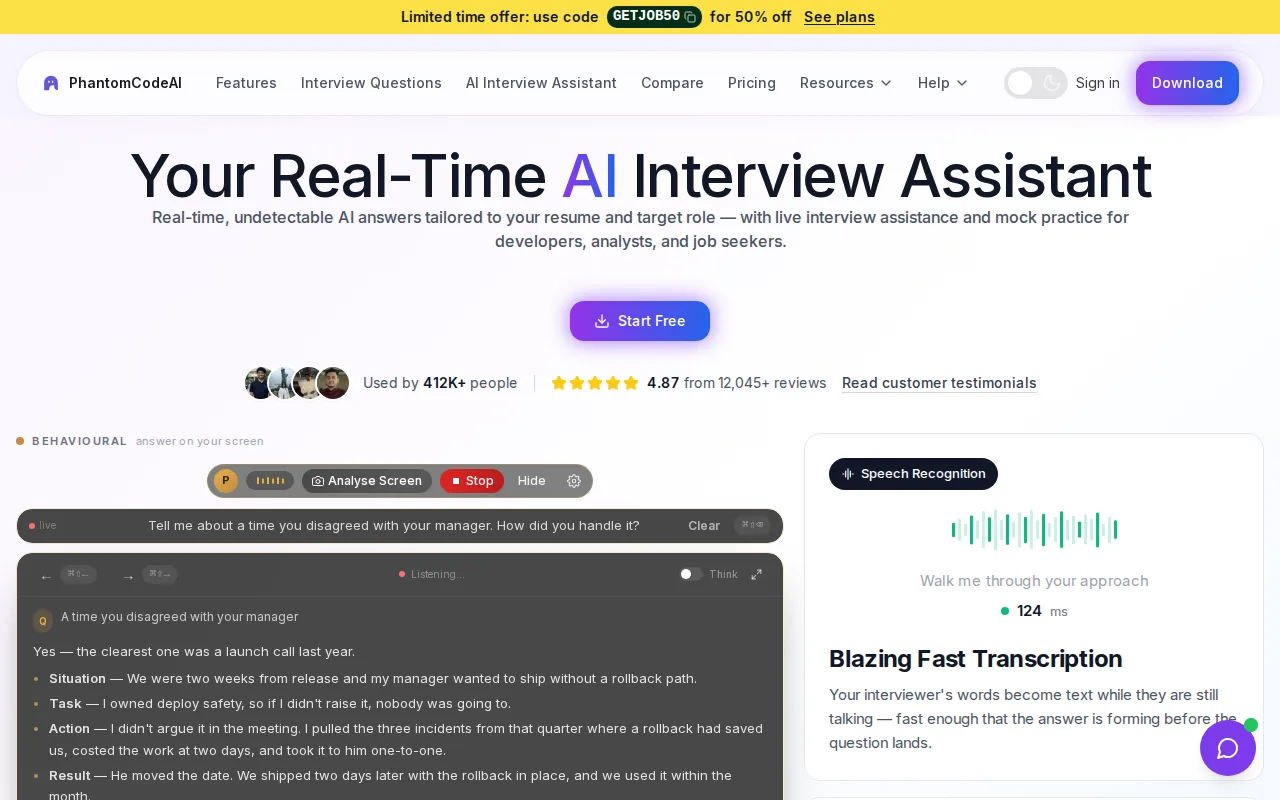
For a full-stack mock, the value is in practicing your response as the prompt unfolds. Say you’re asked to design an API for a shopping cart. You can rehearse clarifying requirements, naming data flows, and weighing a database choice while keeping your explanation moving. For a coding prompt, talk through edge cases before you settle on an approach.
Phantom Code AI runs on macOS and Windows. New accounts get free credits at signup with no card required, and paid plans start at $19. Its website also describes a 30-day prep plan with mock and live practice. These details make it easier to test whether the assistant fits your study routine before committing to a longer plan.
Keep the purpose clear: use live guidance only where the interviewer or employer allows it. For honest mock practice, try a round with guidance, then repeat the same kind of question without it. That second run helps you see what you can explain on your own. Engineers comparing coding-focused practice can also review mock interview platforms for coding speed practice.
2. Huru: unlimited AI mock interviews and a large question library
Huru is an AI mock interview tool built for repeated practice. Its two plans include unlimited AI mock interviews, and its annual Growth plan is $99 per year. It suits candidates who want to practice speaking often and get feedback without arranging a live interviewer for every session.
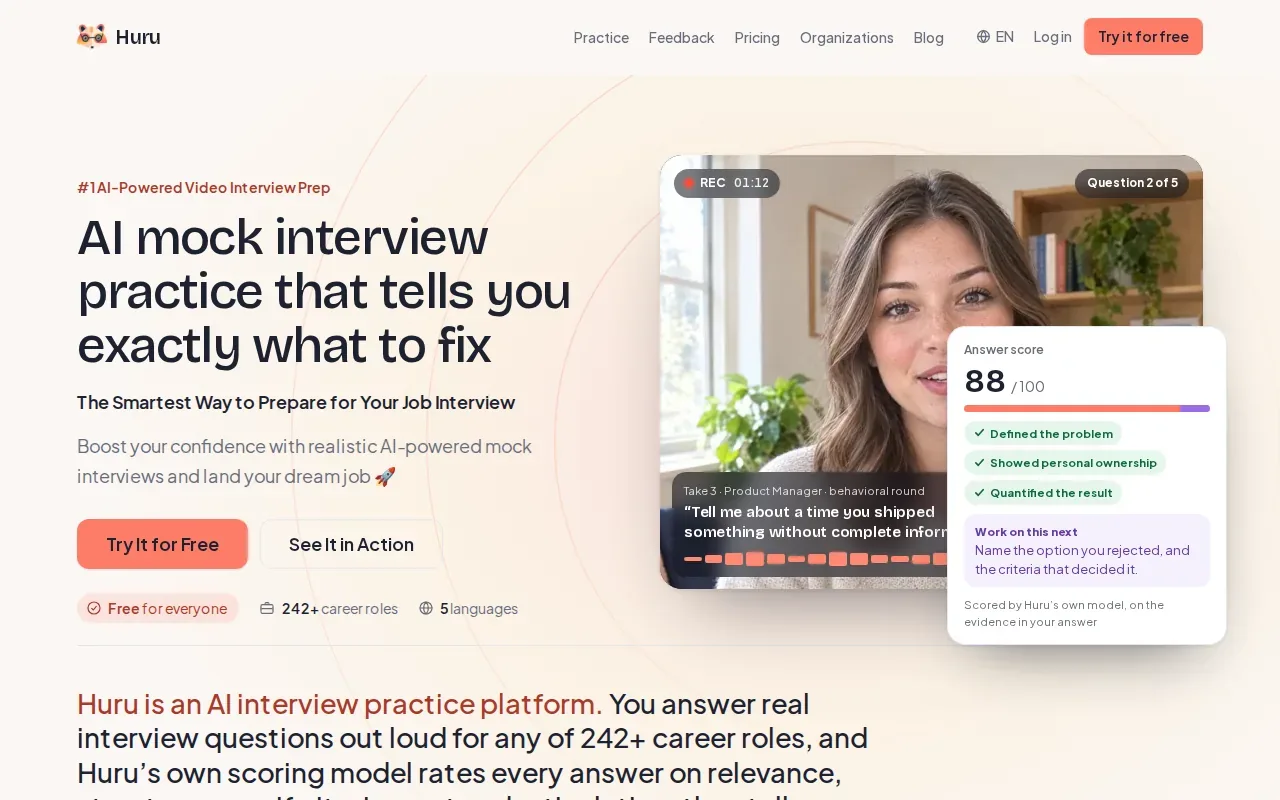
Huru’s question library has more than 50,000 questions across roles. Its AI can generate mock interviews, then give instant feedback. Reports cover answer content, speech patterns, grammar, and confidence cues. Video recordings let you review how your answer sounded, not only what you said.
That mix can help with the parts of a full-stack interview that don’t show up in a code editor. For a behavioral question about a production issue, answer aloud and review whether you explained your role and the outcome clearly. For a technical prompt, practice narrating your plan before writing code. Feedback on speech and grammar can help you spot habits that distract from the technical point.
Huru supports 14 languages, which may matter if you’re preparing in a language other than English. Its scale makes it useful for regular solo sessions; it doesn’t replace the pressure of responding to a person who can ask a new follow-up. A sound routine is to use AI for repetition, then ask a peer or interviewer to challenge one answer you’ve practiced.
3. NeetCode: structured coding practice with AI-assisted assessments
NeetCode is a coding interview practice resource with structured courses, AI-assisted assessments, head-to-head Versus mode, and more than 1,000 problems. It’s best suited to candidates who want a clear coding practice track and a way to test their solutions against another person.
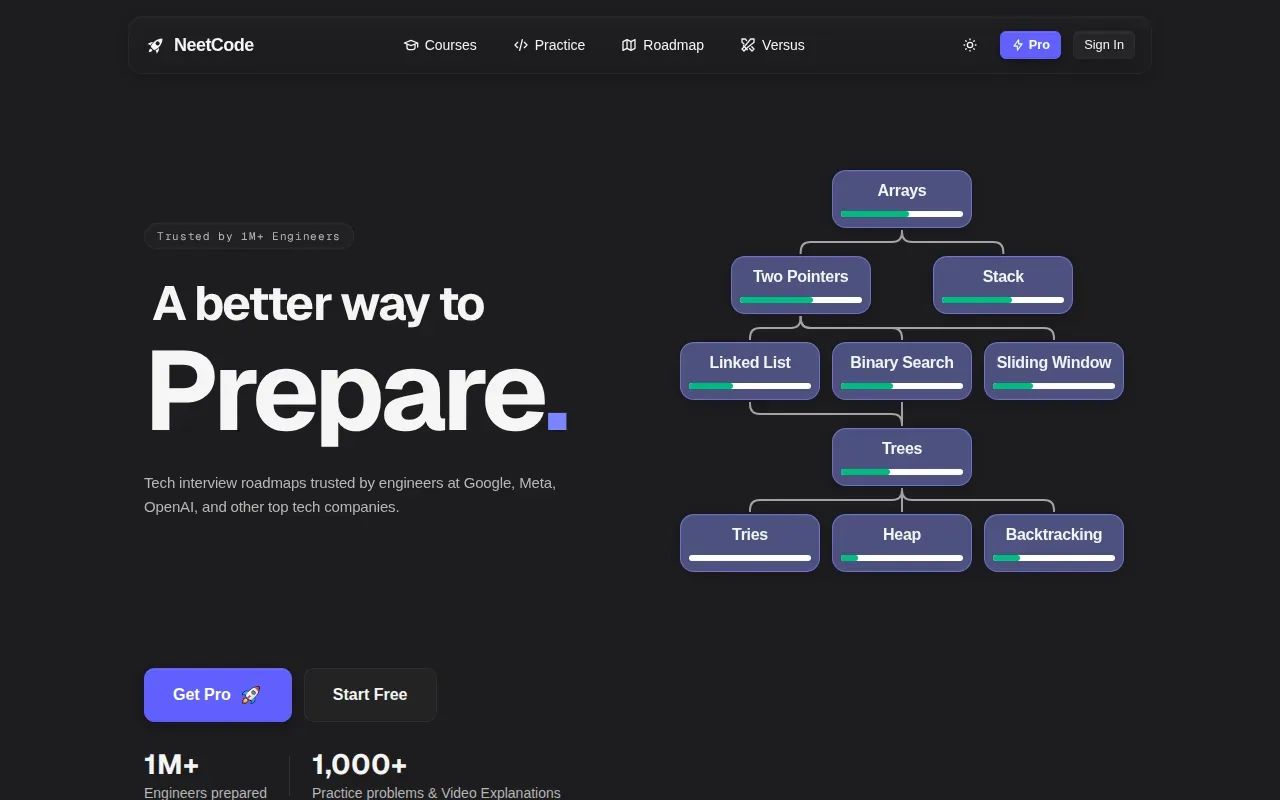
Its strengths map most directly to algorithm rounds. A full-stack interview can still include a data-structure problem, even when the role also calls for React, Angular, Node, Python, or database knowledge. Use the structured course work to build a steady coding routine, then explain your solution out loud as if someone were listening.
Versus mode gives you a head-to-head format. That can make a problem feel less like private homework and more like a timed discussion. Before you start, practice the habits interviewers need to hear: restate the prompt, ask about input limits, and test an edge case. After you code, explain the trade-off in your chosen approach instead of stopping at a working answer.
NeetCode’s capabilities focus on coding practice. If your weakest round is behavioral or system design, you’ll need to rehearse those formats separately. And a problem count alone doesn’t tell you whether your explanations are clear. Pair the problem work with a spoken review: could another engineer follow your reasoning without having to guess?
4. Interviewing.io: live coding and system design mocks with interviewers
Interviewing.io provides live mock interviews for coding, system design, and software engineering. Its sessions are priced one at a time, with individual mocks starting around $179 per session. Choose it when you want a person to hear your reasoning and respond during the interview, rather than relying only on automated feedback.
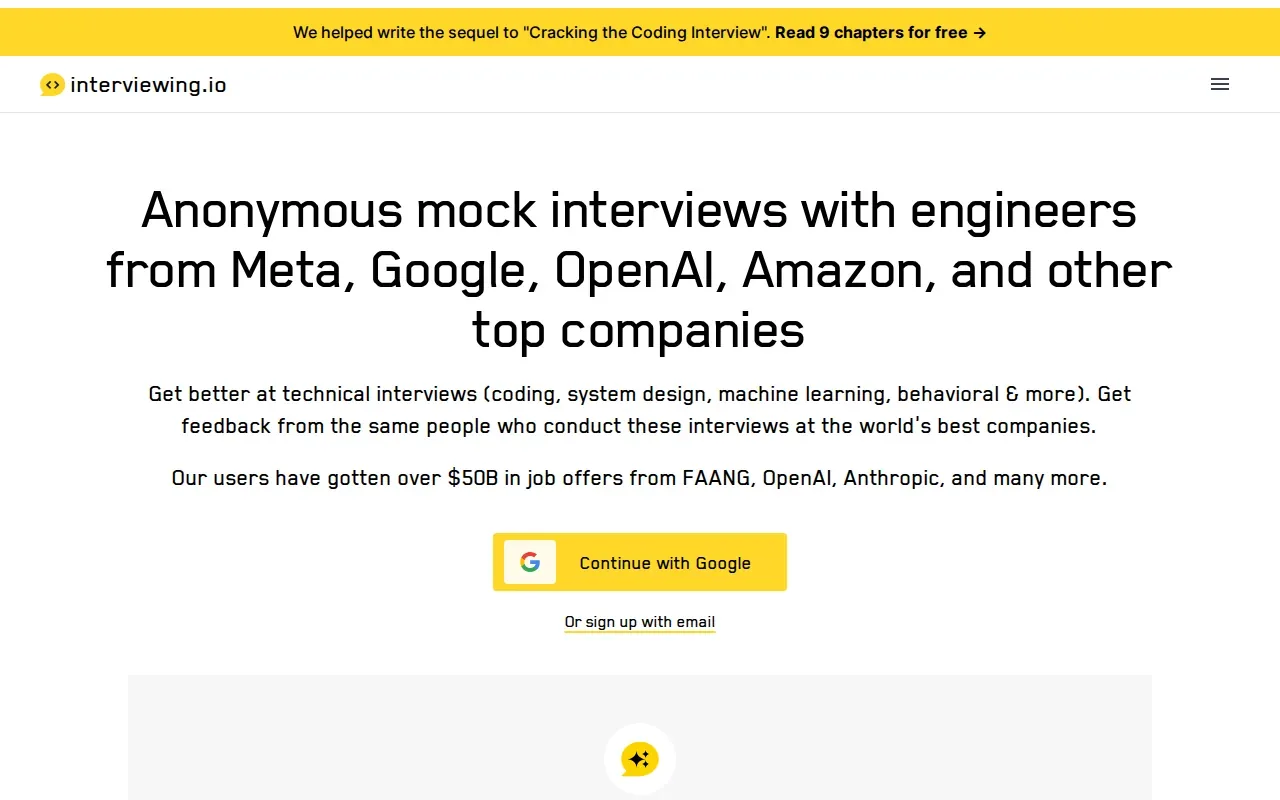
A live mock is useful when you already know the topic but aren’t sure how you’ll handle the conversation. In a system design round, an interviewer can hear whether you clarify the use case before drawing an architecture. In coding, they can see if you explain the plan and test cases as you work. Those are skills a problem set by itself can’t rehearse in the same way.
Interviewing.io also has a free AI Interviewer for coding and system design. Its human mock feedback includes a written review with a performance score, plus an audio recording and transcript. That record gives you a way to revisit a moment where you rushed, missed a question, or could have made your reasoning clearer.
The trade-off is the session format: mocks are individually priced rather than sold as a bundle. Use a live session for calibration, especially when you’ve already practiced alone and need feedback on your interview behavior. If you’re still learning basic patterns, build that base first so you can spend the session on the parts that need a human response.
5. Ultimate Sidekick: unlimited prep sessions
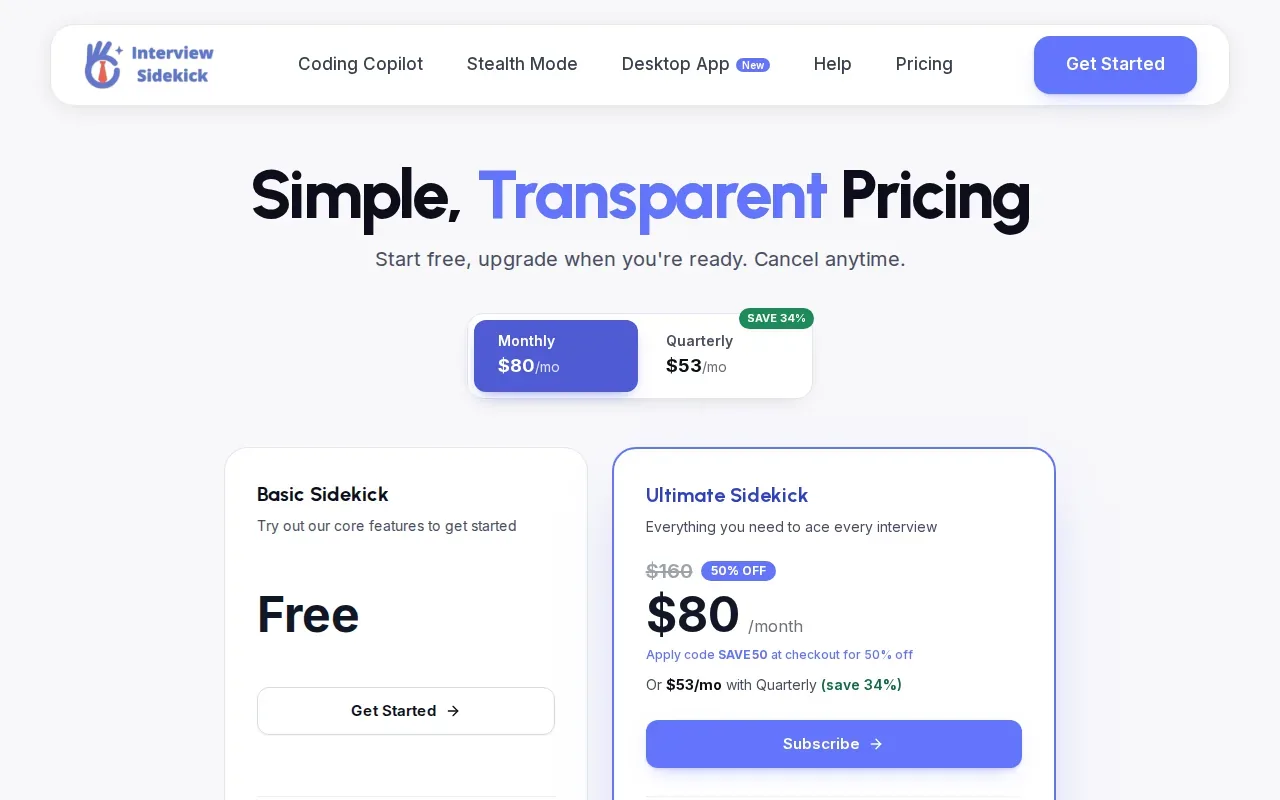
Ultimate Sidekick is a plan from Interview Sidekick that includes unlimited interview prep sessions and advanced prep insights. It’s aimed at candidates who want repeated prep sessions as part of one plan. Before choosing it, match the plan’s scope to the interview rounds you actually need to rehearse.
Repeated practice can help you build a steady rhythm. For example, you might use one session to explain a recent project, then another to work through a coding prompt aloud. A system design rehearsal can focus on scoping the problem before sketching components. The aim is to make each round a distinct practice task, not to repeat the same broad session without a goal.
Full-stack roles often mix front-end, back-end, database, and delivery topics. Set a focus before each prep session: explain how a component talks to an API, reason through a query, or describe how you’d test an edge case. Then note where your answer lost structure. That gives your next practice round a specific target.
Unlimited sessions make frequency the central draw of this plan. Consider the option if the unlimited-session structure suits your routine, and verify the plan’s current terms before you buy.
Compare the mock interview options at a glance
The right fit depends on what you need to improve next. Use this view to pick a starting point, then check whether you need a separate format for another round.
| Option | Best fit | Practice style | Price detail |
|---|---|---|---|
| Phantom Code AI | Live technical guidance | AI desktop assistant | Paid plans start at $19 |
| Huru | Frequent AI interview practice | Generated mocks and instant feedback | Growth: $99 per year |
| NeetCode | Structured coding practice | Courses, problems, Versus mode | See website |
| Interviewing.io | Live coding and system design feedback | Human mocks and free AI Interviewer | Individual mocks start around $179 |
| Ultimate Sidekick | Repeated prep sessions | Unlimited sessions and advanced prep insights | See website |
For a broad full-stack loop, don’t assume one tool covers every need. Choose a main practice format, then add a live session if you need an interviewer to test your communication under pressure.
FAQ: Mock interview bundles for full-stack interview prep
What should a full-stack mock interview include?
A useful full-stack mock should match the interview round you’re preparing for. Coding practice should include time to clarify a prompt and test the result. System design practice should give you room to ask about requirements and explain trade-offs. Behavioral practice should make you answer aloud, then review whether your role and actions were clear.
Are there free options for mock interview practice?
Yes. Phantom Code AI says new accounts get free credits at signup with no card required. Interviewing.io has a free AI Interviewer for coding and system design. Those are different practice formats, so try the one that matches your next round and check the current terms before you plan your prep around it.
How many mock interviews should I do before a full-stack interview?
There isn’t one session count that fits every candidate. Do enough practice to identify a repeat weakness, then repeat the relevant round after working on it. For instance, if you jump into code before clarifying inputs, make the next mock focus on that habit. Add a live session when you need feedback from a person.
Can AI interview tools be detected during a real interview?
There’s no reliable answer that applies to every tool, interview setup, or employer policy. Don’t treat a product’s privacy or visibility claims as permission to use assistance in an assessment. Ask the employer what tools are allowed. For practice, use AI to rehearse, then make sure you can solve and explain the work without help.
Do I need separate practice for coding and system design?
Usually, yes. Coding practice tests how you work through a defined problem, while system design asks you to shape an architecture from a broad prompt. The skills overlap in communication, but the tasks differ. NeetCode focuses on coding work, while Interviewing.io lists live mocks for both coding and system design.
Conclusion
Choose Phantom Code AI if real-time guidance is the main gap in your practice; choose a live mock when you need a person to challenge your reasoning. Start with one session focused on your weakest round, then repeat that round without help and note what changed.