Real-time system design feels different when the clock is running and every trade-off gets challenged. The best practice routine makes you explain a design, change its load, then defend what breaks. Use the steps below to turn passive study into live rehearsal, with Phantom Code AI as one way to add instant feedback to your mock rounds.
Table of Contents
- Step 1: Use a Repeatable System Design Interview Framework
- Step 2: Turn a Real-Time Scenario Into an Interactive Mock
- Step 3: Measure Latency, Throughput, and Failure Behavior
- Step 4: Practice Streaming Patterns and Fault-Tolerant Architecture
- Step 5: Run a Full Mock, Review the Trade-Offs, and Iterate
- FAQ
- Conclusion
Step 1: Use a Repeatable System Design Interview Framework
The first step in learning how to practice system design for real-time systems interactively is to use the same thinking order every time. A fixed structure keeps you from jumping straight to tools.
Start with the user action. For a live video system, that might be “publish a stream” or “watch with low delay.” Then ask what the system must do and how it must behave. Functional needs describe the actions. Non-functional needs describe limits such as latency, availability, consistency, privacy, and traffic shape.
Next, make rough estimates. Write down active users, events per second, average event size, peak load, retention, and an acceptable response time. You don't need perfect math. You do need numbers that let you defend a choice.
- Clarify the main user flow.
- Set functional and non-functional requirements.
- Estimate traffic, storage, and peak demand.
- Define the key APIs and event shapes.
- Draw the high-level request and event paths.
- Deep look at the part most affected by real-time constraints.
- Review failures, recovery, cost, and trade-offs.
For a live chat service, the deep dive may cover WebSockets, connection routing, message ordering, and reconnects. For a telemetry pipeline, it may focus on ingestion bursts, partition keys, late events, and alert delay. The framework stays the same. The pressure points change.
A useful system design interview framework should help you spend less time searching for the next topic. This system design interview question set can give you prompts for storage, scale, sync, and failure cases.
Practice saying why you chose one approach. “I picked a queue because this task can run later” is stronger than naming a queue without a reason. A system design interview rewards clear choices and honest limits, not a wall of product names.

Step 2: Turn a Real-Time Scenario Into an Interactive Mock
To practice real-time architecture interactively, turn a broad prompt into a timed role-play. Don't write a polished answer first. Make yourself respond to new facts as they arrive.
Choose one scenario with a clear stream of events. Good prompts include a live sports score feed, a chat service, a ride location tracker, a market data dashboard, or a video streaming platform. Set a 45-minute timer if you're preparing for a standard system design round. Use a shorter session when you're training one skill. A bank of practice interview questions can help you rotate scenarios without repeating the same design from memory.
Assign two roles. The candidate asks questions and leads the design. The interviewer gives requirements only when asked, then introduces follow-ups. A follow-up might change the peak traffic, require stricter ordering, remove a data store, or cause one consumer group to lag.
Use a shared whiteboard or a simple screen recording. Speak while you draw. Mark each arrow with its purpose. If an event is asynchronous, say what happens when the consumer is slow. If a request is synchronous, state why the user must wait.
After the first five minutes, inject a constraint. For example: “The system now has a tenfold traffic spike during a live event.” Later ask: “A region is down. What does the user see?” These changes test whether the design has a real shape or was only memorized.
Phantom Code AI can fit into this loop when you want a machine-led mock. Its desktop assistant listens and transcribes the discussion, then provides guidance during mock or live technical interviews. Use that feedback to spot moments when you skipped clarification or named a pattern without explaining its use.
Keep a short scorecard after each round:
- Did you clarify the main goal?
- Did you quantify the load?
- Did you explain the hot path?
- Did you handle slow consumers?
- Did you name a failure and recovery plan?
- Did you finish with a clear trade-off?
Mock interviews work best when you repeat the same scenario later with one new constraint. That shows whether you learned the design or only remembered the diagram. The AI mock system design interview format is useful for rehearsing adversarial follow-ups without waiting for a partner.
Step 3: Measure Latency, Throughput, and Failure Behavior
Interactive system design practice needs numbers. Track what the system does under load instead of saying it will be “fast” or “scalable.”
Start with three measures. Latency tells you how long an event takes to reach the user or the next service. Throughput tells you how many events the system handles in a period. Failure behavior tells you what happens when a dependency slows down, drops requests, or returns bad data.
| Measure | Question to answer | Practice signal |
|---|---|---|
| Latency | How long from event arrival to user-visible result? | State a target and name the slowest hop. |
| Throughput | How many events arrive at normal and peak load? | Explain partitions, workers, or load shedding. |
| Lag | How far behind is a consumer? | Describe back-pressure and recovery. |
| Error rate | Which requests or events fail? | Separate retries from permanent failures. |
| Recovery | How does the system return to normal? | State replay, repair, or failover steps. |
Suppose you design a notification pipeline. A burst fills the queue faster than workers can drain it. Your answer should cover the queue depth, consumer lag, retry count, and the point where the system drops low-value work. This is more useful than simply adding another service.
Be careful with event tools. A message stream can decouple services and let several consumer groups process the same data. It doesn't fix poor partitioning, weak API design, or a consistency problem. In a mock, ask first if the use case needs events at all. A request-response path may be easier to explain and operate.
The same rule applies to storage. If writes are uneven, explain the partition key. If one user or device creates most events, call out the hot key. If an event can arrive twice, make the consumer idempotent. If ordering matters, state the scope of that ordering.
Tools such as RTDS, eMEGASim, HYPERSIM, VTB-RT, OPAL-RT, and dSPACE support digital real-time power-system simulation. That split is useful for interview prep: simulation depth doesn't automatically provide interview feedback. Review this technical example of digital real-time simulation when you want to consider simulation as a separate concern.
Step 4: Practice Streaming Patterns and Fault-Tolerant Architecture
Real-time design practice gets stronger when every pattern answers a failure or timing problem. Don't add a pattern because you remember its name.
Use publish-subscribe when many consumers need the same event. Use event sourcing when a sequence of events must rebuild state. Use CQRS when read and write paths have different needs. Use a worker queue when a job may take a long time and shouldn't hold up the event stream.
Then test the design with faults. Ask what happens when a consumer is slow. Back-pressure can limit intake, pause a producer, or move excess work to a durable buffer. Ask what happens when a dependency fails. A circuit breaker can stop repeated calls from spreading the failure, while a bulkhead can isolate one workload from another.
At-least-once delivery means duplicate handling belongs in the design. Add an idempotency key or a dedup step where repeated events could cause harm. A dead-letter path gives failed messages a place to wait without blocking healthy work.
| Scenario | Pattern to test | Trade-off to explain |
|---|---|---|
| One event feeds several services | Pub-sub | Fanout adds consumer coordination. |
| A slow image or video task | Worker queue | Users get a later result instead of waiting. |
| A failing downstream service | Circuit breaker | Some features may show a fallback. |
| Duplicate payment or command | Idempotency | Keys need a safe retention period. |
| Repeatedly invalid events | Dead-letter queue | Operations need a repair path. |
Run each mock twice. In the first round, design the happy path. In the second, the interviewer removes one dependency or doubles the input rate. You should be able to point to the component that absorbs the change and the component that becomes the new bottleneck.
Tools built for real-time simulation show how deep a technical simulator can be while still serving a narrow domain. The IEEE source describes OPAL-RT and dSPACE with MATLAB/Simulink integration, while RTDS uses the RSCAD suite. Those capabilities can help engineers study simulation, but they don't replace a spoken interview loop with follow-up questions.
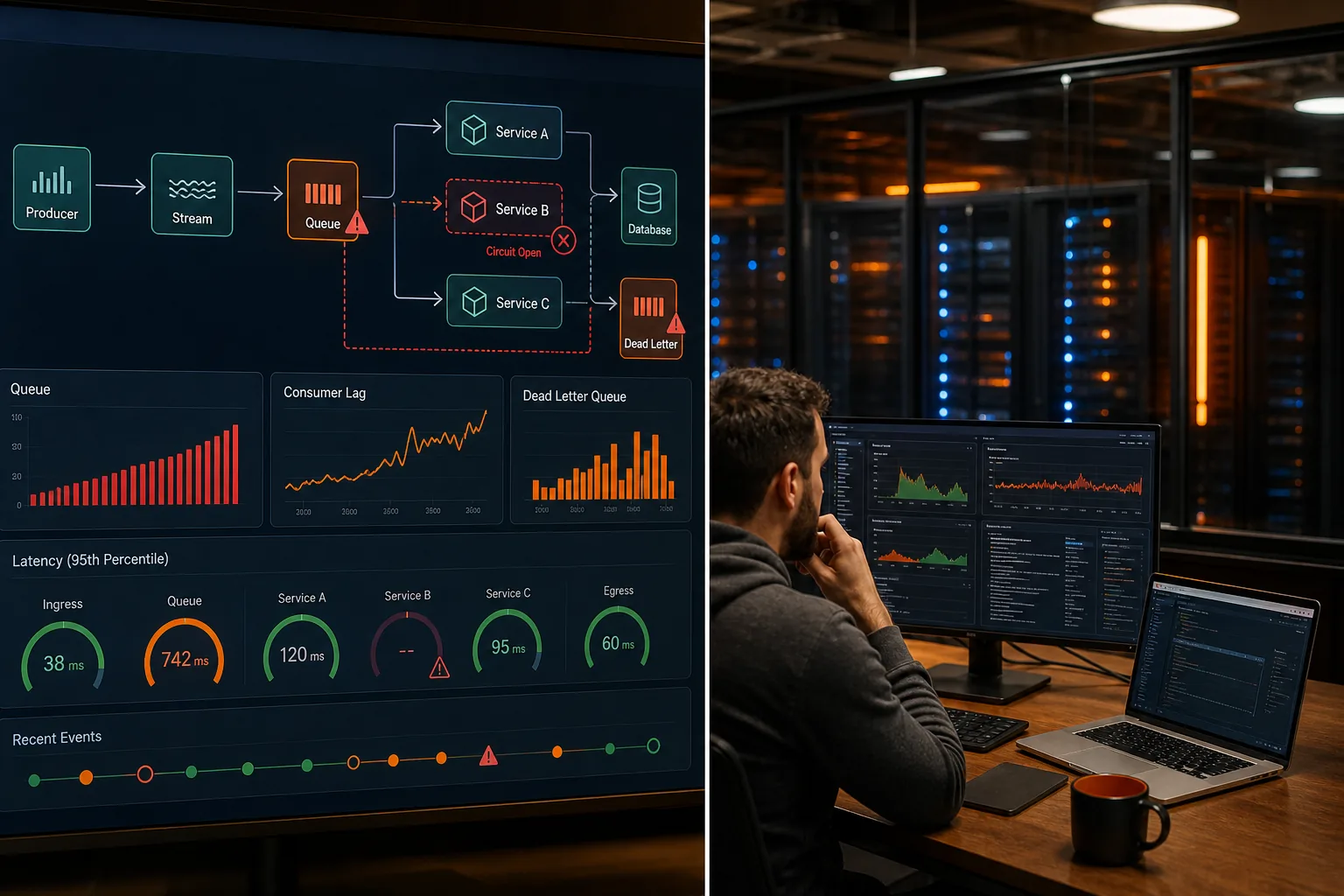
That missing bridge is why many candidates combine a technical sandbox with a separate interview coach. Phantom Code AI is better suited to the feedback side of that routine, while a small local simulation or diagram can help you test the system behavior.
Step 5: Run a Full Mock, Review the Trade-Offs, and Iterate
The final step is to run the whole round without pausing for notes. This is where system design practice becomes interview practice.
Pick one prompt and set a fixed time. Spend the opening minutes on scope. Move to estimates before drawing too many boxes. Keep the main flow visible, then choose one area for a deep dive. Leave time for failures and a short summary. For broader FAANG interview preparation, apply the same discipline to coding and behavioral rounds instead of treating system design as an isolated exercise.
Ask the interviewer to interrupt you. A real round rarely follows your preferred order. You may need to explain why a cache is safe, what happens after a region failure, or how the system handles an event that arrives late.
Review the recording in three passes. First, check communication. Did you answer the question asked? Second, check architecture. Did every component have a job? Third, check trade-offs. Did you state what your design gives up?
Write one correction for the next round. Keep it narrow. “Explain consumer lag before naming a stream” is useful. “Study distributed systems more” is too vague to guide action.
Phantom Code AI can help with the feedback loop because it listens, transcribes, and gives guidance during technical interview practice. Use it as a review aid, not as a substitute for learning the system concepts. You still need to understand why a design works and where it fails.
Repeat the prompt after two or three days. Change one input, such as traffic shape, ordering, or availability. If your explanation stays clear under that change, the practice is doing its job.
FAQ
How do I practice real-time system design for an interview?
Practice with a timed mock that includes a live event flow and surprise constraints. Start with requirements, estimate load, draw the hot path, then test latency, consumer lag, retries, and failures. The key is to speak while you design, because interactive practice tests your reasoning under pressure.
What should I measure in a real-time system design mock?
Measure latency, throughput, consumer lag, error rate, and recovery time. You don't need a production-grade test rig for every session. Write down target values, identify the slowest step, then explain how the design responds when input rises or a dependency fails.
Should I always use an event stream in a real-time system design answer?
No. Choose an event stream only when the workload needs durable events, independent consumers, replay, or high throughput. A queue, request-response flow, or simpler worker model may fit better. In an interactive mock, explain the problem first, then show how the chosen pattern addresses it.
How can I get feedback on a system design interview?
You can use a peer, a paid mock interviewer, or an AI interview coach. Phantom Code AI can listen and transcribe a technical mock while giving real-time guidance. Pair that feedback with your own review of estimates, bottlenecks, and failure handling so you learn the reason behind each correction.
Do real-time simulators help with system design interviews?
They can help you study system behavior, but most real-time simulators target a technical domain rather than interview rehearsal. The available examples split sharply between power-system simulation and interview-focused feedback. Combine a small simulation or load test with a spoken mock to practice both architecture and communication.
Conclusion
Use a repeatable framework, run timed mocks, measure the system, and force failure scenarios into every round. Start today with one live-streaming or notification prompt, record a 45-minute answer, and write down the single trade-off you need to explain better next time. Add Phantom Code AI when you want a faster feedback loop between attempts.