
Your resume can do more than pass a screen. With the right setup, it can shape the questions you practice next. The best workflow to combine resume parsing with mock behavioral prompts pairs a resume analyzer with an interview coach, then checks each answer against clear rules. Here are the strongest options for software engineers, plus the gaps you still need to plan around.
Table of Contents
- Phantom Code AI — Real-time interview guidance for technical candidates
- Skill Edge — Resume analysis as the personalization layer
- AIApply — Live feedback for structured behavioral practice
- Yoodli — Delivery coaching for clearer behavioral answers
- interviewing.io — Technical reasoning practice with human pressure
- Final Round AI — Broad question banks and follow-up practice
- Big Interview — Structured repetition across interview types
- Pramp — Free peer practice to validate AI-generated prompts
- Exponent — Peer practice for technical and behavioral readiness
- Skillora.ai — Recorded AI interviewer sessions for review
- FAQ
1. Phantom Code AI — Real-time interview guidance for technical candidates
Phantom Code AI is a strong fit for engineers who need help across coding, system design, and behavioral practice. It listens during mock or live technical interviews, transcribes the discussion, recognizes the problem type, and provides guidance in real time.
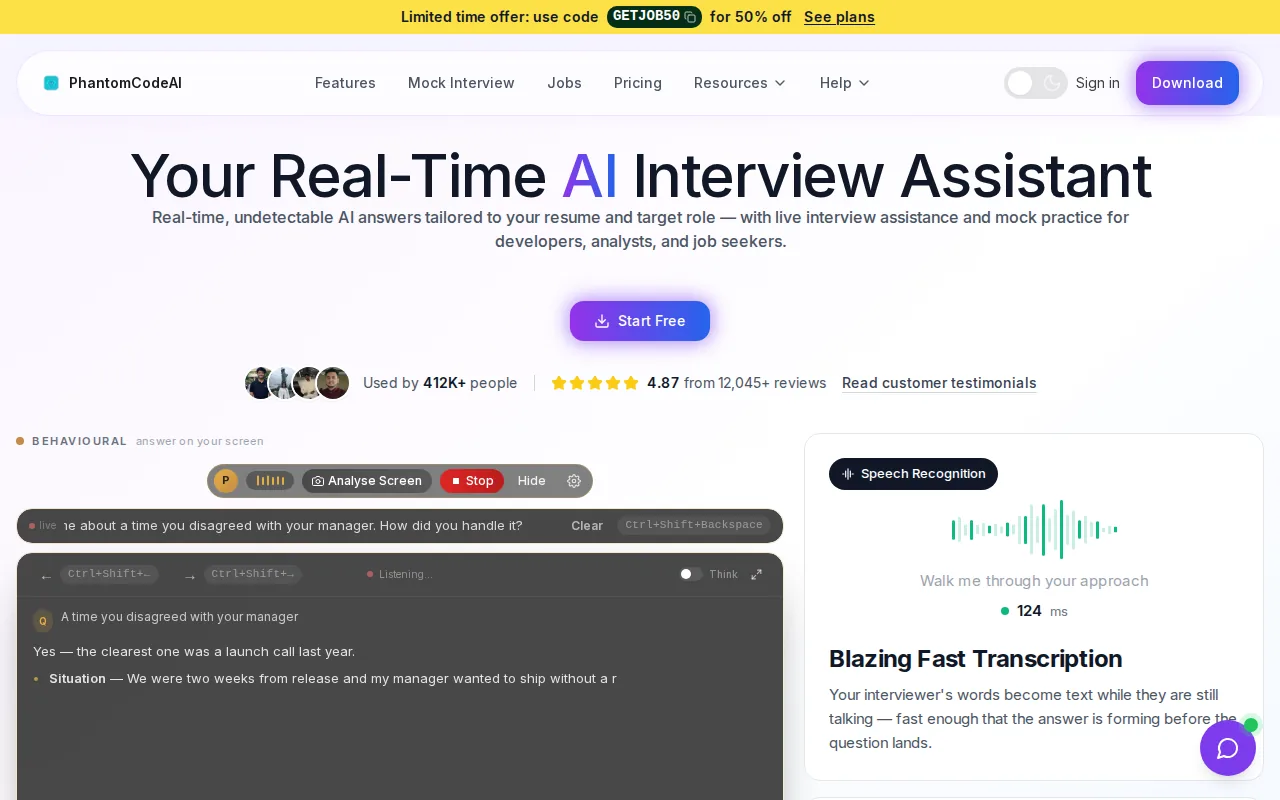
Phantom Code AI fits the interview side of the workflow better than a resume-only parser. You can feed it the role, your resume themes, and the areas you need to rehearse. Then use the session to test a prompt such as, “Tell me about a time you changed a design after a production incident.”
For a senior backend role, that means the practice can move from a system design discussion to ownership questions without losing the technical thread. The assistant is also useful when your answer gets vague. It can help you return to the decision, the tradeoff, and the result.
The main caveat is workflow setup. Phantom Code AI does not remove the need to prepare a clean resume context or a strong story bank. Use the parser first when you need structured resume facts, then bring those facts into the practice session. This is also why Using AI for Tech Interview Preparation: An Honest Engineer's Guide works well as a companion resource.
2. Skill Edge — Resume analysis as the personalization layer
Skill Edge is the clearest choice when resume parsing must come first in your workflow. It accepts a PDF upload through client-side PDF.js extraction, detects more than 100 technical skills, and scores resume quality across ten weighted dimensions.

The tool also provides a 100-point quality score. That gives you a useful input layer for prompt design. Instead of asking an interview bot for generic questions, you can tell it to focus on a listed skill, a missing result, or a project that needs more detail.
Skill Edge's resume extraction and scoring approach provides structured context, not a final judgment. A parser can spot “Kubernetes” or “distributed systems,” but it can't know how deeply you used either one.
Its limitation is just as clear. Skill Edge gives you the personalization layer, but you still need a separate mock interview tool for live practice. A good handoff includes the target role, three resume claims, one weak area, and the expected seniority.
3. AIApply — Live feedback for structured behavioral practice
AIApply is best for candidates who want live feedback while answering behavioral prompts. It gives real-time feedback and structured suggestions during the interview session, which makes it useful after a parser has identified the resume claims worth testing.
Try a narrow prompt first: “Ask about my migration project. Wait for my answer. Then check whether I explained my personal decision, the technical constraint, and the result.” Narrow instructions reduce guesswork. They also make the feedback easier to act on.
AIApply helps when you tend to lose structure halfway through an answer. It can point you toward a clearer response while the thought is still fresh, instead of leaving you with a transcript to review later.
The tradeoff is that the resume-to-prompt handoff is still your job. Paste only the facts needed for the session. Don't send a full resume when three project details will do.
4. Yoodli — Delivery coaching for clearer behavioral answers
Yoodli is best for delivery. It listens to how you speak and coaches you on issues such as rambling and filler, which can matter when a strong technical story gets buried under too much setup.

Use a parsed resume claim as the prompt seed. For example, if your resume says you reduced an API's latency, ask for a follow-up about the baseline, the measurement method, and the choice you made. Then repeat the answer until the key point arrives sooner.
This makes Yoodli a good second pass after content work. First decide what happened. Then practice how you explain it. The tool is less suited to proving whether your architecture is sound, so pair it with technical questioning when the role demands design depth.
Keep the target small. One answer with fewer filler words is more useful than a long session with no clear change to make.
5. interviewing.io — Technical reasoning practice with human pressure
interviewing.io suits software engineers who need to reason through technical problems with another person. Its value comes from practice with real engineers, rather than from live AI coaching during the answer.
That distinction matters in a combined workflow. A resume parser can produce a tailored prompt about caching, queues, or incident response. A human interviewer can then test whether you can explain the tradeoff when the question changes shape.
Use this option after an AI session has exposed weak stories. Bring one project from your resume and ask the interviewer to probe your ownership. Did you make the call? What data shaped it? What failed after launch?
The limitation is time and coordination. It won't give you instant on-screen guidance, and it isn't a resume parser. Choose it when pressure from another engineer is the part of practice you lack.
6. Final Round AI — Broad question banks and follow-up practice
Final Round AI is best for high-volume practice across many roles. It uses large question banks, adds follow-up questions, and gives feedback after each session.

That breadth helps when you need to build a prompt set from a resume. Pull out each major project, skill, leadership claim, and failure story. Then ask the tool to vary the angle. One prompt can test conflict. Another can test prioritization. A third can test the technical result.
Use a simple prompt specification:
- Role: senior backend engineer.
- Context: the pasted resume claim.
- Task: ask one behavioral question at a time.
- Check: ownership, decision, tradeoff, and result.
- Stop rule: wait for the answer before asking a follow-up.
The caveat is feedback depth. A large bank can produce volume, but volume doesn't fix a weak story by itself. Review the transcript and mark one change for the next round.
7. Big Interview — Structured repetition across interview types
Big Interview is a fit for candidates who want a structured practice routine across several interview types. Its question banks, follow-up prompts, and post-session feedback support repeated drills.

It works best when you use the parsed resume as a source of assignments. A project with a vague bullet can become a behavioral drill. A tool named without an outcome can become a results question. A leadership claim can become a conflict or influence prompt.
Don't ask the interview tool to “make questions from my resume” and stop there. Specify the role level and the trait under review. Ask it to flag answers that describe team work without showing your own action.
Big Interview's limitation is the same one found in most broad practice platforms: it doesn't replace coding practice. Keep algorithm and system design drills in a separate track.
8. Pramp — Free peer practice to validate AI-generated prompts
Pramp is best when you want free peer practice with another person. It adds the human reaction that an AI session may miss, especially when an answer sounds clear to you but confusing to someone hearing it for the first time.
Use a parser or question bank to prepare the prompt. Then give your partner one focus area, such as ownership or technical tradeoff. Ask them to stop you when the answer leaves the main point.
Peer practice also tests whether your story works without hidden context. If your partner can't follow the incident, the interviewer probably won't either. Rewrite the setup and lead with the decision.
Pramp doesn't provide real-time AI coaching or resume parsing. It depends on partner availability and honest feedback. Choose it when the missing ingredient is human pressure, not more generated questions.
9. Exponent — Peer practice for technical and behavioral readiness
Exponent is another option for free peer practice. It fits engineers who want to test both technical reasoning and behavioral answers with another person.
The best handoff is small. Give your partner one resume project and one question type. For instance, ask them to probe a database migration for technical judgment, then ask what you learned when the plan changed.
This setup turns resume parsing into a useful briefing sheet. It doesn't ask a peer to read every line. It gives them a clear reason to challenge the answer.
The limitation is consistency. Peer sessions vary by partner and format, and Exponent doesn't provide live AI guidance. Use a short scorecard after each round so your next session has a clear target.
10. Skillora.ai — Recorded AI interviewer sessions for review
Skillora.ai is suited to candidates who want mock interviews in front of an AI interviewer, with session recording for later review. Recording changes the workflow because you can inspect the answer after the pressure has passed.

Start with a resume claim that needs proof. Ask about the system you built, the constraint you faced, or the result you measured. After the session, watch for places where you use broad phrases such as “we improved performance” without saying what you owned.
Recorded review is useful for senior engineers because the gap often sits between knowledge and explanation. You may know why you chose a queue, yet fail to state the tradeoff in plain words. Mark the exact sentence where the answer loses focus, then record it again.
| Use case | Best fit | What to pass into the session | Main gap to cover elsewhere |
|---|---|---|---|
| Resume facts and skill extraction | Skill Edge | PDF resume and target role | Live mock interview |
| Live behavioral guidance | AIApply | One story and one evaluation rule | Resume parsing |
| Delivery and filler review | Yoodli | One timed answer | Technical depth |
| Human technical pressure | interviewing.io | Project and target skill | Automated feedback |
| Question volume | Final Round AI or Big Interview | Role, level, and resume claims | Coding practice |
| Free peer validation | Pramp or Exponent | One prompt and scorecard | Live AI coaching |
| Recorded self-review | Skillora.ai | One project story | Resume extraction |
How to make the handoff work
The strongest workflow has three layers: context, prompt, and verification. The parser supplies facts. The interview tool turns those facts into questions. You verify the answer against a fixed rubric.
Keep the context narrow. Include the target role, seniority, resume claims, and one skill to test. Remove private details that the mock session doesn't need. This reduces noise and makes it easier to spot an invented assumption.
Use a prompt such as: “You are interviewing a senior software engineer. Ask one behavioral question about the project below. Wait for my answer. Score ownership, decision quality, tradeoff awareness, and result from 1 to 5. Quote the sentence that needs work. Do not invent facts that aren't in the resume.”
Then verify the output. Did the question match the resume? Did the feedback quote your actual answer? Did the tool separate your action from the team's work? If the answer is no, tighten the instructions before the next session.
Privacy needs the same care as prompt quality. Resume files contain contact details, work history, and project information. Check what a service stores, how long it keeps recordings, and whether you can delete your data before uploading a full document.
Also keep coding practice separate. Pair the behavioral track with a coding assessment service, then review both tracks against the same target role.
FAQ
What is the best workflow to combine resume parsing with mock behavioral prompts?
The best workflow is to parse the resume first, select a few claims, and pass only those claims into a mock interview tool. Use the parser for skills and gaps. Use the mock tool for questions and follow-ups. Finish with a rubric that checks ownership, decisions, tradeoffs, and results.
Can AI generate behavioral questions from my resume?
Yes, AI can generate behavioral questions from resume details when you provide clear context. Give it the target role, seniority, project claim, and trait to test. Tell it to ask one question at a time. It should wait for your answer and avoid adding facts that aren't in your resume.
Which tool parses a resume for interview practice?
Skill Edge is the named option in this shortlist with PDF resume extraction and technical skill detection. It also gives a 100-point quality score. You still need a separate interview tool for live practice, since resume analysis and behavioral coaching are different parts of the workflow.
Is real-time AI feedback useful for behavioral interviews?
Real-time AI feedback is useful when you lose structure while speaking. AIApply gives structured suggestions during practice, while Yoodli focuses on delivery, filler, and rambling. Neither replaces a human review of technical judgment. Use live feedback to fix the moment, then review the full answer afterward.
How should software engineers prompt an AI mock interviewer?
Software engineers should specify the role, project context, question type, turn-taking rule, and scoring criteria. Ask for one question at a time. Require the tool to quote the answer before giving feedback. This makes the workflow more reliable than asking for a broad list of generic behavioral prompts.
Can one tool handle resume parsing, coding, and behavioral practice?
Don't assume one tool will cover all three areas. The options here split those jobs across resume analysis, behavioral practice, delivery coaching, peer sessions, and technical interview pressure. A hybrid workflow is safer: parse the resume, practice behavioral stories, then run separate coding and system design drills.
For most software engineers, the right starting point is Phantom Code AI for live technical interview guidance, paired with Skill Edge when resume parsing is the missing piece. Extract a small set of project claims today, turn each claim into one behavioral prompt, and run the answers through a fixed rubric before your next interview.