Best System Design Rehearsal Tools for Senior Engineers

Compare the best tools for senior engineers to rehearse system architecture, including voice practice, expert coaching, AI feedback, and interview support.
System design prep can look sharp on a whiteboard and still fall apart once someone asks you to explain a trade-off out loud. The best tools for senior engineers to rehearse system architecture help with different parts of that gap: live interview support, voice practice, expert coaching, or repeatable design feedback.
Table of Contents
- Phantom Code AI
- MockMe.ai: Voice-based system design practice with a drawing tool
- Hello Interview: Structured system design prep with experienced engineers
- Codemia: Interactive system design practice with AI feedback
- Design Gurus: One-on-one mock interviews with ex-FAANG hiring managers
- How These System Architecture Rehearsal Tools Compare
- FAQ
- Conclusion
1. Phantom Code AI
Phantom Code AI is an invisible desktop assistant for coding interviews, including system design and behavioral rounds. It’s best for engineers who want real-time guidance during a mock or live technical interview, rather than a standalone diagram editor.
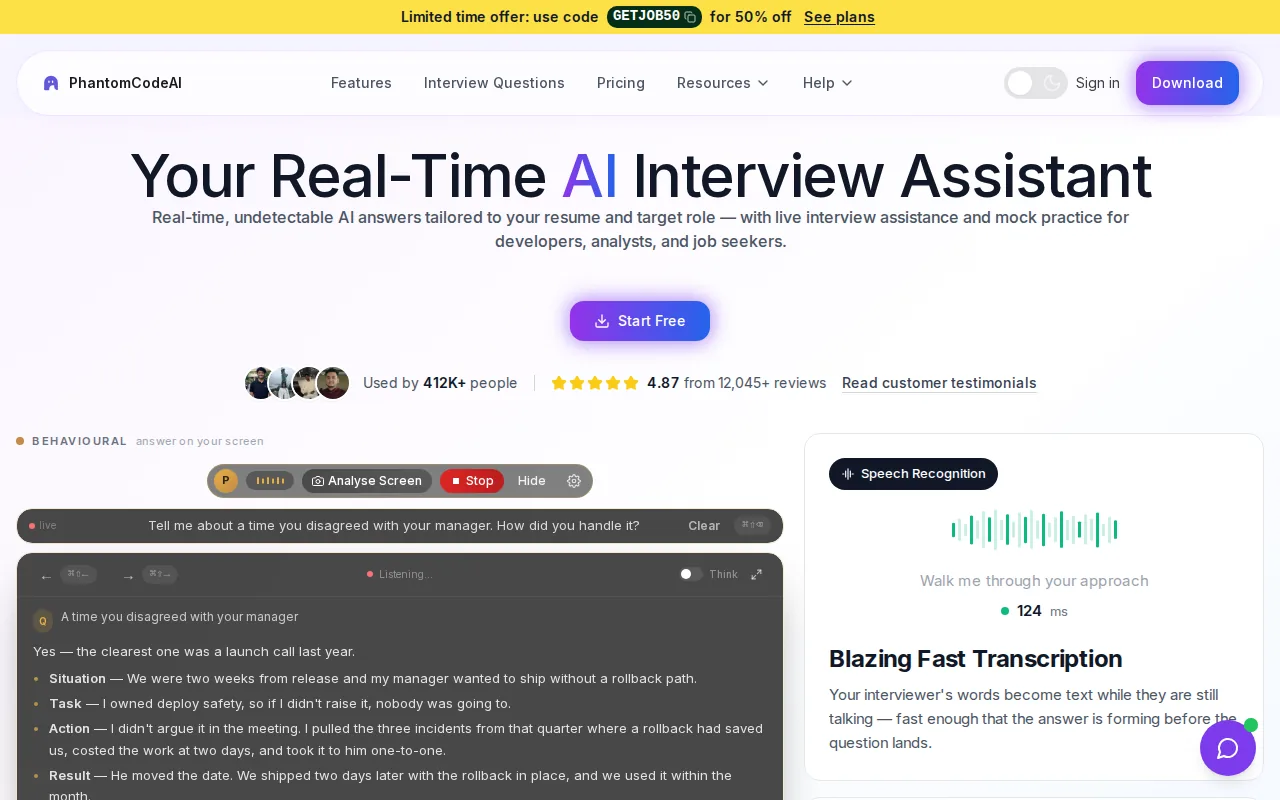
It listens to the interview, transcribes the discussion, recognizes problem types, and provides guidance in real time. That makes it relevant when you need to talk through a design while responding to follow-up questions. A rehearsal can focus on explaining why you chose a modular monolith before moving to microservices, or how you’d handle a growing API load.
For a broader look at interview support across system design, SQL, and behavioral rounds, see AI tools for system design, SQL, and behavioral interviews. Phantom Code AI’s role is distinct from a whiteboard practice tool: it can support the conversation, but it isn’t described as an assistant that watches and critiques architecture diagrams.
That distinction matters. If your main gap is drawing a system from scratch, pair interview guidance with a separate diagram or mock-interview exercise. If you’re rehearsing how to think aloud under pressure, Phantom Code AI fits that need more directly.
Use it to rehearse your explanation, then check whether you can defend each choice without relying on a prompt.
Software architecture describes the structure and organization of a software system, which is the kind of reasoning you’ll need to explain in an interview.
2. MockMe.ai: Voice-based system design practice with a drawing tool
MockMe.ai is a voice-based system design practice tool with a built-in drawing tool. It’s best for senior engineers who want to speak through a design while sketching, rather than prepare only with written prompts.
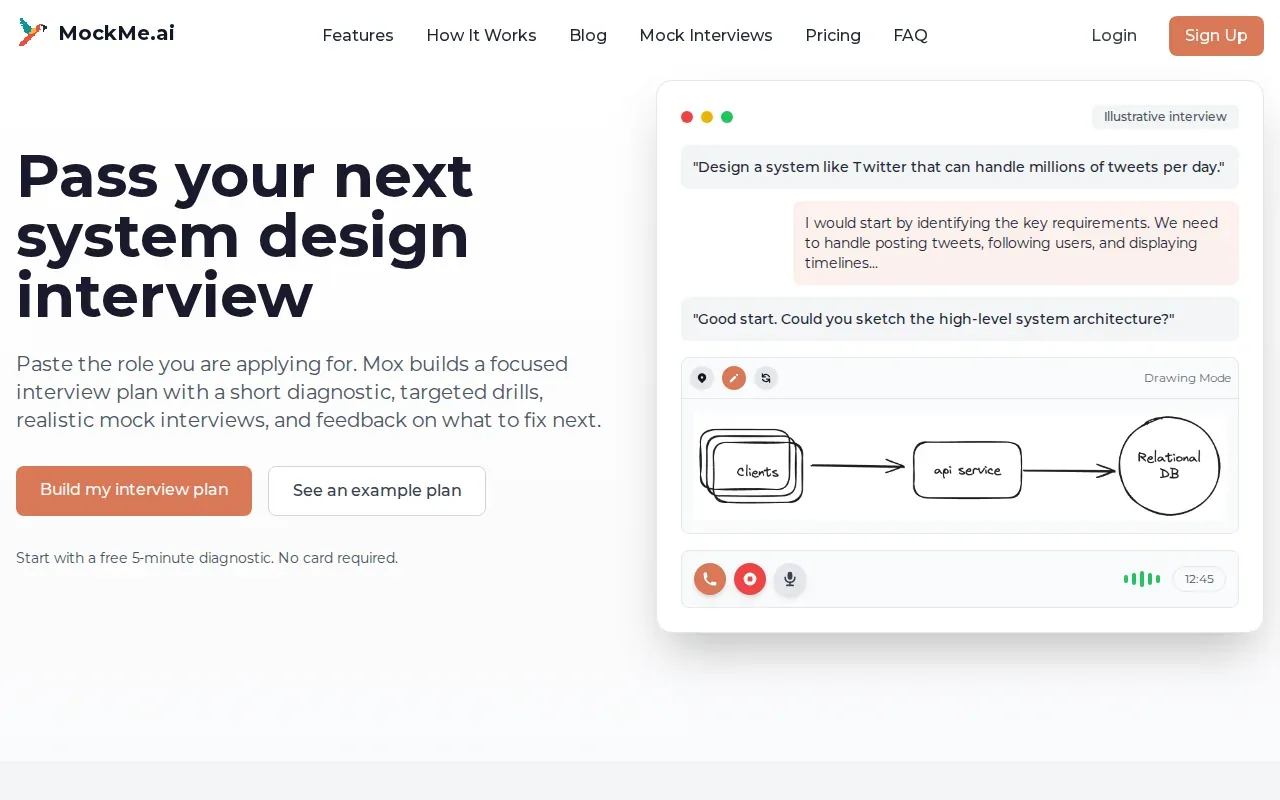
Voice practice changes the pace of a rehearsal. You have to state assumptions, choose a starting point, and keep talking while you shape the design. MockMe.ai’s drawing tool gives you a visual place to build that explanation. Its AI can watch diagrams, ask contextual follow-up questions, and provide feedback.
Imagine a prompt about a service that stores user activity. You might sketch the write path first, then explain what changes if reads grow faster than writes. A contextual follow-up can push you to discuss the next design choice instead of ending the exercise when the first diagram looks complete.
That makes it useful for rehearsing the back-and-forth of an interview. You can practice a simple layered design first, then explain what new demand would justify separating parts into services. The exercise is about defending the change, not naming patterns for their own sake.
One caveat: voice-based practice and diagram feedback won’t replace every kind of review. If you need a human interviewer’s judgment or a structured scoring rubric, choose a tool or session built for that purpose too.
3. Hello Interview: Structured system design prep with experienced engineers
Hello Interview connects candidates with staff and senior engineers from Google, Meta, Netflix, and Amazon. It’s best for engineers who want structured system design prep with experienced coaches and company-specific practice.
The prep plans give you a framework for repeated study instead of a single unstructured mock. Hello Interview also uses company-specific questions, which can help you practice shaping an answer around the kind of prompt you expect to face.
For a senior candidate, a useful session should go beyond drawing boxes. You need to explain where data lives, what fails when a dependency is down, and why your design is a fit for the stated requirements. Guided drills can help you practice those decisions in order, then work on making the explanation clearer.
Hello Interview also fits into a broader prep routine: use a design drill to test the structure of your answer, then use a coached session to get feedback on the reasoning. Practice on reported questions can help you build familiarity with interview prompts, while the coaching provides a human practice setting.
Its focus is structured coaching, not an AI assistant that listens and responds during a live conversation. Choose it when human guidance and a prep plan matter more than instant diagram analysis.
4. Codemia: Interactive system design practice with AI feedback
Codemia is an interactive system design practice platform with an interactive whiteboard and AI feedback. It’s best for engineers who want to repeat a design exercise, revise the diagram, and get feedback on the choices they made.
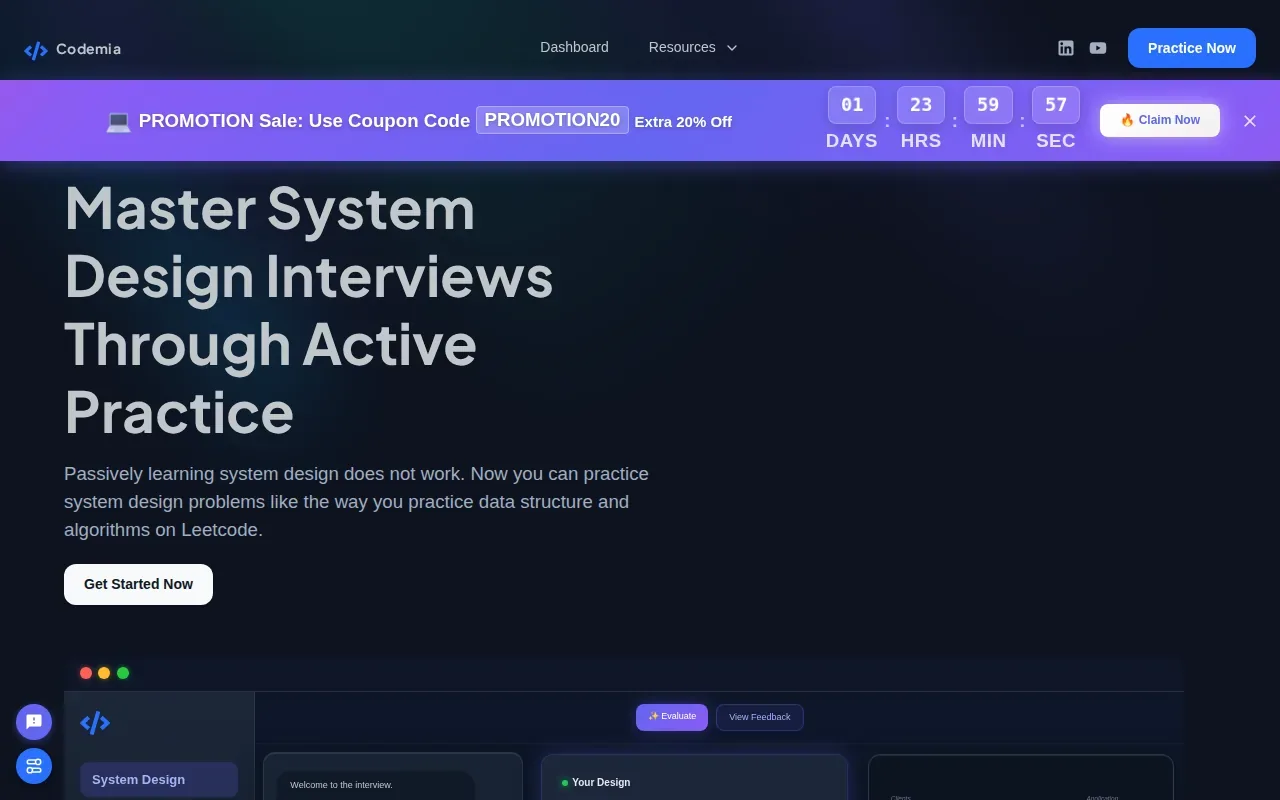
Its feedback covers design completeness, trade-offs, and component selection. That gives you more than a blank canvas: after sketching a design, you can use the feedback to spot a missing piece or rethink a component choice. Then you can revise the design and see whether the new version addresses the issue.
Say you’re designing a feed. Your first pass might cover how posts get stored but skip how readers fetch them. An iterative practice loop gives you a chance to notice that gap, amend the design, and explain why the change helps. Codemia also includes peer mock interview matching and video collaboration, so practice needn’t stay a solo exercise.
For senior engineers, this kind of iteration is most useful when each pass tests a clear decision. For example, compare a single deployable modular design with a microservices approach, then state what operating cost or scaling need would justify the added service boundaries. The goal is a defensible choice, not a more complex picture.
Codemia’s AI feedback is centered on the design artifact. If you need feedback on how you speak, pause, or respond to an interviewer, add a voice or human mock session.
5. Design Gurus: One-on-one mock interviews with ex-FAANG hiring managers
Design Gurus provides one-on-one mock interviews with ex-FAANG hiring managers. It’s best for engineers who want direct feedback from a person during a system design rehearsal.
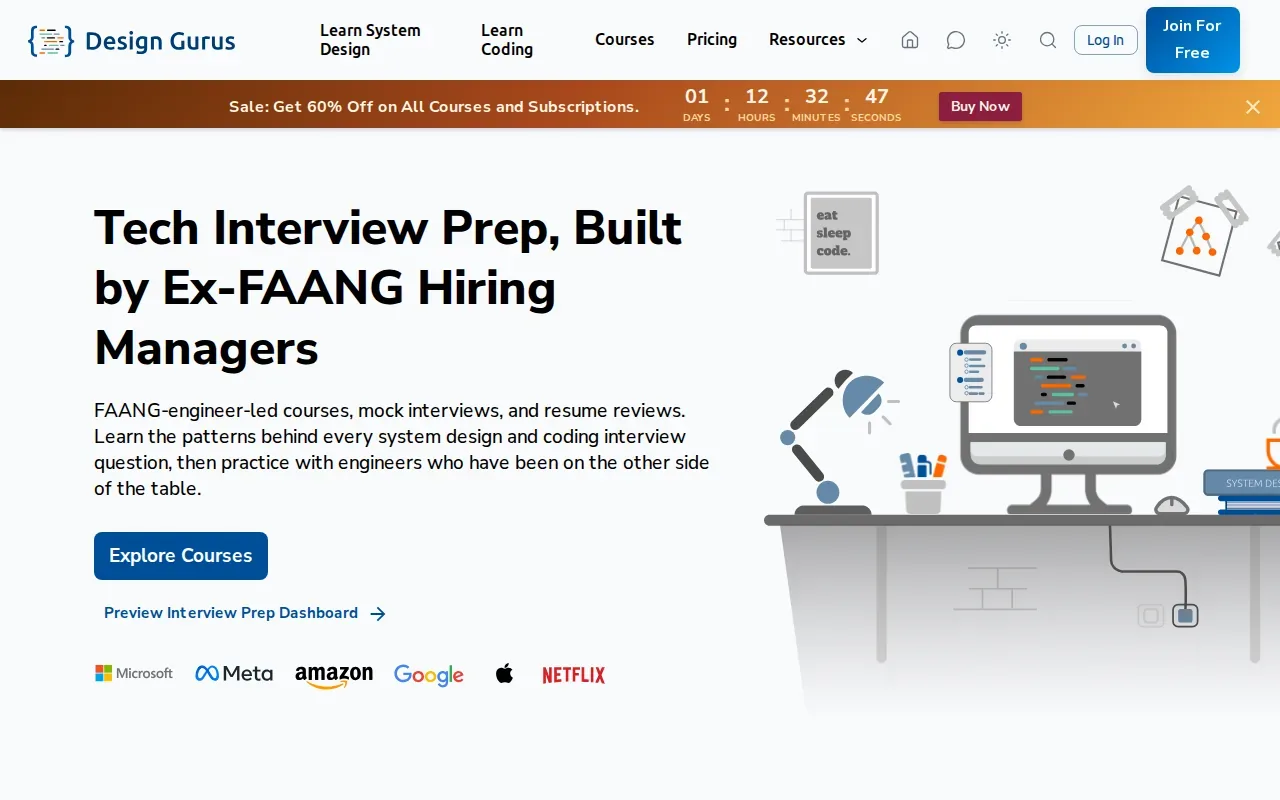
A human mock can test whether your explanation holds up when someone challenges an assumption. You might propose a monolith for an early product, then need to explain what evidence would make you split a component into a separate service. That kind of exchange can show where your reasoning is clear and where it needs more support.
Design Gurus’ sessions complement its Grokking course framework. That gives candidates a way to connect course-based preparation with a live practice session. Use the session to work on a specific weak point, such as framing requirements before drawing or explaining the trade-offs behind a data model.
Experienced interviewers can also help you notice when your answer skips a key question. Did you state what the system must do? Did you explain the failure case? Did you justify the added complexity? Those are useful prompts for a follow-up session or a solo replay.
The main limitation is the format: one-on-one sessions aren’t the same as instant AI feedback on every practice attempt. Pick Design Gurus when live human critique is your priority, and plan other practice for repetition between sessions.
How These System Architecture Rehearsal Tools Compare
The best fit depends on which part of rehearsal needs work. AI guidance can help you practice repeatedly, while a human coach can challenge your reasoning in a live exchange. Few tools in this shortlist are described as integrating with video-call platforms, so check the session format before you expect a rehearsal to match your usual interview setup.
| Tool | Strongest use | Practice format | Key trade-off |
|---|---|---|---|
| Phantom Code AI | Real-time interview guidance | Desktop assistant for mock or live technical interviews | Not a diagram-review tool |
| MockMe.ai | Spoken design practice | Voice interviews with a drawing tool | AI practice rather than a human coach |
| Hello Interview | Structured prep with experienced engineers | Prep plans, company-specific questions, and coaching | Not focused on live AI diagram feedback |
| Codemia | Repeatable diagram practice | Interactive whiteboard, AI feedback, and peer mocks | Feedback centers on the design work |
| Design Gurus | Direct interviewer critique | One-on-one mock interviews | Not an instant AI feedback loop |
Use the same prompt across practice sessions to compare your reasoning.
And don’t treat microservices as the automatic senior-level answer. A modular monolith can be easier to explain and operate when separate deployment or scaling needs haven’t been established. A stronger rehearsal states the requirement first, then ties the architecture to it.
FAQ
What’s the best tool for practicing system design interviews?
The best choice depends on how you want to practice. Phantom Code AI suits engineers who want real-time interview guidance. MockMe.ai is built around voice practice with a drawing tool, while Codemia supports interactive diagrams and AI feedback. For human critique, consider Hello Interview’s coaching or Design Gurus’ one-on-one mocks.
Can AI help me rehearse system architecture?
Yes. AI can support system architecture rehearsal by responding to spoken practice or reviewing a design, depending on the tool. MockMe.ai’s AI can respond to diagrams and ask follow-up questions; Codemia provides feedback on completeness, trade-offs, and component selection. Treat that input as practice feedback, then make sure you can defend the design yourself.
Should senior engineers practice monoliths or microservices?
Practice explaining both, then choose based on the prompt’s needs. A monolith or modular monolith may fit when simple deployment and clear internal boundaries are enough. Microservices can fit when independent service ownership or scaling is needed, but they add communication and data consistency concerns. Explain the reason for the choice, not just the pattern name.
How do I know if a system design rehearsal was useful?
A useful rehearsal leaves you with a clearer explanation of requirements, architecture choices, and trade-offs. Check whether you can describe the data flow and a likely failure case without leaning on notes. Then identify one assumption an interviewer could challenge. If you can answer that challenge with a reason tied to the prompt, your next session has a specific goal.
Conclusion
Start with the format that targets your weakest skill: Phantom Code AI for real-time interview guidance, a voice tool for spoken diagram practice, or a coach for human critique. Pick one design prompt and rehearse it this week, then write down the trade-off you found hardest to defend.