Best System Design Interview Course: 5 Top Picks

Compare five system design interview courses by format, practice, price, and fit. Find a course that matches your experience and prep style.
System design interviews test how you reason through an open-ended problem, not whether you can draw a perfect diagram. The best system design interview course for you depends on how you learn and how much practice you need. Here are five options, plus where Phantom Code AI fits if you want separate support during a mock or live interview.
We analyzed 35 YouTube comments about system design interview courses and found that 17% mentioned effective interview prep leading to offers.
Table of Contents
- ByteByteGo: Visual lessons for learning system design concepts
- System Design School: Templates and hands-on practice
- Hello Interview: Guided practice with an AI tutor
- DesignGurus: Pattern-based interview preparation
- Algoroq: Live cohort learning for senior engineers
- Compare the five system design interview courses
- Frequently asked questions
- Conclusion
1. ByteByteGo: Visual lessons for learning system design concepts
ByteByteGo is a self-paced visual learning platform with infographic-style explainers through its website, newsletter, and books. It’s a good fit if you learn by seeing how system parts connect before trying to explain a design yourself.
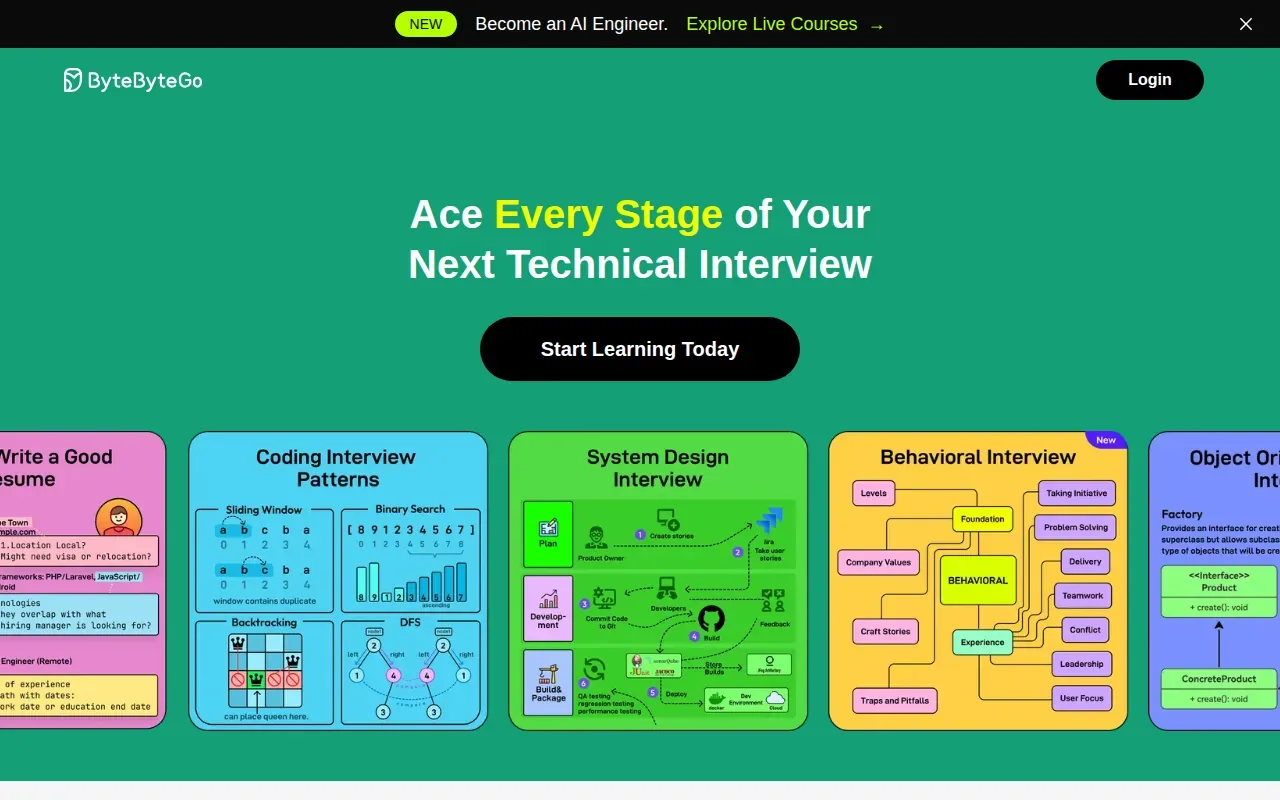
The visual format can help make a busy architecture easier to scan. When you study a feed or messaging service, for example, you can trace a request through an API, application servers, a cache, and storage. Then ask what changes when reads rise faster than writes, or when one service fails.
System design interviews also test whether you can explain your choices. Start with the user’s needs, then sketch a high-level design before discussing scaling. For an HTTP API, explain what each request does and what response the client should expect.
2. System Design School: Templates and hands-on practice
System Design School is a self-paced platform with lessons, reusable design templates, Docker-based codelabs, a study roadmap, and a QPS calculator. It suits learners who want a mix of structured study and exercises rather than video lessons alone.
Its AI practice tool gives feedback on each step. That step-by-step format can help you spot where your design needs more detail. For example, if a prompt asks for a photo-sharing service, you can work through the request rate, API shape, data model, and storage path before moving to failure handling.
The Docker codelabs give lessons a hands-on element. A QPS calculator can help you turn rough traffic assumptions into a starting point for capacity planning. In an interview, state those assumptions out loud. If you estimate 10,000 requests per second, explain which components take the load and where a queue or cache might help.
Plans are Free, Pro Yearly at $45 per year, and Pro Lifetime at $99. Choose it if you want a roadmap and feedback during practice. It can also help to check whether the course’s pace leaves you enough time to rehearse full answers before your interview.
3. Hello Interview: Guided practice with an AI tutor
Hello Interview is a self-paced video library with guided practice and an AI tutor. Its coverage includes core concepts, key technologies, common patterns, question breakdowns, and both high-level design (HLD) and low-level design (LLD). It’s a strong fit if you want a clear path from foundations to interview questions.
The practice set includes 66 guided problems, 45 of them focused on system design. The guided format can help you move from reading a prompt to outlining requirements, trying a design, and checking your answer. The course also recommends practicing out loud with a peer, because explaining a design under time pressure differs from reading a sample answer.
That distinction matters. In a design round, you might be asked to build a ticket booking service. First clarify the booking flow and key constraints. Then define the API and core entities. Draw a simple architecture before discussing how to handle contention, data consistency, or a surge in traffic.
Hello Interview Premium is listed at $47 for one month, $89 for one year, or $299 for lifetime access. Its range of HLD and LLD material can suit engineers preparing for more than one design format. To get value from guided practice, try the problem on your own before using a walkthrough or tutor feedback.
4. DesignGurus: Pattern-based interview preparation
DesignGurus organizes its self-paced courses around reusable design patterns and interview archetypes. It suits learners who want to see how recurring building blocks apply to different prompts, rather than memorize one finished architecture.
The course material covers common system design questions and reusable frameworks. Load balancing, caching, replication, partitioning, and message queues are examples of components that show up across many designs. The point is to know what each component solves, what it costs, and when it creates a new problem.
Pattern knowledge helps with trade-offs. A cache can reduce repeated database reads, but stale data may cause users to see old values. Replication can improve availability, yet replica lag affects consistency. Sharding spreads data across machines, but adds work when a query spans shards. A good answer names the benefit and then says what risk comes with it.
DesignGurus sells single roadmaps as well as monthly, annual, and lifetime all-access plans, with prices shown for your region. It may fit well if you want a structured set of patterns and questions; when practicing, explain why a pattern fits the stated requirements instead of applying it by habit.
5. Algoroq: Live cohort learning for senior engineers
Algoroq is a 12-week system design cohort program aimed at senior engineers, with a live cohort available by application. It suits people who prefer scheduled sessions and feedback over working through a course alone.
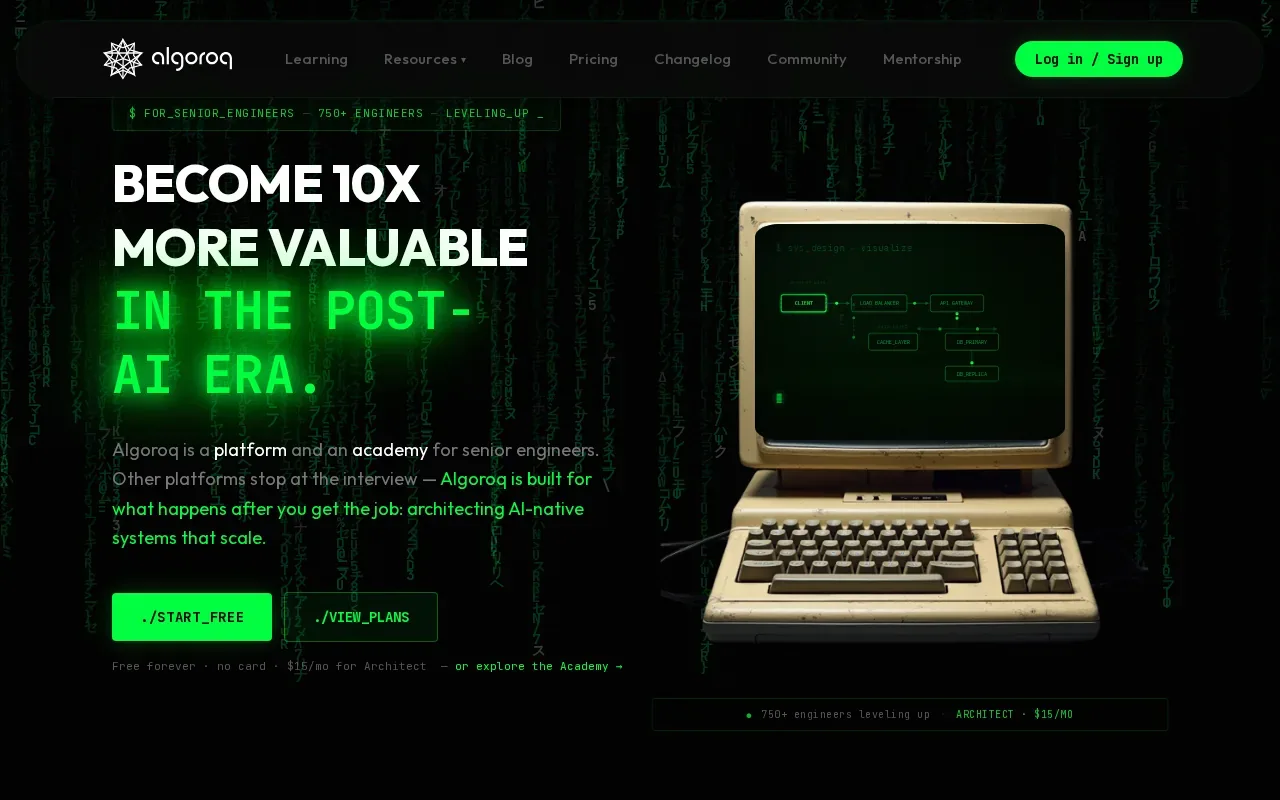
Assignments and feedback give participants a reason to make and defend design choices between live sessions. That can be useful when preparing for senior interviews, where an interviewer may ask you to compare several viable architectures.
Topics include system design fundamentals and distributed systems, along with AI-native architecture such as RAG and LLM serving. Security is also part of the coverage. In an interview, these areas can lead to questions about data flow, failure paths, access control, and how you observe a service once it’s running.
The live format has a fixed 12-week schedule, so it’s best suited to a longer preparation window. The program is aimed at experienced engineers, not someone seeking only a quick introduction. If your interview is soon, check whether the cohort timing matches your deadline before committing to a scheduled format.
Compare the five system design interview courses
Start with the way you want to learn, then check how the course helps you test what you’ve learned. Course listings can mention AI without offering interactive interview practice, so check what a feature does before treating it as mock interview feedback.
| Option | Best fit | Practice style | Listed price |
|---|---|---|---|
| ByteByteGo | Visual learners reviewing broad concepts | Self-paced visual explainers | Yearly or lifetime access |
| System Design School | Learners who want a roadmap and exercises | Docker codelabs and step feedback | Free, $45/year, or $99 lifetime |
| Hello Interview | People who want guided questions and an AI tutor | 66 guided problems, including 45 system design | $47/month, $89/year, or $299 lifetime |
| DesignGurus | Pattern-focused preparation | Pattern-based lessons and questions | Roadmap, monthly, annual, or lifetime plans |
| Algoroq | Senior engineers who want live instruction | Assignments, masterclasses, and AMA sessions | Free to $15/month platform; $799 lifetime cohort course |
For any course, judge the practice by whether it makes you explain trade-offs, not just recognize terms. A complete answer should cover functional needs and non-functional needs such as latency, reliability, and availability. Then move through API design, a high-level diagram, and a deeper look at the components that carry the main risk.
For example, a global photo service could use a CDN for image delivery, a cache for repeated reads, and replicated storage for availability. If writes arrive in bursts, a queue can let background workers process them. Sharding may help when one database can’t keep up, but it adds complexity. Rate limits and idempotency keys can help protect APIs from excess traffic and duplicate requests.
API choices should follow the clients and data needs. REST is a common fit for resource-based web APIs; GraphQL can fit clients that need flexible queries; gRPC can suit service-to-service calls. Say how you’ll keep changes backward compatible, and explain whether a binary format such as Protocol Buffers fits the service boundary. For multi-region designs, discuss data locality and consistency. For operations, explain which metrics and traces would alert the team to rising latency. OpenTelemetry can help collect telemetry such as traces, metrics, and logs.
If you’re deciding between a course and a separate practice tool, Phantom Code AI is aimed at real-time interview guidance, while the five picks above focus on learning or course-based rehearsal. For more options built around rehearsal, see these system design practice platforms for interviews.
Frequently asked questions
What should a system design interview course teach?
A useful course should teach you to clarify requirements, shape an API, draw a high-level design, and explain trade-offs. It should also help you reason about scaling, reliability, latency, and availability. Look for practice that asks you to apply those ideas to a prompt, because knowing what a cache does is different from choosing where it belongs.
Which system design course is best for beginners?
System Design School or Hello Interview may suit beginners who want a path through core ideas and practice. System Design School has a study roadmap and lessons; Hello Interview covers foundations before guided problems. Start with basic components such as databases, caches, and load balancers, then attempt a simple design before reading a solution.
Are AI features in a course the same as a mock interview?
No. An AI feature might mean a tutor, step-by-step feedback, or a full mock interview. Check what the feature actually does and whether it responds to your design choices. If you need spoken practice, rehearse with a peer or use a tool built for mock interviews rather than assuming every AI label means live interview simulation.
How do I prepare if my interview is close?
Choose a course whose format you can use right away, then focus on a few common designs instead of trying to finish every lesson. Practice requirements, APIs, a basic diagram, and one or two deep dives under a timer. End each attempt by summarizing your main choices and the trade-offs you accepted.
Conclusion
Choose ByteByteGo for visual explanations, Hello Interview for guided practice, or Algoroq for scheduled cohort learning at a senior level. Pick one course and complete a timed design this week. If you also want separate real-time interview guidance, Phantom Code AI is an option to assess alongside your course plan.