Best Software Engineer Interview Coaching Options

Compare software engineer interview coaching options for coding, system design, and behavioral prep, from live human mocks to AI-guided practice.
Software engineer interview coaching can mean a live mock, a longer coached program, or feedback from an AI tool. The right fit depends on what you need to improve and how you want to practice.
We analyzed 54 comments and questions from YouTube and Quora about software engineer interview coaching and found that 24% mentioned lack of confidence before interviews.
Here are six named options, with their formats, costs where available, and the kind of prep each supports. Phantom Code AI is another option for engineers who want live AI guidance while they work through an interview question.
Table of Contents
- interviewing.io: Live practice with real technical interviewers
- IGotAnOffer: Real-interviewer mocks with written feedback
- Formation: A multi-week coached program for sustained preparation
- InterviewFocus: Adaptive video mocks with AI scoring
- Hello Interview: AI-guided practice through a question bank
- Big Interview: Structured practice for behavioral answers
- Frequently Asked Questions About Software Engineer Interview Coaching
- Conclusion
1. interviewing.io: Live practice with real technical interviewers
interviewing.io provides anonymous live mock interviews with senior engineers, followed by a rundown of your strengths and areas to improve. It’s best for engineers who want a person to watch how they solve a problem and point out what to work on after the session.
A live mock gives you a chance to practice the parts that are hard to recreate alone. For a coding round, you can talk through a data structure choice, explain the time complexity, and respond to follow-up questions while someone listens. The feedback comes after the session, so you can use them to plan your next practice round.
You pay per session, so check interviewing.io for the current rate. That makes this a focused option for someone who wants a human mock rather than a multi-week program. You might use one session to test your baseline, then work on the specific feedback before booking another.
It’s also useful to compare human-led practice with tools that give guidance during practice or a live interview. Phantom Code AI is built for that different use case: it listens, transcribes, recognizes problem types, and provides real-time guidance. The two formats solve different problems, so choose based on when you need feedback.
2. IGotAnOffer: Real-interviewer mocks with written feedback
IGotAnOffer sells one-hour mock interviews with a real interviewer and written feedback after the session. It’s best for candidates who want to rehearse with a person and leave with specific notes for their next attempt.
The one-hour format can help you test a full answer, not just its technical content. For instance, during a system design mock, you can practice clarifying requirements before proposing a design. In a behavioral mock, you can notice whether your story answers the question or gets lost in background details.
The rate depends on the coach you book, so check it before you weigh a paid mock against independent practice. A human session is most useful when you arrive with a clear goal, such as checking whether you explain trade-offs well or whether your example makes your own role clear.
Written feedback arrives after the session, rather than as live AI guidance while you answer. That’s a useful distinction: post-session notes help shape your next practice, while live feedback can help you adjust in the moment. If you’re preparing behavioral answers, build a small story bank first. Include an example of a disagreement, a mistake, and a technical choice you had to explain.
Keep your stories concise. A strong answer gives enough context to make the problem clear, then spends most of its time on what you did and what happened. If you want a separate refresher on answer structure, review STAR and engineering examples.
3. Formation: A multi-week coached program for sustained preparation
Formation is a multi-week coached program with adaptive daily drills, live mocks, and mentorship. It’s best for engineers who want structured preparation over time, especially when they’re targeting mid-level, senior, or staff roles.
The program covers 16 interview types, including data structures and algorithms, system design, AI-assisted coding, and behavioral interviews. Formation pairs members with senior and staff-level engineers, tech leads, and hiring managers for mocks and mentorship. That breadth can suit someone who needs more than a single practice session.
Formation’s cost is a major factor in the choice. Its Fellowship is $5,000 down, then a portion of your salary gain once you land a role. It also lists a $2,500-a-month membership and a $299 one-time diagnostic mock. Review the terms carefully and compare the commitment with the time and range of coaching you expect to use.
Formation makes more sense when you have time for a sustained program and want support across several kinds of interviews. A single technical weakness may call for targeted practice instead. For example, if you can solve coding problems but struggle to explain a system’s failure modes, focus your sessions on design trade-offs and follow-up questions.
Before signing up for a longer program, check that its structure fits your schedule and the roles you’re pursuing. A coaching plan only helps if you can make room for the work between sessions.
4. InterviewFocus: Adaptive video mocks with AI scoring
InterviewFocus runs realistic video mock interviews that adapt to your target role. It uses AI to score answer content and delivery, then gives a post-session performance summary. It’s best for software engineers who want feedback on both what they say and how they say it.
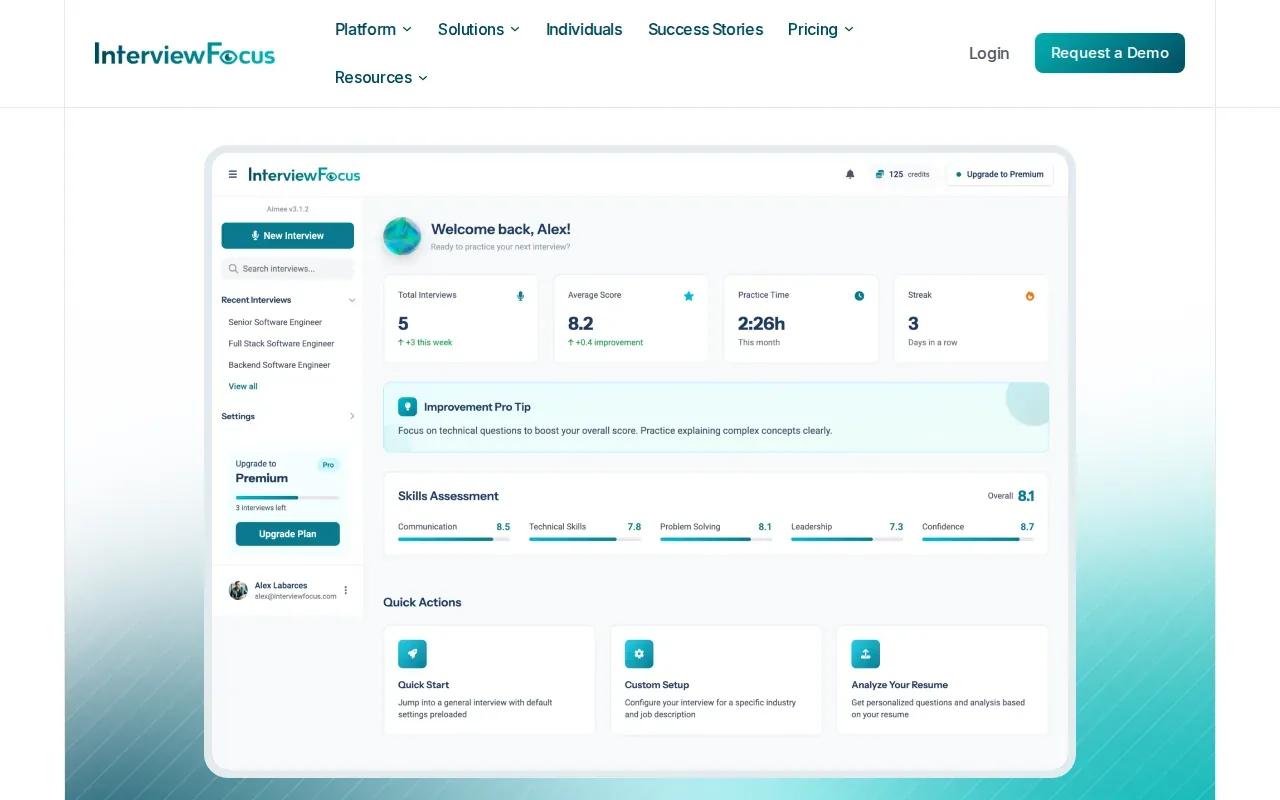
That split can matter in a technical interview. A candidate may reach a sound solution but explain it in a scattered way. Or they may speak clearly while missing a key edge case. Content and delivery scoring can give you two separate areas to review instead of treating the session as one overall result.
Use a video mock to rehearse speaking while you think. For a DSA question, explain why a hash map fits before you start coding, then state the expected time complexity. For a behavioral prompt, keep the story tied to the question and make your own actions clear. The post-session summary gives you a record to work from in the next practice round.
InterviewFocus is centered on video mocks and post-session scoring. That differs from Phantom Code AI’s live guidance during an interview, which is designed to listen and respond as the conversation unfolds. Think about the timing of the feedback you need: after the attempt, or while you’re working through it.
For engineers who want to review speaking habits alongside answer quality, a video format can make the practice feel closer to a spoken interview than silent problem drills.
5. Hello Interview: AI-guided practice through a question bank
Hello Interview provides an AI-guided question bank and a premium content subscription for system design, coding, and behavioral prep. It’s best for engineers who want self-paced practice across those areas, with AI mock interviews and a written report.
A question bank is useful when you need repeatable practice. You can work through a coding prompt, then move to system design or behavioral questions without relying on a single live session. The written report gives you feedback to review once you finish the mock.
The listed prices are $47 for a month, $89 for a year, or $299 for lifetime access. The choice depends on how long you expect to prepare. A monthly plan may suit a short interview sprint, while a longer access period may fit a job search with no firm end date.
Set a purpose for each practice session. One day, focus on explaining a coding approach before writing code. Another day, sketch a system design and explain one trade-off. For behavioral practice, answer aloud and check that the story includes your role and the result, rather than only describing the team’s work.
Hello Interview is a self-guided option with AI practice and written feedback. If you need a human interviewer to challenge an answer in real time, a live mock may fit better. If you want in-the-moment AI guidance, consider whether Phantom Code AI’s format matches your needs.
6. Big Interview: Structured practice for behavioral answers
Big Interview wraps a structured training curriculum around practice interviews, with a focus on behavioral questions. It’s best for engineers who need a clear way to prepare stories and improve how they deliver them.
Behavioral rounds can test how you communicate about technical work, not only how you solve a coding problem. Prepare examples that show how you handled a disagreement, learned from a mistake, or explained a design choice. Keep the context short, then focus on your actions and the outcome.
Use a simple story structure such as STAR: situation, task, action, and result. For example, a story about changing a deployment process should make clear what risk you saw, what change you proposed, and what happened after the team adopted it. Don’t assume every interviewer knows the details of your tools. Explain the technical point in plain terms.
| What you need | How Big Interview fits | How to use it |
|---|---|---|
| Behavioral answer structure | Curriculum plus practice interviews | Rehearse concise stories tied to the question. |
| Technical problem-solving | Its focus is behavioral practice. | Pair it with coding practice that fits your interview needs. |
| Feedback after practice | Structured practice interviews | Review your answers and refine the next attempt. |
Use Big Interview to build a consistent routine for behavioral answers. It can sit alongside technical practice, so you don’t leave communication prep until the day before an interview.
Frequently Asked Questions About Software Engineer Interview Coaching
How much does software engineer interview coaching cost?
Costs run from a single paid mock, priced per session at services such as interviewing.io and IGotAnOffer, to much higher totals for a longer program. Formation lists a $2,500-a-month membership, or a $5,000 Fellowship down payment plus a portion of your salary gain after placement. Check the structure as well as the price before deciding.
Is a human mock interview better than AI practice?
A human mock is useful when you want an interviewer to observe your approach and give written feedback afterward. AI practice can make it easier to repeat questions and review reports. The better fit depends on your gap: choose human feedback for a live outside view, or AI practice for repeated self-guided work.
How should software engineers prepare for coding interviews?
Review core data structures and Big O, then practice recognizing patterns instead of memorizing answers. During a mock, explain your approach before coding. Test an edge case and state the time and space costs. Afterward, pick one weakness, such as graph traversal or unclear reasoning, and make that the focus of your next session.
How do I prepare for behavioral interviews as a software engineer?
Build a bank of work stories that cover conflict, failure, collaboration, and technical decisions. Shape each answer with STAR, keeping the setup brief and giving most of the time to your actions. Practice aloud, then check that your story answers the prompt and makes your role easy to understand.
Can I use AI during a live software engineering interview?
Rules depend on the employer and the interview format, so ask what tools are allowed before using any assistance. Phantom Code AI is a real-time AI interview assistant for coding interviews. Use any tool only when the interviewer or company permits it, and don’t present outside help as your unaided work.
Conclusion
Choose the format that matches your biggest gap: a live human mock for interviewer feedback, a coached program for sustained support, or AI practice for repeatable drills. If you need guidance during interview work, review Phantom Code AI’s interview preparation tool and check your target company’s rules before using live assistance.