Mastering the Amazon Software Engineer Interview: Questions, Process, and Expert Tips for Preparation
Organise Amazon interview preparation around real examples, leadership principles and thoughtful follow-up questions without memorising scripts.
TL;DR
- Confirm the role and interview stages with your recruiter before choosing a preparation plan.
- Study Amazon's official Leadership Principles and connect relevant ones to real decisions you have made.
- Use STAR to explain your responsibility, actions and outcomes without inventing metrics.
- Practise follow-up questions about tradeoffs, mistakes and lessons, not just the opening answer.
Introduction
As one of the world’s leading tech giants, Amazon is known for its high standards and difficult hiring process. In this article, we’ll be showing you what to expect during a software engineer interview at Amazon and what you should do to prepare.

Just like Meta, Amazon is a dream destination for many software engineers. Thorough preparation is essential, starting with familiarising yourself with Amazon’s Leadership Principles (LPs). We’ll be discussing those, as well as the process, commonly asked questions, and our tips.
Table of Contents
- The Amazon Interview Process and Timeline
- Common Amazon Software Engineer Interview Questions
- Mistakes to Avoid During Amazon’s Interviews
- What Happens After the Amazon Interview?
- FAQ
- Conclusion
The Amazon Interview Process and Timeline
Confirm your sequence of assessments and interviews with the recruiting team. Your role may include an online assessment, a technical conversation, and an interview loop; the invitation should specify the sessions, time limits, and tools. Do not plan around a universal number of rounds or hours.
Online Assessment or Recruiter Screen
Read the invitation to see whether you have an online assessment, a recruiter conversation, or both. Prior employment at another company does not establish a general exemption; ask which steps apply to your application.
For an online assessment, follow the instructions about topics, platform, time limit, and permitted resources. Practise relevant coding or role-specific exercises without assuming a particular provider, difficulty label, or set of multiple-choice questions.
A recruiter conversation is an opportunity to explain relevant experience and clarify the role, location, process, and compensation information. Prepare accurate answers and ask for details you need to assess the opportunity.
Technical Phone Screen
If a technical screen is included, confirm the coding environment and whether you can execute code. Practise explaining an approach, implementing it clearly, and checking examples; do not assume every interview uses the same internal tool.
Practise problems across the topics confirmed for your role, and learn to adapt when a constraint changes. The number of questions, their difficulty, and the time available come from the specific assessment instructions.
Prepare relevant examples for behavioral questions as well as technical work. Ask the recruiter how those topics are organized in your schedule.
Onsite Interview
Amazon describes an interview loop in which individual interviewers assess different aspects of a candidate’s experience. Confirm your own schedule. Depending on the role, preparation may include:
- Behavioral examples and decisions
- Coding and algorithm work
- System design or other role-specific technical work
- Discussion of the role and team
- Amazon describes Bar Raisers as interviewers trained around its Leadership Principles. Treat each conversation as an opportunity to explain your experience; this guide does not claim a private veto rule or identify one session as the only decisive round.
Prepare for follow-up questions. The following practice habits help make your examples clear:
- Go beyond your resume: Tell them something that they can’t learn from your resume.
- Familiarise yourself with Amazon’s Leadership Principles: the 16 leadership principles are key for working at Amazon. Build your stories around them.
- Practice, practice, practice: Try out mock interviews or find someone to practice interviews with and record yourself answering questions. Don’t be afraid of feedback.
- Learn from your mistakes: be self-critical and demonstrate what you’ve learnt from failure. Mention how it impacted you or how it changed your approach to work.
- Show your value: Give out examples that show your added value, but also end your response with a result.
- Ask questions: let the interview be more of a conversation as opposed to an interrogation. Ask questions you want to know the answers to.
- Show your personality but stay professional: don’t overshare, but be yourself.
Common Amazon Software Engineer Interview Questions
Coding Questions Use the recruiter’s instructions to establish where coding and behavioral discussions appear in the schedule. Practise explaining the solution, testing it, and responding to follow-up constraints.
Do not rely on a promise of medium-only problems. Start with the skills required by the role and practise reasoning through unfamiliar problems rather than memorizing a difficulty label.
During a timed practice session, reserve time to clarify the prompt and check the implementation. Adjust your pace to the actual assessment rather than assuming a fixed number of questions.
During the coding round Amazon tests mainly computer science fundamentals and knowledge of data structures and algorithms and the candidate's ability to write logical and maintainable code.
Readable names, edge cases, testing, complexity, and a clear explanation all support a sound solution. If execution is unavailable, walk through representative inputs by hand; speed should not replace correctness.
Useful coding practice topics include:
- Graph questions
- Tree questions that require BFS or DFS
- Classic questions like LRU cache, word break, meeting rooms and word ladders
System Design Questions If system design is part of your schedule, practise clarifying requirements, comparing alternatives, and explaining failure behavior. Confirm how much time is available and which tools to use.
For an open-ended design exercise, start with the requirements and constraints. If you get stuck, return to the workload, data flow, reliability needs, and bottlenecks rather than adding components without a reason.
Original system design practice prompts include:
- Design autocomplete
- Design file upload/download to the cloud
- Design search
The examples above are practice topics, not a verified Amazon question bank. For each, explain the scope, data model, API, scaling assumptions, and tradeoffs; then test how the design behaves when a dependency fails.
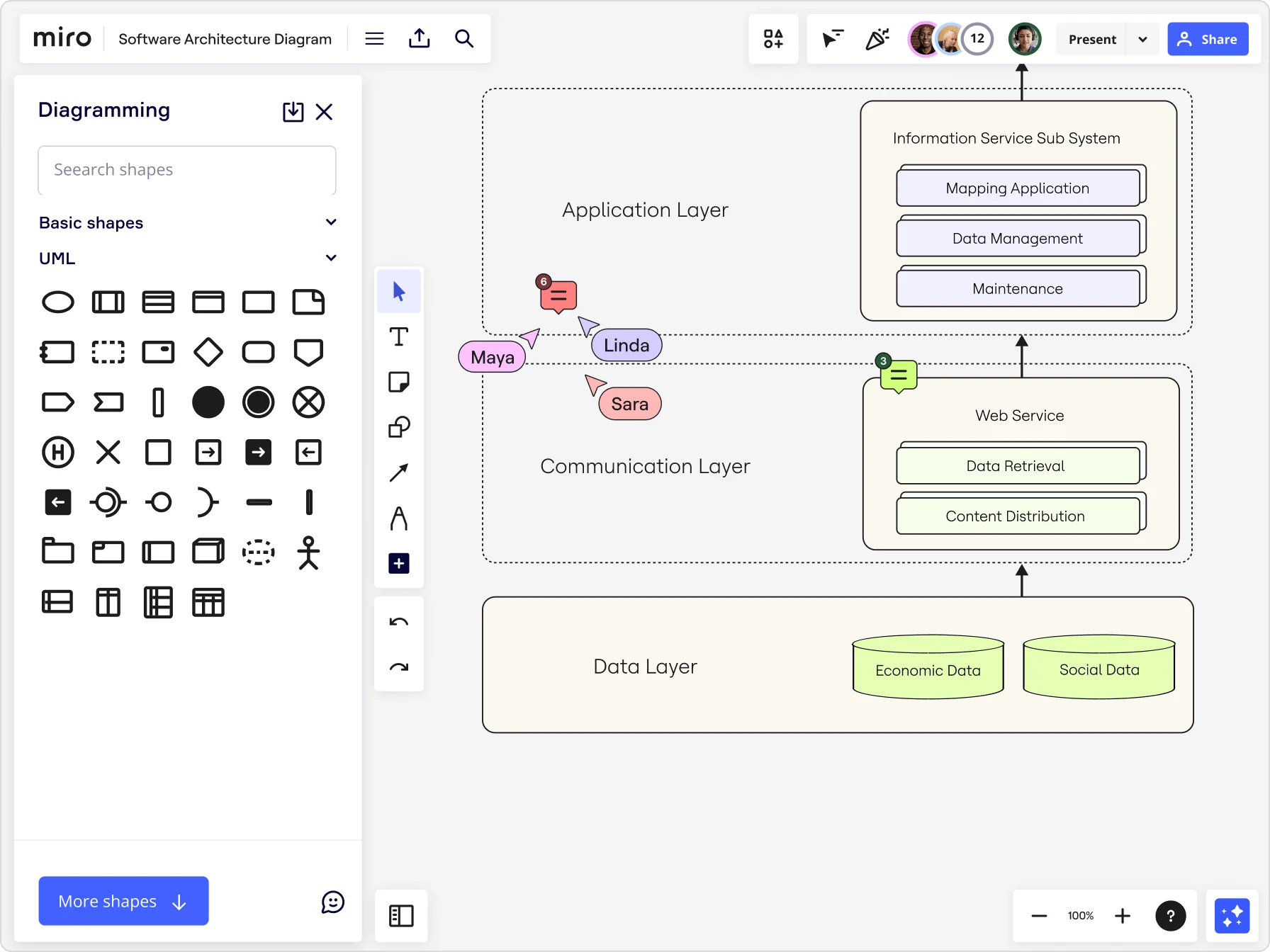
Confirm the permitted drawing tool before the interview. For personal practice, options include Excalidraw or Miro.
Behavioral Questions and Leadership Principles
Prepare behavioral evidence alongside the technical topics required for the role. A story about a real decision helps explain how you worked, but no behavioral answer guarantees that it will offset a technical assessment. Use relevant experience from work or other contexts permitted by the employer.
Each interviewer has their own way of determining whether you as a candidate are a good fit.
Useful themes for a practice story bank include:
- Technical problem solving
- Learning (and failure)
- Getting stuff (for the business) done
- Interpersonal conflict
- Ambiguity
Amazon publishes 16 Leadership Principles. Read the current definitions directly, then use the following original practice prompts to explore relevant experiences. These are not confirmed interview questions, and a prompt can relate to more than one principle.
1. Customer Obsession - Tell me about a time when you disagreed with your manager or peer on something you considered very important to the business. - Tell me about a time when you overcommitted yourself or your company.
2. Invent and Simplify - Tell me about a time when you didn't meet customer's needs. - Give me an example of a difficult problem you solved with a simple solution.
3. Learn and Be Curious - Give an example of something that you’ve worked on the improve your overall work effectiveness.
4. Insist on the Highest Standards - Tell me about a time when you had to work with a difficult customer or user. - Tell me about a time when you used external trends to improve your own company's products or services.
5. Deliver Results - Tell me about a time where you had to take on more responsibility over a project. - Tell me about a decision ou had to make without clear benchmarks.
6. Strive to be Earth’s Best Employer
7. Dive Deep - Tell me about a time when you had to communicate a change of direction that you thought people would have concerns with. - Tell me about a time where you were put onto a project where you had no experience in.
8. Have Backbone; Disagree and Commit - Give me an example of a time you committed to a group decision even though you disagreed. - Tell me about a time where you disagreed with a coworker or manager because you thought the decision they wanted to make was wrong for the customer.
9. Success and Scale Bring Broad Responsibility
10. Ownership - Describe a time when you took on work outside of your comfort area. - Describe a situation where you made an important decision without consulting your manager.
11. Are Right, A Lot - Tell me about a time when you did not effectively manage your projects and something did not get completed on time. - Tell me about a time you wouldn't compromise on achieving an outcome when others felt something was good enough.
12. Hire and Develop the Best - Tell me about a time when you received negative feedback. - Describe a time when you improved morale and productivity on your team.
13. Think Big - Give an example of an idea you had that proved really difficult to implement. - Tell me about a time where you encouraged someone to take a risk.
14. Bias for Action - Tell me about a calculated risk you’ve taken where speed was critical. - Tell me about a time where you were the first one to take action.
15. Frugality - Tell me about a time where you pushed back on a deadline. - Tell me about a time where you helped save costs within your role.
16. Earn Trust - Tell me about a time where you had a disagreement with a colleague.
Mistakes to Avoid During Amazon’s Interviews
Avoid these mistakes to increase your chances of acing Amazon's interview process and standing out as a strong candidate.
1. Neglecting Amazon’s Leadership Principles
Many candidates focus only on technical skills and overlook behavioral questions. As mentioned before, Amazon highly prioritises its Leadership Principles, and failing to prepare examples that demonstrate these principles won’t work in your favor. Our Amazon Leadership Principles deep dive offers reflection prompts for each principle to help you find those examples in your own engineering work.
2. Rushing Through Problem-Solving
Jumping straight to coding without clearly explaining your thought process can be detrimental. Interviewers are as interested in how you approach problems as they are in the final solution. Take your time to outline your approach before coding.
3. Underpreparing for System Design Questions
For senior or experienced roles, system design questions are critical. A vague or unscalable design can signal a lack of depth in architectural thinking. Practice designing systems with scalability, fault tolerance, and efficiency in mind.
4. Failing to Communicate Effectively
Explain the assumptions and decisions that matter, and ask clarifying questions when needed. This gives the interviewer a clearer view of your reasoning and communication.
5. Ignoring the Importance of Mock Interviews
Overconfidence can lead to underestimating the value of practice. Skipping mock interviews or real-time problem-solving sessions can leave you unprepared for the actual interview dynamics.
What Happens After the Amazon Interview?
Before the conversation ends, confirm when and how you should expect an update. Follow up politely after the agreed date if you have not heard back; the response time for a particular application is not guaranteed by a generic timeline.
Frequently Asked Questions
1. What are the main stages of Amazon's software engineer interview process?
The recruiting team should confirm whether your application includes an assessment, technical screen, and interview loop, and which topics each covers. Use that schedule rather than assuming a fixed number or duration of sessions.
2. What types of coding questions should I expect during Amazon’s technical interviews?
Use the assessment instructions to guide practice. Graph traversal, trees, caching, scheduling, and string problems can develop useful algorithmic reasoning, but this list does not predict the exact questions or difficulty.
3. How should I prepare for the behavioral interview at Amazon?
Prepare stories that highlight your skills and align with Amazon’s 16 Leadership Principles. Use the STAR (Situation, Task, Action, Result) method to structure your responses and practice explaining how your experiences demonstrate customer obsession, ownership, and other key principles.
4. What system design topics are commonly covered in Amazon interviews?
When design is included in the role’s assessment, practise requirements, data flow, scaling, reliability, and tradeoffs. Autocomplete, file transfer, and search are original practice prompts rather than guaranteed Amazon questions.
5. How long does it take to hear back from Amazon after the interview?
Ask the recruiting team for the expected update date and follow-up channel. Timing varies; a five-to-ten-business-day response is not promised here.
Start with Amazon's own process guidance
Amazon describes an interview loop in which candidates meet individual employees who assess different aspects of their experience. Its official interview-loop page identifies behavioural questions, Leadership Principles and STAR among its preparation topics. Your specific process can still depend on the role and instructions from recruiting.
Do not assume every vacancy involves the same technical rounds or the same number of conversations. Write down what has been confirmed, what materials are required and which stages remain unclear. Ask the recruiter to resolve the practical gaps.
Online lists labelled “Amazon interview questions” can help suggest practice themes, but they do not establish the questions you will receive. The examples here are original exercises for preparation, not a leaked question bank.
Connect principles to decisions you can explain
Amazon's explanation of its Leadership Principles provides the company's own context. Read it directly, then look for experiences where you made a meaningful choice. Simply attaching a principle's name to a story does not explain your judgement.
For example, a customer-focused story might involve identifying why customers repeatedly misunderstood a feature. An ownership story might involve following a problem across a handoff rather than considering it finished when your individual task ended. Choose the experience because it contains evidence, not because it lets you mention a slogan.
Use a preparation sheet with the decision in the first column and supporting detail beside it. This keeps the focus on what happened rather than on memorising labels.
Build a flexible story bank
Prepare several examples that cover different kinds of work. Include a success, a disagreement, a mistake, a difficult deadline and a time you investigated an uncertain problem. One experience may support several themes, but avoid answering every question with the same story.
| Story | Detail to gather | Question to ask yourself |
|---|---|---|
| Customer issue | Evidence that revealed the real problem | How did I distinguish a symptom from a cause? |
| Deadline | Constraints and prioritisation | What did I deliberately postpone? |
| Disagreement | Competing reasons and the decision process | What evidence changed the discussion? |
| Mistake | Consequence and correction | What would I detect earlier next time? |
Use your own records where appropriate, but do not bring confidential employer material into an interview. You can explain an approach without exposing customer identities, private code or sensitive business data.
An original example of an evidence-based answer
Imagine a fictional operations analyst who notices repeated stock discrepancies. A useful answer could explain that they compared a sample of physical counts with records, discovered that returns were being entered at different stages and proposed a shared check before the weekly report.
The important details are the analyst's responsibility, how they tested the explanation and what changed afterwards. “I fixed inventory accuracy” is too broad. “I checked twelve discrepancies, found a common return-processing issue and worked with the warehouse lead to change the handoff” makes the contribution understandable.
If the team did not measure a long-term percentage improvement, the candidate should say so. A documented process change and fewer discrepancies in a later sample can be described accurately without presenting a guess as a company-wide result.
Practise the second and third question
After your first answer, a practice partner should ask why you chose that approach, what alternatives you considered and how you knew it worked. Ask them to challenge an assumption or change a constraint.
For the inventory example, useful follow-ups include: What if the sample was unrepresentative? Who disagreed with the proposed change? What would happen during a busy period? Which part could be automated, and which still needed judgement? These are our practice prompts, not predictions about Amazon's assessment.
The goal is to become comfortable discussing the experience from several angles. Memorising a perfect two-minute answer can leave you less prepared for a simple request to explain one decision in more detail.
Finish preparation with logistics and questions
Confirm the time zone, location or meeting link, required tools and backup contact. Prepare questions about the role's priorities, team collaboration and how success is evaluated. Use information from earlier conversations to make the questions specific.
For a general structure you can apply to your examples, read our STAR interview method guide. If you practise with PhantomCodeAI, keep answers grounded in your actual experience and follow the employer's rules during any live assessment.
Related reading: Googleyness Interview Questions: Practise Collaboration and Judgment.
Conclusion
Landing a software engineering role at Amazon requires thorough preparation, technical expertise, and a strong understanding of the company’s unique culture and Leadership Principles. By familiarizing yourself with Amazon’s Leadership Principles, practicing data structure and algorithm problems, and keeping your system design skillsup to date, you can improve your chances of success. Don’t overlook the importance of the behavioral interview, as it plays a significant role in the hiring decision.
Throughout the process, focus on clear communication, thoughtful problem-solving, and showcasing your ability to add value to Amazon's fast-paced environment. Avoid common pitfalls like neglecting leadership principles, underpreparing for system design, and skipping mock interviews.
Review the confirmed format, practise clear technical explanations, and use accurate examples. PhantomCodeAI can support preparation; follow the employer’s rules about assistance during an assessment.
Frequently asked questions
What are the stages of Amazon's software engineer interview process?
Confirm the sequence and timing with your recruiting contact. An assessment, technical conversation, and interview loop may require different preparation, but there is no universal three-stage or four-hour schedule assumed in this guide.
How important are the Amazon Leadership Principles in a software engineer interview?
Amazon publishes 16 Leadership Principles and includes them in its interview preparation material. Choose relevant examples and explain your own decisions; there is no requirement here to name two principles in every answer or a claim about private scoring weights.
What kind of coding questions does Amazon ask in technical rounds?
Practise the topics specified for the role. Data structures, algorithms, complexity, and testing are useful foundations; the examples in this guide are practice material, not a prediction of the interview questions.
What is a Bar Raiser interview at Amazon?
Amazon describes Bar Raisers as interviewers trained in its Leadership Principles. Prepare clear, truthful examples for all interviewers. This guide does not assert a private veto process or label one round as more decisive than all others.
How long should I prepare for an Amazon software engineer interview?
Assess your current skills against the role and the confirmed interview topics, then use the available time on the largest gaps. There is no universal six-to-twelve-week requirement or fixed percentage split between coding, design, and behavioral practice.