How to Practice Interview Follow-Up Questions

Learn how to practice interview follow-up questions during mocks with technical, behavioral, and system design drills, feedback, and realistic prompts.
Strong interview practice isn't only about giving polished answers. The better test is what happens when someone asks, “Why did you choose that approach?” or “What would you change?” Follow-up questions turn a rehearsed answer into a real conversation. Use the steps below to practice them during coding, system design, and behavioral mocks.
We read the 6 top-ranking guides on practicing interview follow-up questions, checking each for five elements. Only 1 of 6 tailored follow-ups separately across coding, system design, and behavioral interviews. Only 1 of 6 named a specific pause length, and only 1 of 6 repeated a drill with progressively harder variations. Three of the 6 covered timed mock setup and three covered transcript review, but none combined all five elements in one guide.
Table of Contents
- Step 1: Set Up a Realistic Mock Interview
- Step 2: Build Follow-Up Questions Around the Interview Type
- Step 3: Practice Answering Without Losing Your Reasoning Thread
- Step 4: Add Pauses, Probes, and Unexpected Follow-Ups
- Step 5: Use Transcripts and Feedback to Review Each Follow-Up
- Step 6: Repeat the Drill With Harder Variations
- FAQ
- Conclusion
Step 1: Set Up a Realistic Mock Interview
The first step in learning how to practice interview follow-up questions during mocks is to make the session feel like an actual interview. A casual chat with a friend can help, but a timed session with clear roles will show you where your thinking breaks down.
Pick one interview type before you start. For a coding round, give the interviewer a problem without explaining your planned solution. For system design, share only the prompt. For a behavioral round, ask for a story about conflict, failure, ownership, or a difficult technical choice.
Ask your mock interviewer to avoid rescuing you. Their job is to listen for gaps and probe them.
Follow a full mock loop: find a partner, run the session at full length, say your questions out loud, then review what happened. If you practice alone, record your voice and act as both people.
Set a firm end time. A 45-minute coding mock might include five minutes for the prompt, 30 minutes for solving, and 10 minutes for feedback. Don't pause the clock each time you feel stuck. That discomfort is part of the drill.
Phantom Code AI can help when you need a repeatable solo setup. Its desktop assistant listens, transcribes, recognizes problem types, and gives guidance during mock technical interviews. Use it to review the moment a follow-up question changed your plan, not to replace your own thinking.
Step 2: Build Follow-Up Questions Around the Interview Type
Follow-up practice works best when the questions match the kind of interview you're preparing for. A coding interviewer probes your assumptions. A system design interviewer tests tradeoffs. A behavioral interviewer asks for proof behind your story.
For coding interviews
Start with the question itself. Then write follow-ups that test your reasoning at each stage:
- Use open-ended prompts that begin with why, how, what, or how much.
- Ask for explanations rather than yes-or-no answers.
Don't write ten questions for one problem. Choose three. One should test correctness. One should test complexity. The last should force a change in constraints.
For system design interviews
Build questions around scope before technology. Ask what the service must do, who uses it, and what failure looks like. Then probe scale, storage, consistency, caching, or recovery. During a mock system design interview with adversarial follow-ups, the interviewer might probe the rationale for a design choice. If your answer only names a tool, explain the tradeoff and the cost.
For behavioral interviews
Use the STAR structure as a frame. State the situation briefly. Explain the task. Spend most of the answer on your action. Close with the result and what you learned. You can review the Behavioral Interview Questions at FAANG: STAR Method Deep Dive when you need more practice with that shape.
Prepare follow-ups for the weak spots in your story. If you say a project improved reliability, expect “By how much?” If you say the team disagreed, be ready to explain the situation and your response. Avoid inventing numbers. Say what you measured, or explain that you didn't have a clean measure.
The best question bank is tied to your own answers. Read each answer once, circle every broad claim, and write one probe beside it.
Step 3: Practice Answering Without Losing Your Reasoning Thread
When you practice interview follow-up questions during mocks, your goal isn't to answer fast. Your goal is to keep a clear reasoning thread after the question changes direction.
Use a short reset when you need one. This gives you a moment to think while showing the interviewer how your model is changing.
For coding problems, speak in a fixed order:
- State the current assumption.
- Explain the effect of the new question.
- Change the plan or defend it.
- Recheck the cost and edge cases.
Imagine you're solving a sliding-window problem. The interviewer asks what happens with repeated values. Don't jump straight to code. Say what the window represents, explain why the current invariant still holds or fails, then adjust the data you track.
For system design, keep a visible decision log. If you choose a queue, state why. If the interviewer adds a low-latency requirement, revisit that choice. The answer may stay the same, but you should show that you tested it against the new constraint.
Behavioral answers need the same discipline. If a follow-up asks what you personally did, move away from “we.” Name your action. If it asks what went wrong, don't restart the whole story. Point to the moment that matters and explain your response.
Phantom Code AI can transcribe a session while you speak through a solution. Review the transcript for places where you stopped naming assumptions. Those gaps often explain why a follow-up feels harder than the original question.
Step 4: Add Pauses, Probes, and Unexpected Follow-Ups
Good follow-up practice includes silence. Ask a question, then wait. Use a deliberate pause of about five seconds, along with open-ended starters and exact notes of useful quotes. These habits keep the drill close to a real interview.
Start with “why,” “how,” or “what” when you want a full answer. “Did you test this?” invites yes or no. “How did you test this?” asks for a process. “What did the test show?” asks for evidence.
Ask the interviewer to use silence on purpose. After you answer, they should pause before adding another prompt. Many candidates fill that gap by talking past the point. If you keep adding detail, the interviewer may probe the least useful part of your answer.
Next, add a few surprise changes. In a coding mock, change the input size or ask for a streaming version. In system design, add a region outage or a second write path. In a behavioral round, ask what a manager disagreed with or what the candidate would do differently now.
Keep a verbatim note of one phrase that deserves a closer look. This makes the drill feel less like a list of prepared questions.
Don't make every follow-up adversarial. The point is to test whether you can stay precise when the path shifts. A fair question can still expose a weak assumption.
Try this three-round pattern:
- Round one checks the claim.
- Round two changes a constraint.
- Round three asks what you learned.
Stop if the questions become random. A hard follow-up should connect to something you said.
Step 5: Use Transcripts and Feedback to Review Each Follow-Up
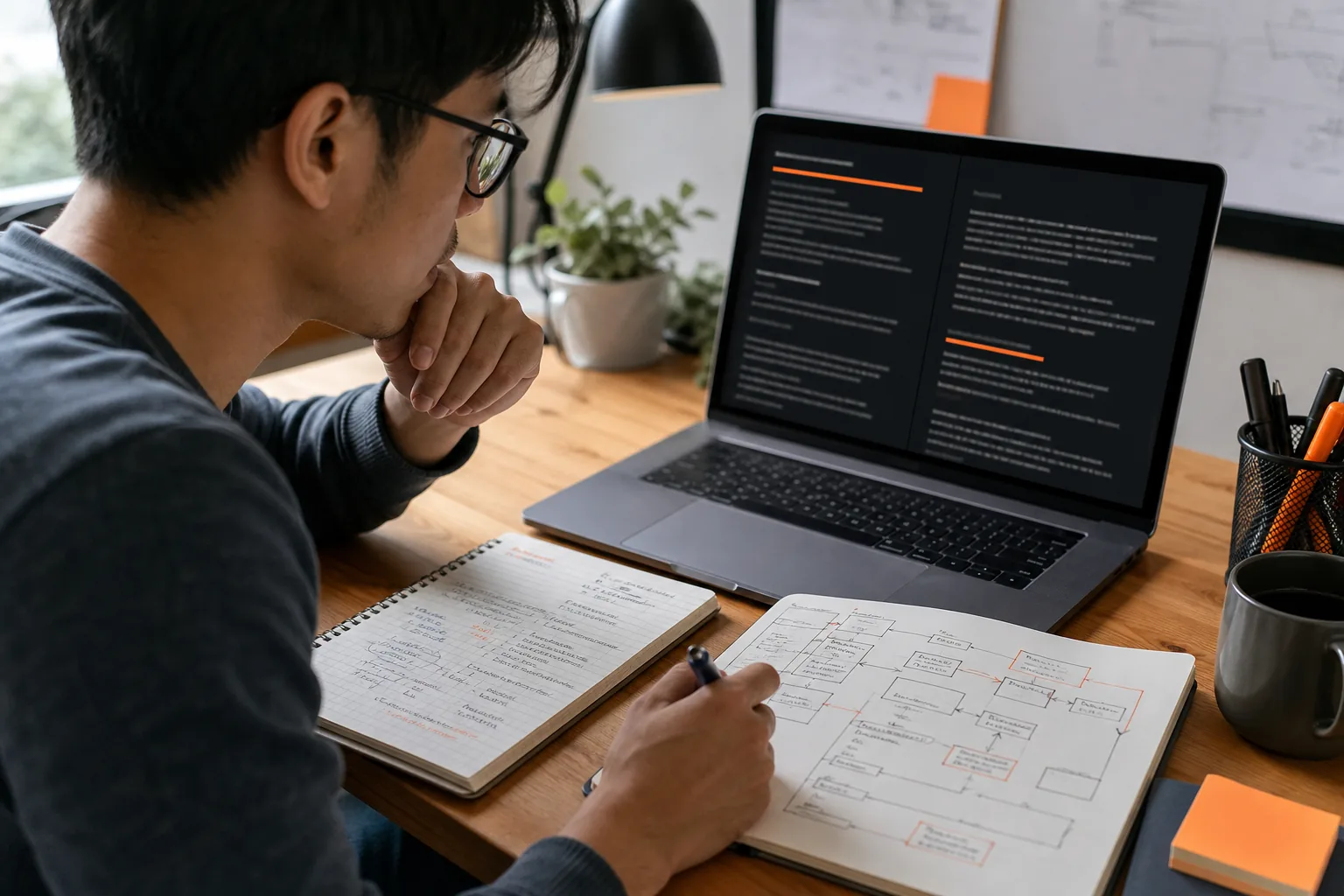
Review turns a mock interview into a training loop. After each session, inspect every follow-up instead of rating the whole interview as simply good or bad.
Make a small review sheet with five columns:
- The question you received.
- Your first answer.
- The assumption the question tested.
- What became unclear.
- What you will say next time.
Then tag the problem. Was the answer too broad? Did you miss a requirement? Did you give a claim without proof? Did you rush into code? Did you keep talking after answering the question?
A transcript helps because memory smooths over awkward moments. You may remember explaining a design well, but the transcript can show three minutes of tool names before you stated the user need. You may think a behavioral story was concise, while the recording shows that the result never appeared.
Ask a human reviewer for one observation at a time. Specific feedback leads to a specific next drill.
AI feedback can help with patterns such as repeated filler words, long pauses, or answers that drift past the question. Human feedback is still useful for judgment, tone, and whether your tradeoff made sense. The distinction matters, so compare both forms of review in AI vs Human Interview Coaching: Choosing Useful Feedback.
Phantom Code AI transcribes the session, so you can note the wording of each follow-up beside the transcript. That makes it easier to revisit the exact point where you lost the thread. Keep the review short. Ten focused minutes after a mock is better than a long review you never repeat.
Step 6: Repeat the Drill With Harder Variations
Repeat the same core question until your response improves, then change one condition. This is how you build skill instead of memorizing a script.
For coding practice, begin with a familiar problem. On the next attempt, change one input rule. Remove the sorted property. Allow duplicate values. Ask for lower memory use. Then compare your explanation, not only your final code.
For system design, keep the user goal but change the operating conditions. Add a read-heavy workload. Require stronger consistency for one action. Introduce a regional failure. Ask which decision you would delay if the team had two weeks instead of two months.
For behavioral practice, keep the same story and vary the probe. Ask what you personally changed. Then ask how you checked the result and what you would do differently.
Use your review sheet to choose the next variation. If you missed requirements, practice clarification questions. If you rambled, use a two-minute limit. If you defended a weak choice, ask a friend to challenge that choice twice.
Structured frameworks can help here. STAR gives behavioral answers a clear shape. For situational prompts, explain the situation, your options, the decision you would make, and how you would check the result. Use the structure to organize your answer in your own words.
For senior engineers, add stakeholder pressure. Ask what happens when a product manager rejects the tradeoff, when an on-call engineer disagrees, or when a deadline cuts your preferred design. The follow-up is testing judgment under pressure.
Keep a simple progress rule: advance only when you can answer the same probe twice without losing your assumptions. Then raise the difficulty. If you cannot do that, repeat the current version.
The aim is calm flexibility. You don't need a perfect answer for every surprise. You need a repeatable way to pause, clarify, reason, and respond.
FAQ
How do I practice interview follow-up questions during mocks?
Practice by asking a partner to probe every broad claim in your answer. Run a timed mock, record the session, and review each follow-up afterward. Mark where you lost an assumption or gave an unsupported claim. Then repeat the same question with one changed constraint. This builds flexible reasoning instead of memorized replies.
What are good follow-up questions for coding interviews?
Good coding follow-ups test correctness, complexity, and changing constraints. Ask why the approach works, which edge case could break it, and what changes when memory or input rules change. During a mock, choose one question from each group. That keeps the drill focused while still testing the main parts of your solution.
How long should I pause before answering a follow-up?
A pause of about five seconds gives you time to understand the question and plan a response. You can also signal that you are considering the constraint before answering. A short pause looks more thoughtful than rushing into a weak answer. Practice the pause during mocks so silence feels normal on interview day.
Should I use STAR for every behavioral follow-up?
STAR works well for behavioral stories, but you don't need to restart the full structure after every follow-up. Use the original story as your base. Answer the new question directly, then return to your action or result when needed. For senior roles, also practice questions about tradeoffs, disagreement, and what you would change.
Can AI help me practice follow-up questions?
AI can help by transcribing mocks, spotting repeated phrases, and generating probes around a stated answer. It cannot fully judge whether your tradeoff made sense to a team or whether your story showed sound judgment. Use Phantom Code AI for repeatable practice and transcript review, then add human feedback when you can.
Conclusion
Make follow-ups the main part of your next mock, not an extra at the end. Ask one partner to challenge your assumptions, pause before you respond, and review the exact questions afterward. If you practice alone, use Phantom Code AI to transcribe and review the session. Start with one coding or behavioral prompt today, then repeat it with a harder constraint.