How to Practice Concurrency Interviews Interactively
Learn how to practice concurrency interview questions interactively with timed prompts, race-condition drills, debugging tasks, and feedback.
Concurrency interviews expose weak reasoning fast. A solution may look correct, yet fail when two threads reach the same line at once. To practice well, you need a live session that tests your explanation, timing, and response to new faults. Follow these steps to build one with timed prompts, code-level feedback, and repeatable review.
We read 6 pages that currently rank for advice on practicing concurrency interview questions. We checked each for 5 elements: a timer, spoken reasoning, injected race conditions or deadlocks, transcript scoring, and spaced repetition. Only 1 of the 6 recommended speaking through a solution aloud or writing deadlock-prone code on purpose. None of the 6 timed the session or scored a transcript, gaps that a timer, injected faults, and rubric-based review are built to close.
Table of Contents
- Step 1: Set Up a Realistic Interactive Concurrency Practice Session
- Step 2: Choose a Concurrency Problem and Define the Interview Contract
- Step 3: Run the Interview Using Timed Prompts and Verbal Reasoning
- Step 4: Add Race Conditions, Deadlocks, and Debugging Challenges
- Step 5: Review the Transcript, Score the Attempt, and Repeat
- FAQ
- Conclusion
Step 1: Set Up a Realistic Interactive Concurrency Practice Session
The goal is to make your practice feel like an interview, not a quiet coding worksheet. Set a fixed session length, use a voice-based prompt, and keep a record of what you say before you code.
Start with a 45-minute block. Reserve the first five minutes for clarifying questions. Use the next 25 minutes for design and implementation. Keep the final 15 minutes for tests, review, and follow-up questions.
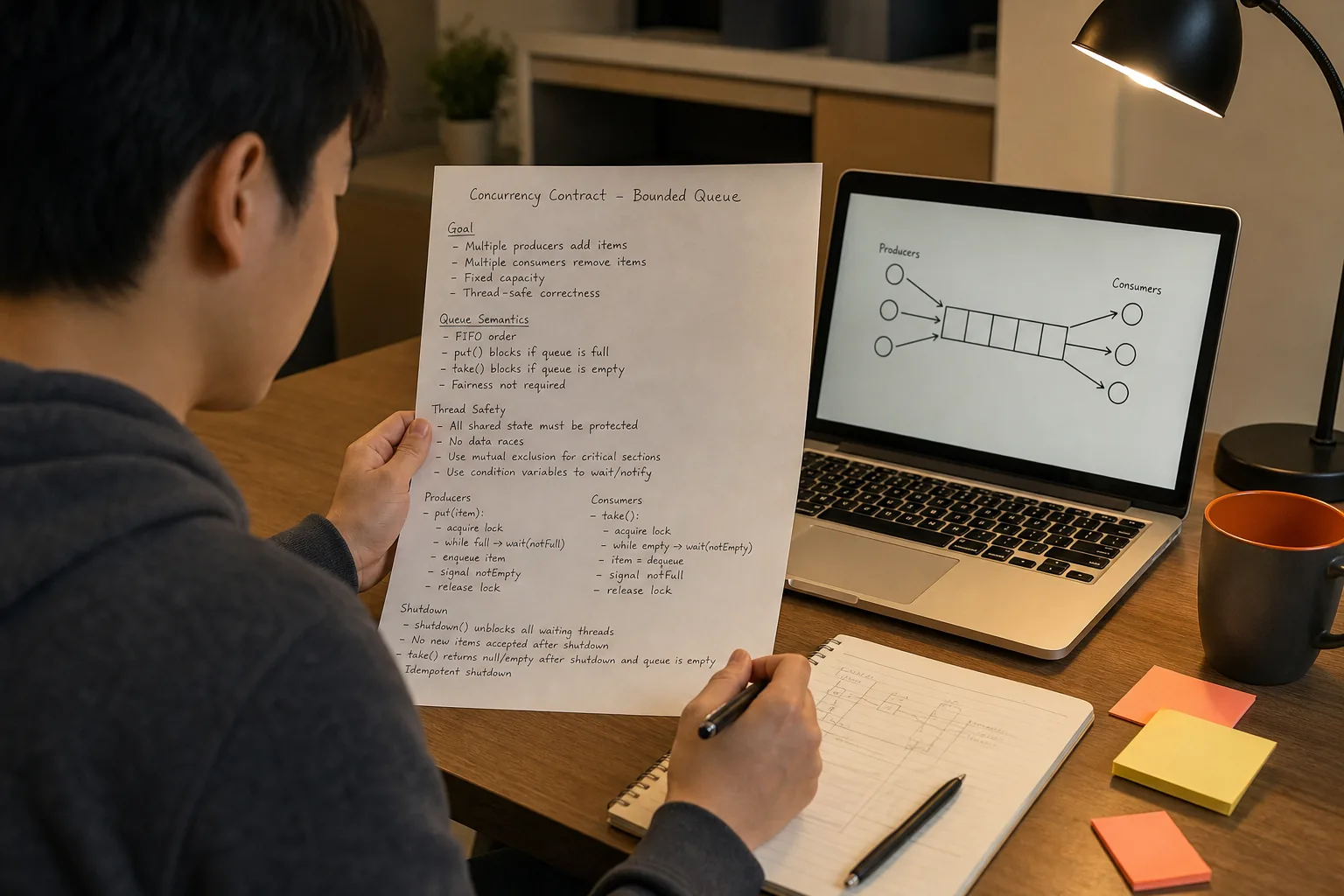
Use a problem that needs shared state. A bounded blocking queue works well because it brings up capacity, waiting, notification, and shutdown. A thread-safe counter is useful too, but it may be too small for a full interview unless you add a follow-up.
Before the timer starts, prepare four things:
- A code editor with one blank file.
- A timer that you can see without leaving the session.
- A way to capture speech or notes.
- A short score sheet for reasoning and correctness.
Phantom Code AI fits this kind of drill because it listens to the session, transcribes speech, recognizes the problem type, and gives guidance through its desktop assistant. Use it as a coach during a mock round, not as a replacement for your own explanation. If a hint appears, state why you accepted it before changing the code.
Keep your setup close to the conditions you expect. If you usually interview in Java, use Java. If the role may test C++ or Go, run later sessions in those languages. The point is to practice the thought process while syntax and library details still cost some attention.
Organize concurrency practice around synchronization, memory consistency, and high-level concurrency objects. Use that structure to build a topic rotation rather than repeating the same lock problem each day.
By now, you should have a timed workspace and a clear rule: explain first, then code.
Step 2: Choose a Concurrency Problem and Define the Interview Contract
Good interactive practice starts with a problem that has a clear contract and room for follow-up questions. Pick one task, then write down what the code must guarantee.
For a bounded queue, define the contract before discussing locks. Producers must wait when the queue is full. Consumers must wait when it is empty. A removed item must be returned once. The queue must not lose an item when several threads act at the same time.
Then set the boundaries. Decide whether the task needs blocking calls, timeouts, cancellation, fairness, or shutdown. An interviewer may leave these details open on purpose. Ask about them early, but do not spend ten minutes asking questions that do not change your design.
Write a small contract like this:
- Inputs: items from several producer threads.
- Shared state: a fixed-size buffer and its current count.
- Safety: no duplicate removal and no access outside the buffer.
- Progress: a waiting thread can move when the state changes.
- Shutdown: blocked calls have a defined way to stop.
Now add one follow-up. Ask what changes if the interviewer bans a built-in blocking queue. Then ask what changes if a consumer is cancelled while waiting. These additions test whether you understand the state machine instead of memorizing a lock pattern.
Concurrency questions often mix basic thread work with deeper issues such as compare-and-swap, rollback, or the difference between a single-threaded and multi-threaded execution path. Oracle's atomic-variable documentation explains Java's compareAndSet operation. Define what your code should do when the expected value no longer matches.
For interactive practice, give the prompt to your coach or assistant one piece at a time. Start with the base task. Wait until you explain the first design. Only then reveal the first follow-up. This prevents you from solving a complete written exercise in advance.
Phantom Code AI can help with this format because problem-type recognition can keep the session focused on the concurrency topic. Still, define the contract yourself. An assistant can point to a missing case, but you need to explain why that case breaks the design.
By now, you should have one problem, one contract, and at least one follow-up. That is enough for a full mock round.
Step 3: Run the Interview Using Timed Prompts and Verbal Reasoning
To practice concurrency interview questions interactively, make your spoken reasoning part of the task. The code is only one output. Your interviewer also needs to hear how you track shared state and timing.
Use a prompt schedule. At minute five, ask yourself to state the shared variables. At minute ten, describe the invariant. At minute 20, write the first version. At minute 30, test an interleaving. At minute 38, answer a failure follow-up.
Do not narrate every keystroke. Say the decisions that affect correctness. For example: “The count and buffer position must change under the same lock. Otherwise, two producers can both observe free space and write to one slot.” That sentence shows the state, the risk, and the protection.
Use small execution traces. Imagine two consumers reach a removal method while one item remains. Write down the order of reads and writes. Then ask what each thread sees after a context switch. This is often clearer than staring at a long code listing.
When you choose a lock, name its scope. Say which state it protects. Explain why a condition check sits inside a loop. If another thread runs first, the condition may no longer hold. A single check can let bad state through.
Use prompts that force a change in direction:
- “What if two producers arrive at the same time?”
- “What if the consumer wakes without an item?”
- “What if the callback calls back into the locked method?”
- “How would you stop all workers safely?”
Keep hints delayed. Ask for a nudge only after you name the failure you cannot resolve. Phantom Code AI is useful here because its speech transcription and live guidance can capture the point where your reasoning stalls. Treat each hint as a question to answer, not a line of code to paste.
Avoid turning the session into a speed contest. If you code quickly but cannot explain a lost wake-up or an unsafe publication bug, the session has not done its job. Slow down at the exact point where another thread could change the state.
For C++ practice, a standard library thread and synchronization reference can help you check library details after the session. Do not keep it open as a search tool during the timed attempt. Look up the rule later, then repeat the same problem without help.
The milestone is simple: you should finish with a transcript that shows your assumptions, your design choice, and the moment a prompt changed the problem.
Step 4: Add Race Conditions, Deadlocks, and Debugging Challenges
Interactive concurrency practice becomes much stronger when the interviewer gives you broken code. Add faults after you can solve the base problem. Otherwise, you may spend the whole session guessing at symptoms.
Start with a race condition. Give yourself a shared counter with a read, increment, and write sequence. Ask whether two threads can produce the same result. Then fix it with a lock or an atomic operation. Explain why your choice fits the needed guarantee.
Next, test a lost update in a resource reservation task. Two threads read ten available slots. Both reserve six. The final state may claim four remain, even though twelve were promised. Ask yourself which operation needs to be indivisible and which data must stay together.
For deadlock practice, create two locks with opposite acquisition order. Thread A takes lock one before lock two. Thread B takes lock two before lock one. Use Oracle's deadlock example to trace the cycle, then choose one fix:
- Use one lock order across all code paths.
- Avoid holding one lock while waiting indefinitely for another.
- Use a timed lock attempt, release the locks acquired for that attempt if it fails, then retry according to a bounded recovery plan.
Then add a visibility problem. One thread writes a stop flag. Another thread loops until it sees that flag. Ask whether the second thread is guaranteed to observe the write. The answer depends on the memory rules and the type of synchronization used.
Keep debugging prompts narrow. Show one failing test or one suspicious method. Ask for a diagnosis before a rewrite. A strong answer names the interleaving that breaks the code. It does not merely say, “Add synchronization.”
Use a fault ladder for each session:
- Find the unsafe shared state.
- Describe one failing schedule.
- State the smallest safe fix.
- Check whether the fix adds a deadlock or liveness issue.
For example, adding a broad lock may stop a race but block unrelated work. Replacing a lock with an atomic counter may protect the count while leaving the buffer contents unsafe. Ask what the fix protects and what it leaves exposed.
End the drill with a system question. Ask how the design behaves under load, what happens during shutdown, and how you would test rare schedules. You are ready to move on when you can explain both the bug and the limit of your fix.
Step 5: Review the Transcript, Score the Attempt, and Repeat
Review turns one interactive session into a training loop. Read the transcript after the timer ends, then score the choices that affected correctness.
Start with the first five minutes. Did you ask about inputs, thread count, blocking behavior, and shutdown? Did you state the shared state before naming a lock? If you skipped those points, write the missing questions down for the next attempt.
Score the attempt across five areas. Use a simple zero to two scale, where zero means missing, one means partial, and two means clear:
- Contract: You defined the required behavior and limits.
- Invariant: You stated what must always remain true.
- Interleaving: You tested at least one harmful thread schedule.
- Implementation: Your synchronization matched the shared state.
- Communication: Your explanation stayed clear under follow-up pressure.
Do not score only the final code. A correct answer reached through random edits will not hold up when the interviewer changes one condition. Mark each hint you needed. A hint is not a failure, but repeated hints in the same area show what to study next.

After scoring, make one change to the next session. If your issue was weak invariants, start the next round by writing the invariant before touching the editor. If your issue was deadlock analysis, add a two-lock schedule. If your issue was communication, force yourself to explain each lock’s protected state in one sentence.
Repeat the same problem only after a delay or a meaningful change. You can switch languages, remove a library helper, or introduce cancellation. Repeating the exact prompt immediately may test memory rather than skill.
Phantom Code AI can support the review loop by keeping a transcript of what happened during the practice round and giving guidance during the next attempt. Pair that with your own score sheet. Mark pauses in your recording, then decide whether each pause came from a missing concept or unclear wording.
Keep a short log with three lines: the fault you missed, the rule that explains it, and the next drill. After several sessions, those lines become your personal concurrency question set. That is far more useful than a long list of questions you never run under time pressure.
FAQ
How can I practice concurrency interview questions interactively by myself?
You can practice alone by using a timed prompt, speaking your reasoning aloud, and recording the session. Choose a problem with shared state, then inject one race or deadlock follow-up. Review the transcript afterward. An assistant such as Phantom Code AI can provide live guidance, but you should explain every hint before applying it.
What concurrency topics should I practice first?
Start with shared-state safety, lock scope, condition waiting, and atomic updates. Then add visibility, deadlock, cancellation, and shutdown. This order helps you build from one protected variable toward a full worker design. Use Java, C++, or Go based on the role, since library details differ even when the reasoning pattern stays similar.
How long should an interactive concurrency mock interview be?
A 45-minute session is long enough for a full problem without becoming hard to review. Spend about five minutes on the contract, 25 minutes on design and code, and the rest on tests and follow-ups. If you are new to the topic, use 20-minute drills first. Increase the time after you can explain the main invariant.
How do I practice race conditions for a coding interview?
Practice race conditions by writing a small shared-state task and tracing two threads through each read and write. Look for a schedule that produces a wrong result. Then apply the smallest fix and test whether it creates a new liveness problem. The key skill is explaining the failing interleaving, not naming a lock.
Should I use AI help during concurrency interview practice?
AI help is useful during practice when it exposes a missed case or asks a sharp follow-up. It should not replace your explanation. Ask for a hint only after you describe where you are stuck. Then close the tool and repeat the problem unaided. This keeps the session focused on skill growth rather than answer recall.
Conclusion
Use a timed, voice-based mock round with one concurrency contract and one injected fault. Record the reasoning, score the weak point, and repeat that skill in the next session. If you want guided practice, run the same loop with Phantom Code AI, then review the transcript before your next interview.