Best Subscriptions for Interactive System Design Practice

Compare subscriptions for interactive system design practice, including AI feedback, guided exercises, whiteboards, pricing, and course-based prep.
Buying a subscription for interactive system design practice comes down to one choice: do you need guided lessons, an AI interviewer, or a board where you can revise your design? Here are five options, with the hands-on format and known pricing for each. The lowest price isn’t always the best deal if you need feedback while you work.
Table of Contents
- LeetCode: Interactive questions with AI feedback
- Design Gurus: Courses and interview-prep support
- Hello Interview: Staged practice with detailed explanations
- Mockingly.ai: AI interviews that react to your architecture
- Codemia: Whiteboard practice and iterative design feedback
- Quick comparison: Which system design practice subscription fits your needs?
- FAQ
- Conclusion
1. LeetCode: Interactive questions with AI feedback
LeetCode is a practice platform with interactive system design questions and AI-powered feedback. Its starting option is free, while Premium is listed at $35 per month. That makes it a useful first stop if you want to try design questions before paying.
Pick it if you’re already using LeetCode for coding practice and want to add system design to the same study routine. An interactive question gives you a prompt to work through, while AI feedback can respond to your attempt. That’s a different kind of study from reading a finished architecture and hoping you’d have reached the same choices on your own.
Try a design prompt by stating the system’s main job first. For a rate limiter, say what needs limiting and where you’d enforce it. Then describe the data you’d track and what should happen when a limit is reached. Review the feedback against your reasoning, rather than treating any automated answer as the only valid design.
Premium makes sense if you expect to use the practice often enough to justify a monthly fee. If you’re still learning what system design interviews ask, start with the free option and see whether the interactive format fits how you study.
2. Design Gurus: Courses and interview-prep support
Design Gurus is a tech interview-prep platform built by ex-FAANG hiring managers. It offers courses, mock interviews, and resume reviews. Choose it if you want a course-led plan alongside opportunities for human feedback.
As you study system design, practice explaining architecture decisions and trade-offs. For example, prepare to discuss concepts such as the CAP theorem and how they affect a design. Pair course study with mock interviews to practice communicating your reasoning.
The Bootcamp structure is listed at $33 per month with annual billing. You can also start Design Gurus free, giving you a chance to try its course style before committing to an annual plan. Check the current pricing and course options before buying.
3. Hello Interview: Staged practice with detailed explanations
Hello Interview uses step-by-step guided practice, staged requirements, and feedback. It suits candidates who want a clear sequence and detailed explanations, rather than a blank canvas and a prompt with no structure.
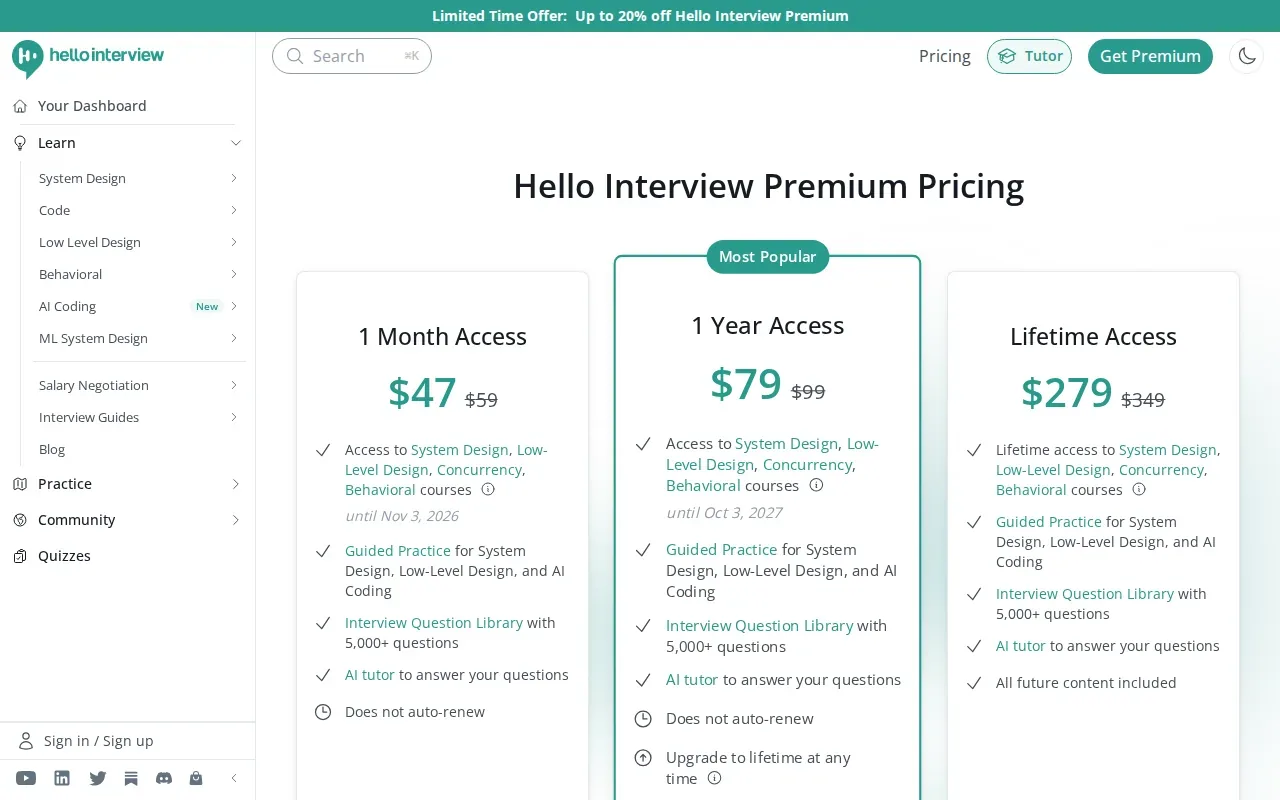
The system design practice set includes questions at easy, medium, and hard levels. Named examples include designing a rate limiter, a distributed cache, a notification system, or YouTube. Guided practice breaks the work into stages, so you can focus on each part of the answer before moving forward.
That structure helps when you’re still learning how to move from a vague prompt to a sound design. For a video platform question, you might first pin down what users need to do. Then you can work through the main components and discuss trade-offs. The aim is to explain why a choice fits the stated needs, not to name as many components as possible.
It’s a strong fit when you want the path laid out for you. If you already know the basics, try harder prompts and spend more time defending your choices.
4. Mockingly.ai: AI interviews that react to your architecture
Mockingly.ai runs dynamic system design interviews with an AI interviewer and an interactive whiteboard. The AI can ask follow-up questions based on your architecture, then give feedback on areas such as scalability, fault tolerance, and latency.
Choose it if your main gap is explaining design choices under pressure. For example, after you place a database in an architecture, an interviewer might press you on how the design handles more traffic or a service failure. The value is in having to respond to the challenge, then review what your answer missed.
Mockingly.ai starts at $14 per month. Its free reading material covers system design problems and trade-off analysis, while its practice flow brings together an AI conversation and an interactive canvas.
That mix is useful when you want to rehearse the back-and-forth of an interview, not only draw boxes. Still, automated feedback is a prompt for another round of thinking, not a hiring decision. If the AI questions your database choice, explain the workload and constraints again, then test whether your design still holds.
5. Codemia: Whiteboard practice and iterative design feedback
Codemia pairs an interactive whiteboard with AI feedback and peer mock interview matching. It’s a fit if you want to draw an architecture, get a review, revise the design, and practice with another engineer.
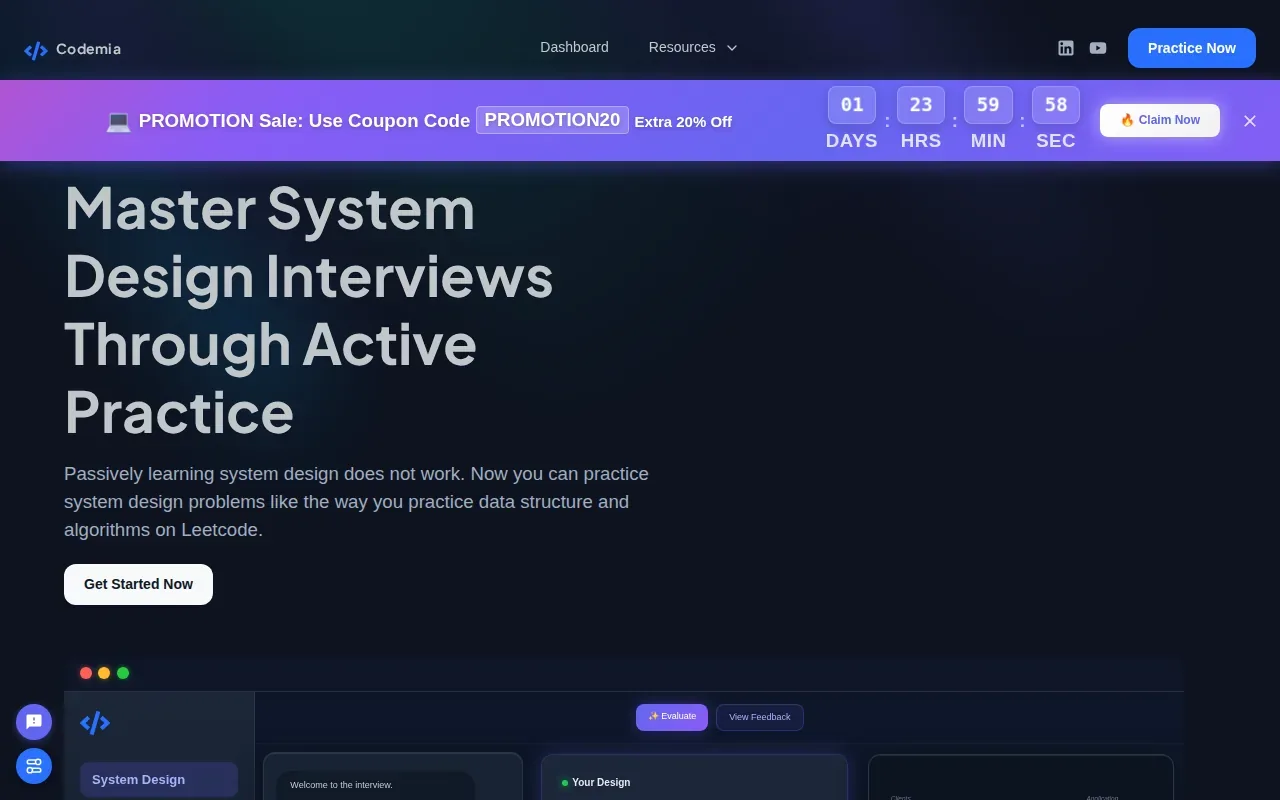
The key loop is simple: make a design, review the feedback, then refine your answer. That can help with a system such as a notification service, where the first draft may leave questions about delivery, retries, or scale. Use feedback to spot gaps, then explain why your changes address the problem.
Peer mock interview matching offers a chance to explain your reasoning to another person and respond to follow-up questions. Pair that practice with the interactive whiteboard and AI feedback to review and refine your design.
Check the subscription details before you pay, especially if peer mock interviews are the main reason you’re considering it.
One useful routine is to redo the same prompt after reviewing the critique. You’ll see whether your next explanation is clearer, not just whether you can copy a model answer.
Quick comparison: Which system design practice subscription fits your needs?
These subscriptions differ most in how you practice. Some guide you through a curriculum. Others put you in a mock interview or let you revise a diagram. Match the format to the skill you’re trying to build before comparing the monthly fee.
| Option | Practice format | Feedback style | Known price or access | Best fit |
|---|---|---|---|---|
| LeetCode | Interactive questions | AI feedback | Free option; Premium $35/month | Adding design practice to coding prep |
| Design Gurus | Courses, plus mock interviews | Course learning and interview support | Bootcamp $33/month with annual billing | Following a course-led study plan |
| Hello Interview | Step-by-step guided practice | Staged feedback and explanations | See website | Learning a consistent answer sequence |
| Mockingly.ai | Dynamic AI interview with whiteboard | Real-time AI follow-ups and feedback | $14/month; free practice | Practicing responses to design challenges |
| Codemia | Interactive whiteboard and peer mocks | AI feedback and peer feedback | $29/month; selected free problems | Revising designs and practicing with a peer |
For a course plan, start with Design Gurus. For guided stages, look at Hello Interview. Choose Mockingly.ai if you want an AI to question your design; choose Codemia if you also want peer practice. LeetCode is an easy starting point if you already use its free practice.
Phantom Code AI is a different kind of tool. It’s a desktop AI interview assistant for coding, system design, and behavioral interview prep, rather than a subscription built around a practice whiteboard. Use it as a companion when you want interview-focused help, and keep practice focused on explaining your own design choices.
Ready to prepare for technical interviews with Phantom Code AI? See Phantom Code AI pricing and free signup credits.
FAQ
Which subscription is best for interactive system design practice?
The best fit depends on how you want to practice. Choose Hello Interview for staged, guided exercises. Pick Mockingly.ai for an AI interviewer that reacts to your architecture, or Codemia for whiteboard work with AI and peer feedback. LeetCode suits people who want interactive questions alongside coding practice.
Can I practice system design for free before subscribing?
Yes, some options provide free access. LeetCode has a free option, Mockingly.ai offers free practice, and Design Gurus lets you start free. Check what each free tier includes before relying on it for a full study plan.
Do these subscriptions include live mock interviews?
Some include mock interview support, but the format varies. Design Gurus includes mock interviews as part of its interview-prep offering, while Codemia offers peer mock interview matching. Mockingly.ai runs AI interviews. A guided course or interactive question set isn’t automatically the same as a live session with another person.
Do subscriptions renew automatically, and can I get a refund?
Check the checkout terms for renewal timing and refund rules before you pay. Those terms can differ by plan and payment period. If you’re unsure how long you’ll need practice, start with a free option where available, then choose a paid term only after confirming the cancellation and refund details.
Can I share or transfer a subscription?
Don’t assume a subscription can be shared or transferred. Review the account terms for the specific service before buying, especially if you’re paying through a team or school. For personal prep, use your own account so your practice history and feedback stay tied to the right learner.
Conclusion
For hands-on feedback, start with Mockingly.ai or Codemia; for a guided curriculum, compare Design Gurus with Hello Interview. Test a free practice option first, then choose a paid plan that fits your weekly routine. If Phantom Code AI’s interview-assistant format fits your prep, check the current plans and use the free signup credits to try it.