Best Coding Interview Platforms for 2026

Compare coding interview platforms for DSA practice, live technical screens, and mock interviews. Find the right fit for your next interview.
Picking among the best coding interview platforms is easier when you know what you need to practice: solving problems alone, coding with an interviewer, or explaining your reasoning aloud. This shortlist compares five tools for those different jobs. Phantom Code AI is a separate live interview assistant, not a substitute for the study and assessment platforms below.
We analyzed 45 reviews, comments and questions from the App Store, Trustpilot, YouTube and Quora about coding interview platforms and found that 38% mentioned irrelevant or excessively difficult assessment content.
Table of Contents
- LeetCode: The largest problem bank for coding practice
- NeetCode: A structured, free starting point for DSA
- HackerRank: Technical screening and live interviews in one platform
- CodeSignal: A cloud environment for live coding interviews
- Interviewing.io: Live mock interviews with experienced engineers
- Coding Interview Platforms Compared
- FAQ
- Conclusion
1. LeetCode: The largest problem bank for coding practice
LeetCode is a large typed problem bank for solo coding practice. It suits engineers who want repeated reps on data structures and algorithms, then want to run their code against test cases and see whether it passes.
That instant execution makes it useful for checking edge cases. For example, after writing a binary search, test a one-item array and a target that falls outside the array. LeetCode gives you a quick way to see whether your code handles those cases.
The paid Premium tier adds company-tagged questions. That can help you focus your practice when you have a target employer, though tags are a way to organize practice, not a promise about what an interviewer will ask.
LeetCode is strongest for building problem-solving volume. It doesn’t train spoken delivery by itself, so explain your approach aloud as you work. State the input assumptions, describe the algorithm, then walk through a test case before you code. Phantom Code AI can complement that prep during a separate live interview workflow, while LeetCode remains the place to build your own pattern recall.
When you can solve a problem but struggle to explain it, add mock practice rather than another silent coding session.
2. NeetCode: A structured, free starting point for DSA
NeetCode is a curated roadmap for data structures and algorithms, with the NeetCode 150 and Blind 75 arranged around common patterns. Its free core roadmap suits self-directed learners who want a clear route through practice instead of choosing each next problem from a broad bank.
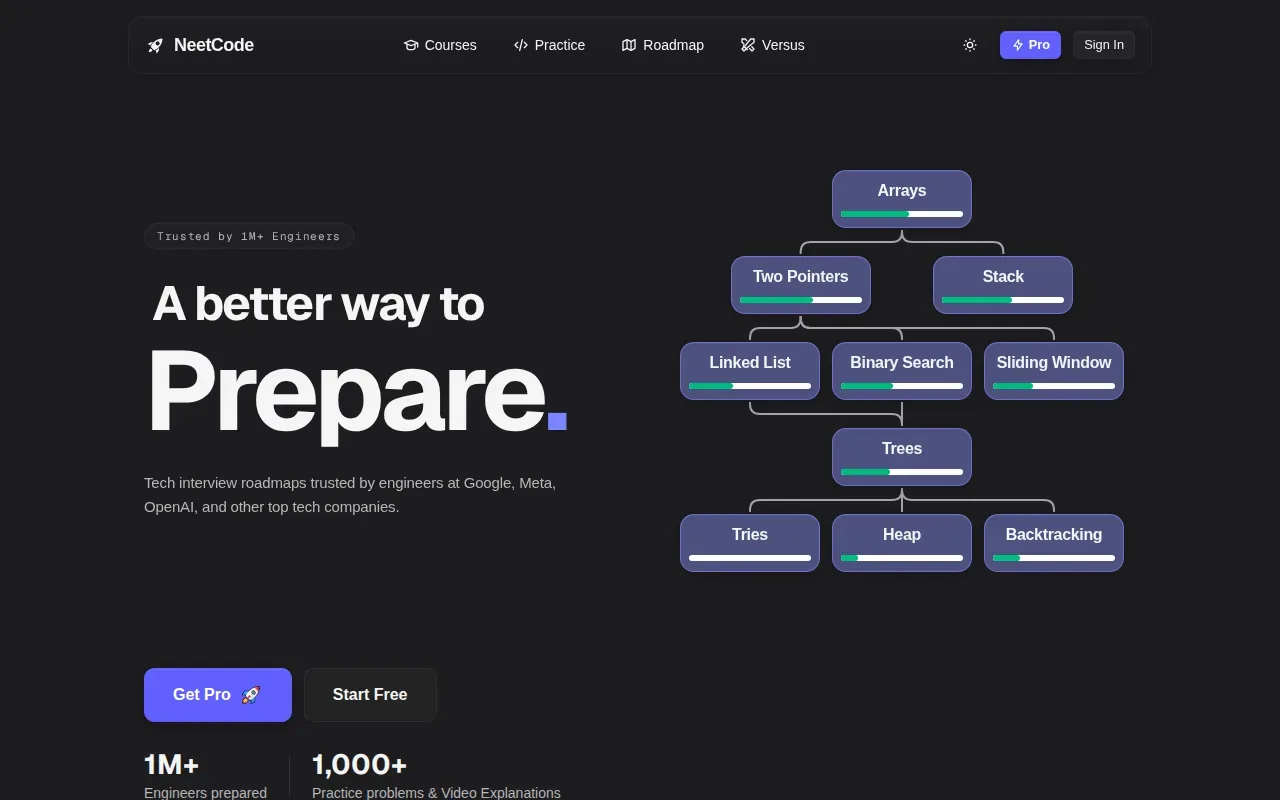
The sequence helps you connect related problems. After arrays, for instance, you can work through two pointers and sliding windows, then revisit those patterns in harder questions. The NeetCode 150 is the Blind 75 plus 75 more problems. It suits learners who already know basic algorithms and data structures. Its learning materials also cover system design.
Pattern work is more useful when you can name why a method fits. For a graph question, ask whether you need to visit each node once or find the shortest path in an unweighted graph. That distinction can point toward depth-first search or breadth-first search, which uses a queue to visit nodes level by level.
Use the roadmap to build recall, but don’t treat finishing a list as proof that you’re interview-ready. Pick a problem, set a time limit, and narrate your plan before writing code. Then test a small case and an edge case. If you can’t explain why the pattern works, pause and review the underlying idea before moving on.
NeetCode’s strength is the study path. Add live practice when you’re ready to work on pacing and communication with another person.
3. HackerRank: Technical screening and live interviews in one platform
HackerRank combines technical screening with live interviews inside a wider developer hiring platform. It suits teams that need to assess applicants at more than one stage, and it gives candidates a place to practice coding in a live setting.
In live interviews, candidates can write, compile, and test code in real time. The platform supports live coding in many programming languages. That matters when an interview needs to focus on a candidate’s chosen language rather than forcing a switch to another one.
HackerRank’s interview IDE can also give candidates an AI assistant, and the hiring team can watch how it is used during the session.
For candidates, the key is to find out what the interview permits. AI rules differ by employer and by interview, so don’t assume an assistant is allowed just because a tool supports one. Practice the core task without help first. Then practice explaining how you would check generated code for errors if the interviewer asks you to work with AI.
HackerRank fits best when you want assessment-style practice or a live coding environment. Use a problem bank for extra DSA reps, then rehearse explaining your choices under time pressure.
4. CodeSignal: A cloud environment for live coding interviews
CodeSignal Interview is a cloud-based technical interview environment for recruiters and engineering teams. It suits live technical screens where the candidate and interviewer need to work together while code is written and compiled.
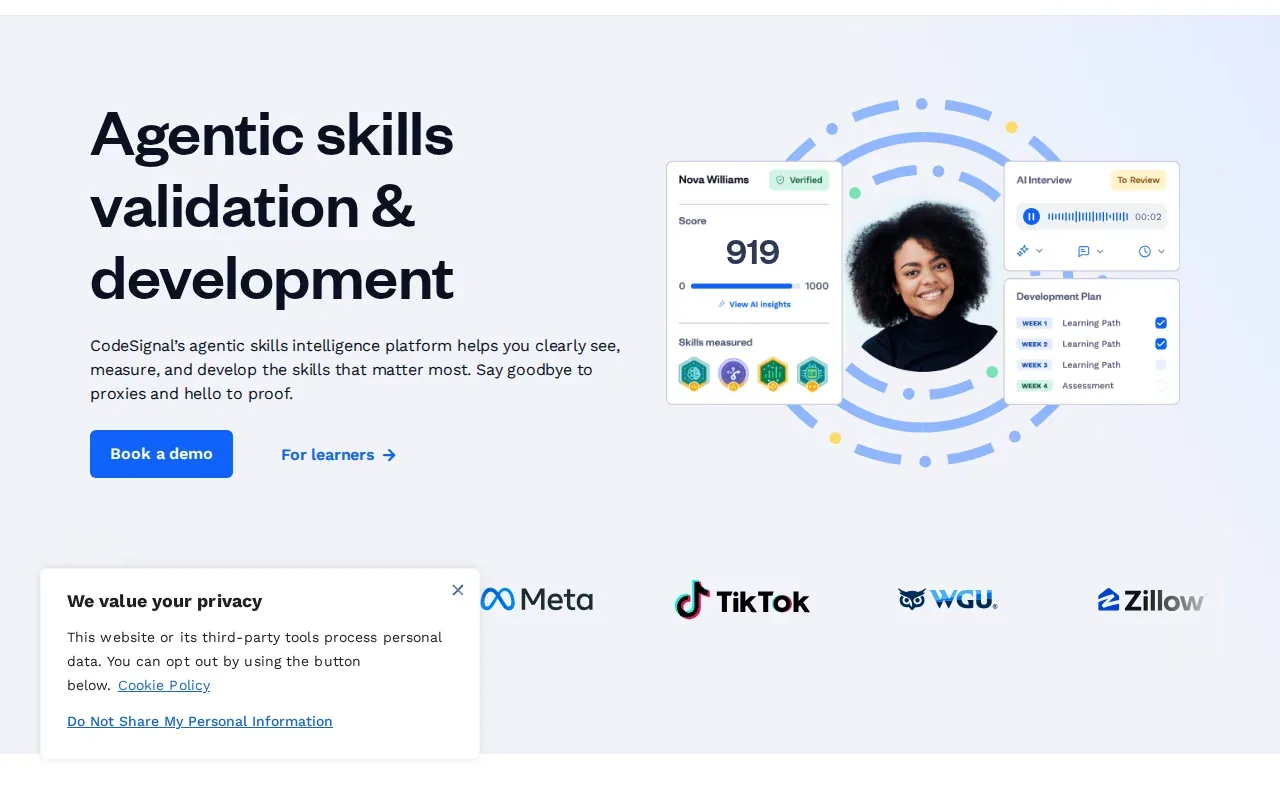
That shared workflow is useful when the interviewer wants to see more than the final output. A candidate can describe a plan, write a first version, and test it while the discussion is still happening. Real-time code feedback lets the pair catch a syntax or test failure during the session instead of waiting until the end.
CodeSignal’s AI tutor, Cosmo, is a learning aid that can explain concepts and adapt to how you study. It supports learning rather than live interview assistance. Keep that distinction in mind when you compare tools. A tutor for study is not the same as an assistant that participates in a live screen.
For candidates, use a collaborative coding session to practice keeping the interviewer in the loop. Say what you’re checking before you change the code. If a test fails, explain what the failure tells you, then adjust the solution. This makes the session easier to follow and gives you practice responding calmly when your first attempt is wrong.
CodeSignal is a fit for live, collaborative coding. Pair it with solo DSA practice if you also need more repetition on specific patterns.
5. Interviewing.io: Live mock interviews with experienced engineers
Interviewing.io runs live mock interviews with senior engineers from major tech companies. Sessions are priced per interview, so it suits candidates who want a small number of live practice rounds rather than only solo drills.
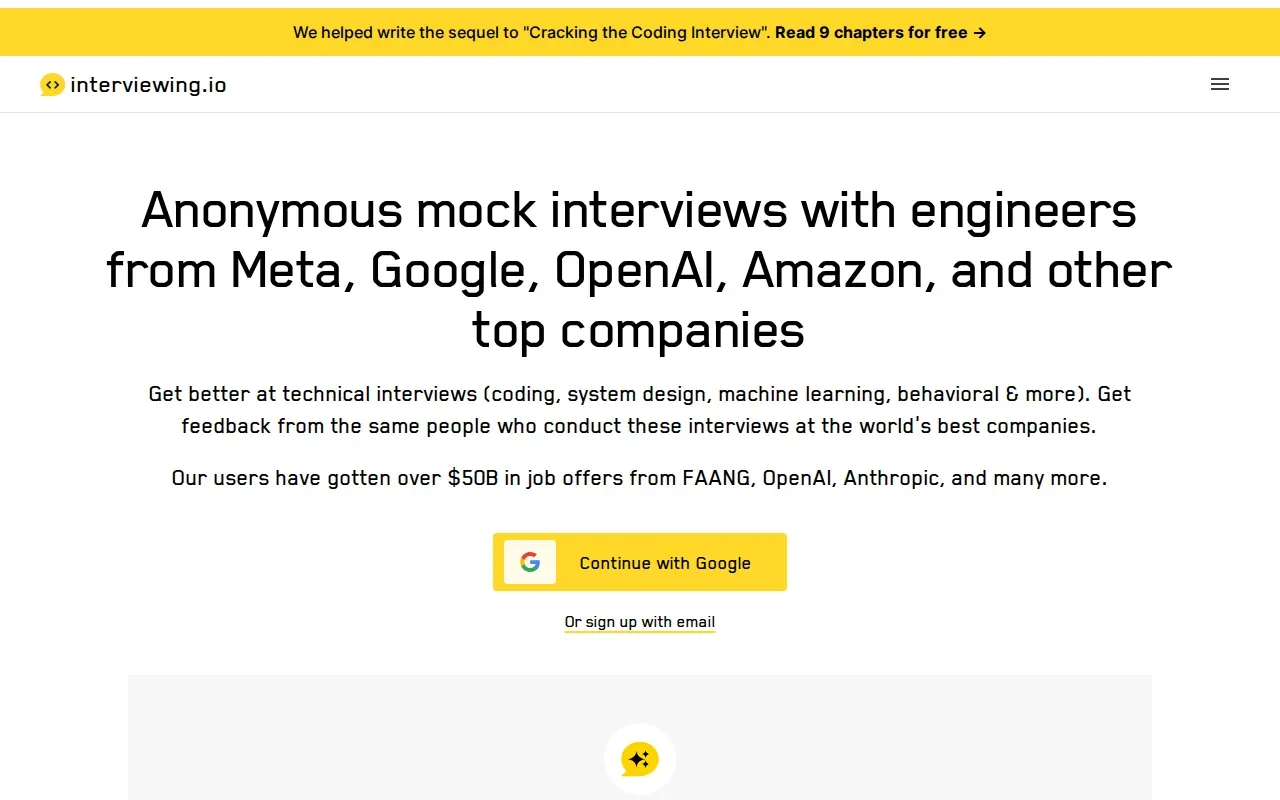
The range of interview types is broad: DSA, system design, machine learning, frontend, behavioral, and manager interviews. That lets you focus a mock on the round that’s coming next. If your weak point is system design, use the session to talk through requirements and trade-offs. If you’re preparing for DSA, practice clarifying the prompt before proposing an algorithm.
Live mocks train a part of the interview that a problem bank can’t reproduce: speaking while you think. Tell the interviewer what you know, ask questions when a requirement is unclear, and state why you’re choosing one approach over another. If you get stuck, say what you’ve ruled out and ask a focused question instead of sitting in silence.
Interviewing.io gives detailed feedback at the end of each session. The human session is the main reason to choose it. If you want to compare formats for spoken practice, see these mock coding interview platform options.
Use a live mock close to an interview date, once you’ve done enough solo work to make the session about your process and communication.
Coding Interview Platforms Compared
These tools suit different stages of preparation. Start with the format that matches your next gap, then add a second type only when it fills a clear need.
| Platform | Best fit | Practice format | Useful decision point |
|---|---|---|---|
| LeetCode | Building DSA problem volume | Solo problems with instant test execution | Choose it when you need more coding reps or company-tagged questions. |
| NeetCode | Learning patterns with structure | Curated roadmap and study materials | Choose it when you want a guided path through core DSA topics. |
| HackerRank | Assessment-style work and live coding | Technical screens and collaborative interviews | Choose it when your practice should include a live coding environment. |
| CodeSignal | Collaborative technical interviews | Cloud-based coding with an interviewer | Choose it when you need to write and compile code together. |
| Interviewing.io | Live practice with a senior engineer | Mock interviews priced per session | Choose it when you want to rehearse a specific interview type aloud. |
Phantom Code AI sits in a different part of the workflow: it’s a live interview assistant that listens, transcribes, recognizes problem types, and provides guidance. Compare it with the platform you use to study, not as a replacement for learning the material.
FAQ
Which coding interview platform is best for beginners?
NeetCode is a strong starting point for beginners who want a structured DSA roadmap. Its free core roadmap organizes problems by pattern, which gives you a clear way to build skills in sequence. If you already know basic algorithms and data structures, the NeetCode 150 is designed for that level. Use LeetCode when you want a larger typed problem bank.
Which platform is best for practicing coding interview problems?
LeetCode is a good fit for repeated solo problem practice because it has a large typed problem bank and instant code execution with test cases. NeetCode is a better fit if you want a curated sequence organized around patterns. Pick based on whether you need more problem volume or more structure.
Are coding interview platforms free?
Some platforms have free access options, but the details vary. NeetCode’s core roadmap is free. LeetCode has company-tagged questions on its paid Premium tier. Interviewing.io prices live mocks per session. Check the current access terms for the activity you plan to use before you commit.
Can I practice live coding interviews with these platforms?
Yes. HackerRank and CodeSignal support collaborative live coding environments, while Interviewing.io runs live mock interviews with experienced engineers. These formats help you practice speaking as you solve a problem. A solo problem bank is still useful for building DSA recall, but it won’t give you the same conversation practice.
Should I use AI while preparing for a coding interview?
AI can be part of study, but check the rules for each real interview before using it there. CodeSignal’s Cosmo is a tutor for learning, while HackerRank’s interview environment can include an AI assistant that interviewers can watch. Practice without assistance too, so you can explain and test your own solution when help isn’t allowed.
Conclusion
Choose the platform that targets your next weak spot: NeetCode for a guided DSA path, LeetCode for more solo reps, or a live mock when speaking is the hard part. Then run one timed practice problem and explain your reasoning aloud. If you need assistance during a separate live interview, Phantom Code AI is built for that workflow.