Best Mock Coding Interview Platforms for Practice

Compare mock coding interview platforms for realistic coding practice, AI feedback, peer sessions, and behavioral prep. Find the right fit for your goals.
A mock coding interview tests more than whether your code works. You need to explain your plan, respond to follow-up questions, and manage the clock. Here are six platforms for different kinds of practice, starting with Phantom Code AI for live guidance and free signup credits.
We analyzed 62 comments from YouTube and Reddit about mock coding interviews and found that 26% mentioned nervousness and forgetting.
Table of Contents
- Phantom Code AI
- Pramp
- interviewing.io
- DevInterview.AI
- Sensei AI
- Final Round AI’s AI Mock Interview
- Mock coding interview platforms compared
- Mock Coding Interview FAQs
- Conclusion
1. Phantom Code AI
Phantom Code AI is an invisible AI desktop assistant for coding interviews. It listens to and transcribes interview audio, recognizes problem types, and gives real-time guidance during mock or live technical interviews.
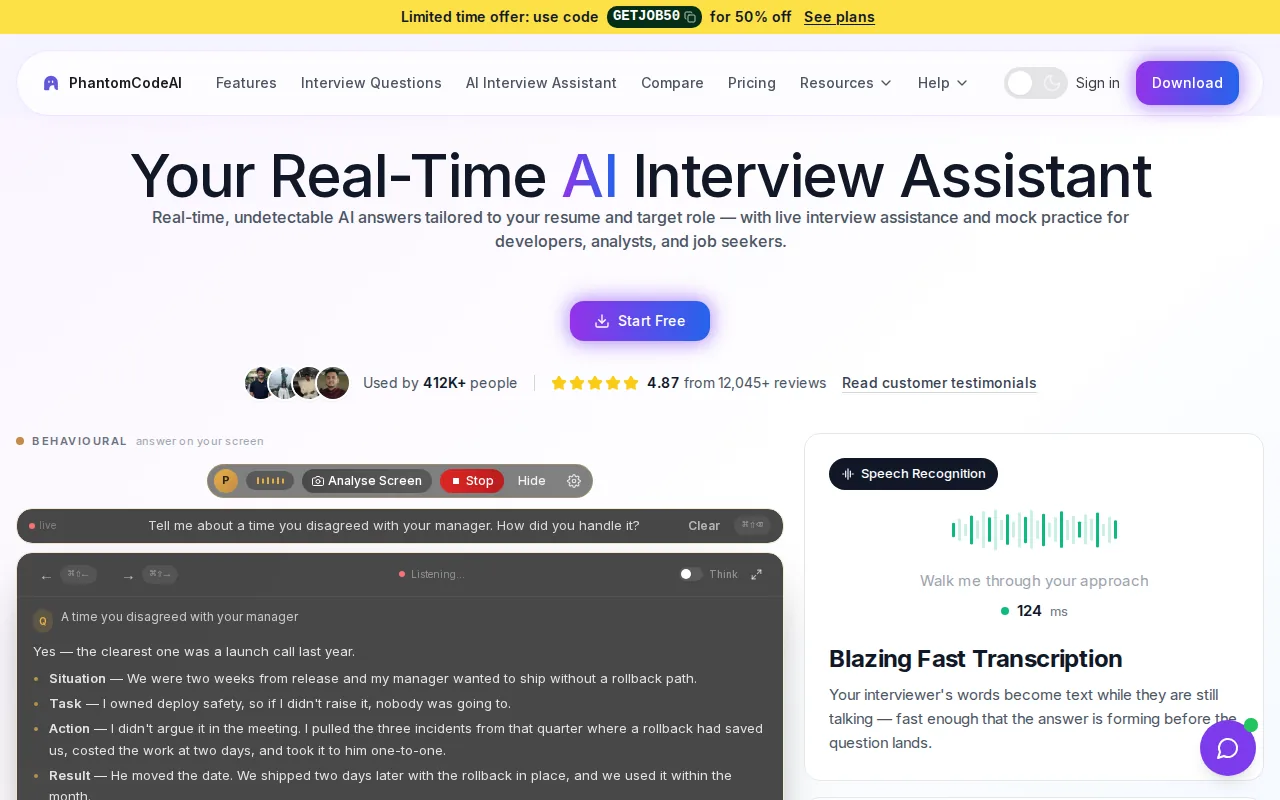
It’s a fit if you want one tool for coding, system design, and behavioral preparation. The software runs on macOS and Windows. New accounts get free credits at signup without a credit card, and paid plans start at $19.
For coding practice, the AI-graded DSA mock rounds give you a way to rehearse explaining your approach under time pressure. That matters when you can solve a sliding-window problem alone but lose your train of thought while narrating it. You can use the mock format to work on that gap before an interview.
Phantom Code AI also supports live guidance through interview audio. That’s a different use from a peer mock or a practice-only AI interviewer. Check the rules for your interview before using any assistance during a live assessment. If you’re still building your skills, start with practice and use feedback to decide what to work on next.
2. Pramp
Pramp is peer-to-peer practice: the platform matches candidates, gives them a question and a shared interview setting, then has them take turns as interviewer and candidate. It is free to use.
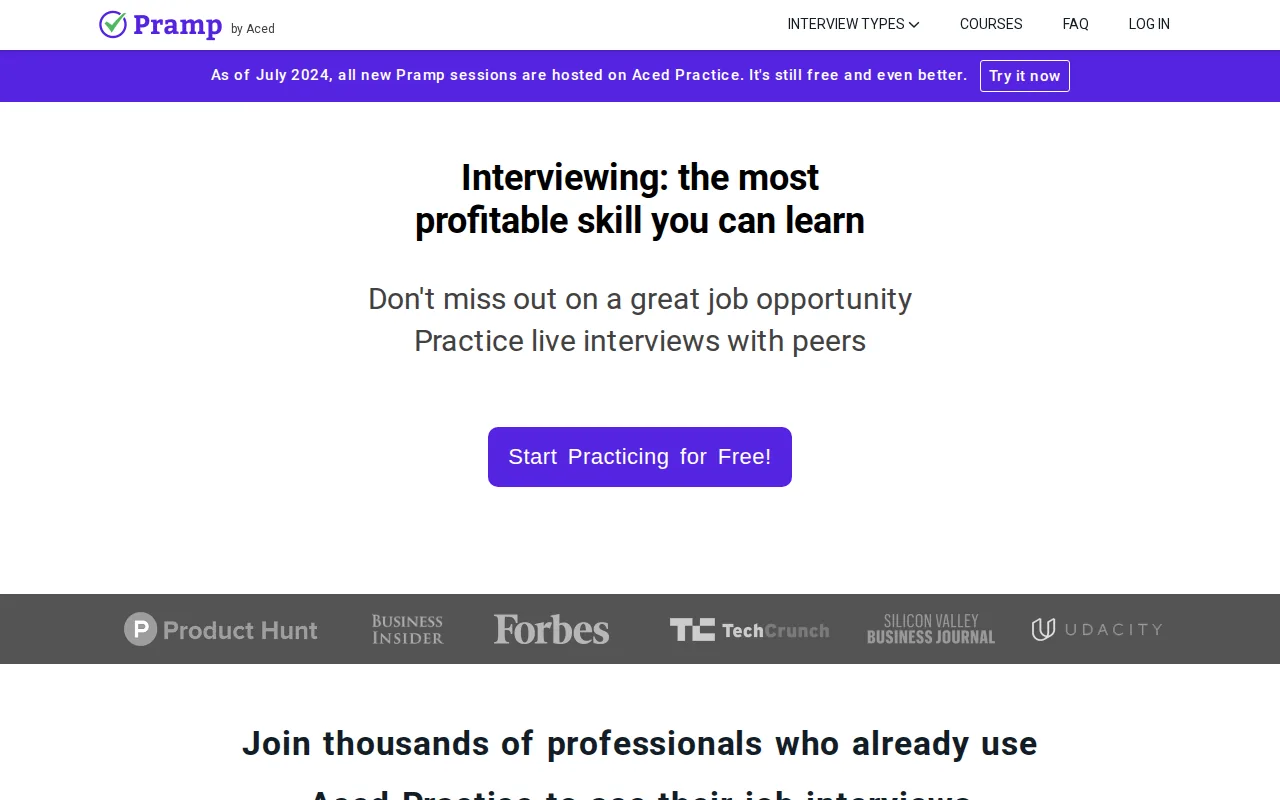
Choose it if speaking to another person is the part you need to rehearse. A peer can ask what led you to a hash map, or point out that you never tested the empty-input case. You’ll also have to explain your solution out loud instead of silently checking whether your code passes.
The role swap makes each session useful in two ways. As the candidate, you practise reasoning through a prompt. As the interviewer, you learn to listen for gaps and ask follow-up questions. Pramp provides interview questions and a collaborative environment in the browser, with video chat.
There’s a tradeoff: your partner is another candidate, so the depth of feedback can vary. Both people need to show up and take the exercise seriously. Pramp’s peer sessions are now under Aced, so check the current sign-up route before planning a session.
Use this option when you want human practice at no cost. For detailed technical feedback, treat a peer session as a rehearsal, not the final word on your readiness.
3. interviewing.io
interviewing.io connects candidates with engineers who conduct technical interviews. The platform covers coding and system design, with practice from experienced interviewers.
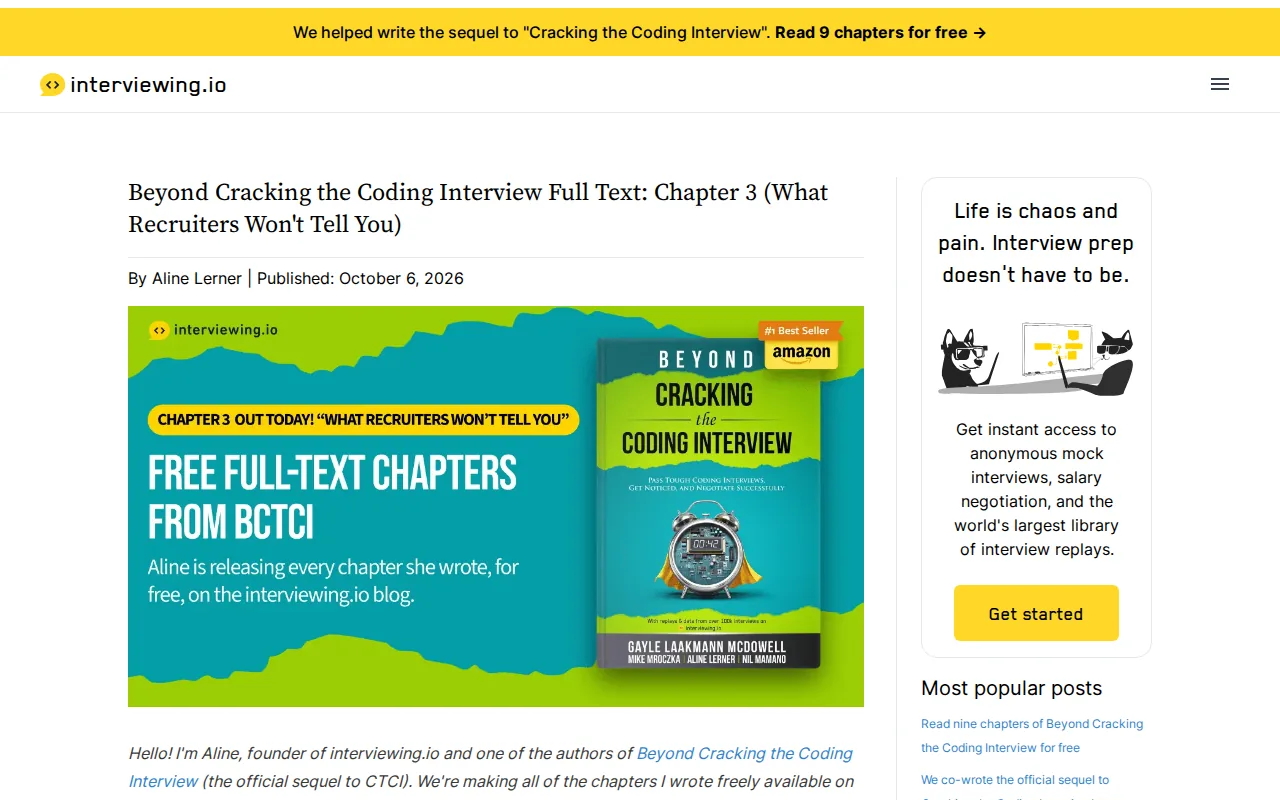
It’s best suited to engineers who already know the core material and want a more informed read on how they perform. A senior engineer may spot that your solution works but that you skipped a key tradeoff, or that your explanation was hard to follow. That kind of feedback can help when a real interview is close.
There’s a clear distinction between this and peer practice. You’re speaking with someone who has experience running interviews, rather than another candidate learning the same skills. That can make the feedback more useful for questions like, “Did I explain why this approach scales?” or “Did I clarify the constraints before coding?”
Paid human sessions are a significant cost compared with free peer practice, so it’s sensible to save them for a specific purpose. For example, use one to check your system-design discussion after you’ve practised the basics on your own.
One practice session can tell you where an answer gets muddy. Bring a focused question, such as whether your explanation of database sharding covered the tradeoffs, so you can make good use of the feedback.
4. DevInterview.AI
DevInterview.AI is an AI-led practice platform for coding, system design, and behavioral interviews. Its coding mock uses a voice interviewer and a code editor with live execution. New accounts get one full mock interview free.
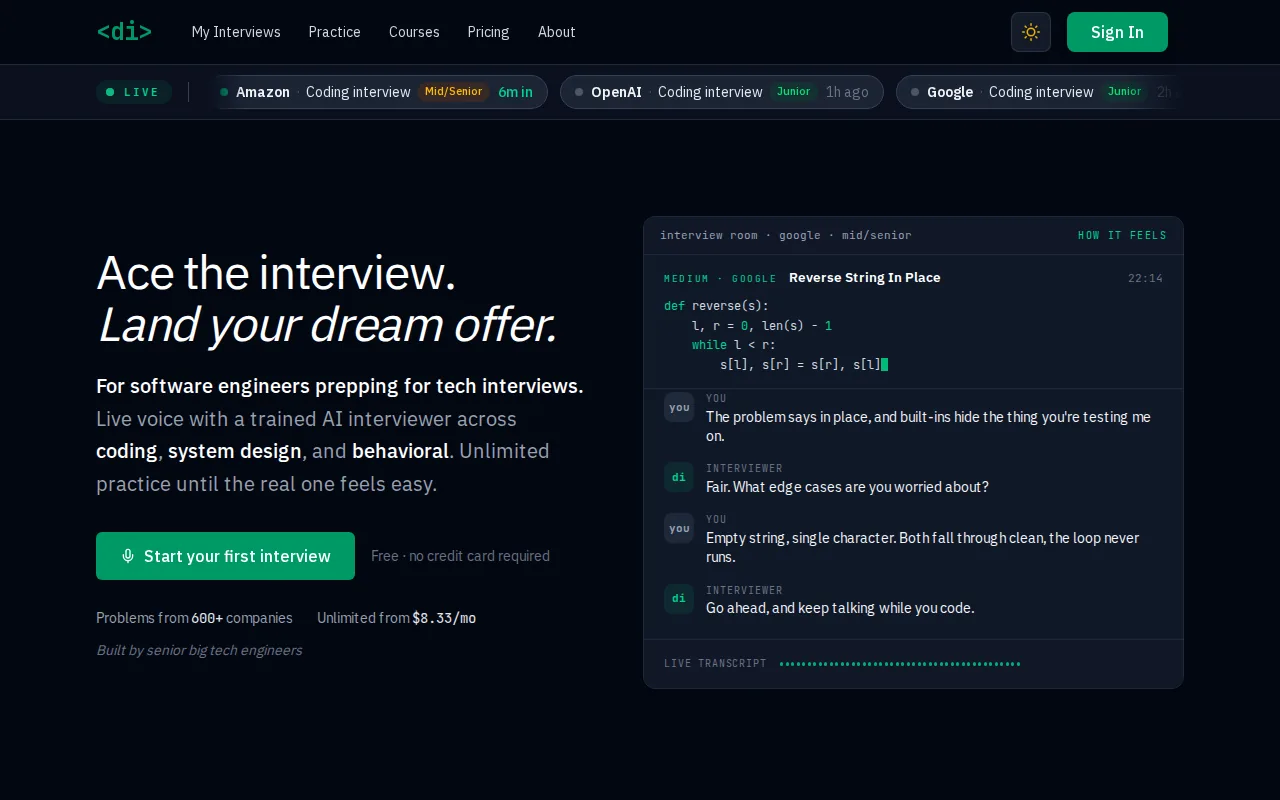
This may suit you if you want to practise on demand without booking a human partner. The interviewer can ask why you chose an approach and push back on a weak answer. After a session, you get an evaluation with a verdict and scores covering problem solving, code quality, language proficiency, and communication.
That feedback can turn a vague sense of “I got stuck” into a more useful review. Maybe you chose a workable approach but didn’t explain its time cost. Or perhaps you wrote correct code but missed a test case. Its coding sessions support several languages, including Python, Java, C++, and JavaScript.
DevInterview.AI also covers system design and behavioral practice. The interview is AI-led, though, so it doesn’t give you the judgment of a human interviewer who has run hiring loops. Use it for repeated practice and a human session when you want another kind of perspective.
If feedback scores help you stay focused, review them alongside the transcript or your own notes. A score can point to a weak area, but you still need to practise the skill behind it.
5. Sensei AI
Sensei AI has a coding copilot and a practice sandbox. Its free tier includes sessions limited to 15 minutes.
It may fit candidates who want a short practice block before a longer session. For example, take one algorithm prompt and practise stating the input constraints before you code. Then use a separate timed mock to work on pacing across a full round.
Sensei AI can also help with behavioral preparation, such as structuring stories with the STAR method. STAR stands for Situation, Task, Action, and Result. It gives a simple shape to an answer about a conflict at work: set the scene, explain your responsibility, say what you did, then give the outcome.
Sensei AI runs in a browser, which makes it a prep option rather than a desktop tool. For any product that provides help during a live interview, check what the employer allows before using it. Practice sessions are a safer place to test whether its format suits you.
6. Final Round AI’s AI Mock Interview
Final Round AI’s AI Mock Interview is for practice, with behavioral questions alongside technical and role-based interview prep. Practice sessions run in its desktop app and need a paid plan.
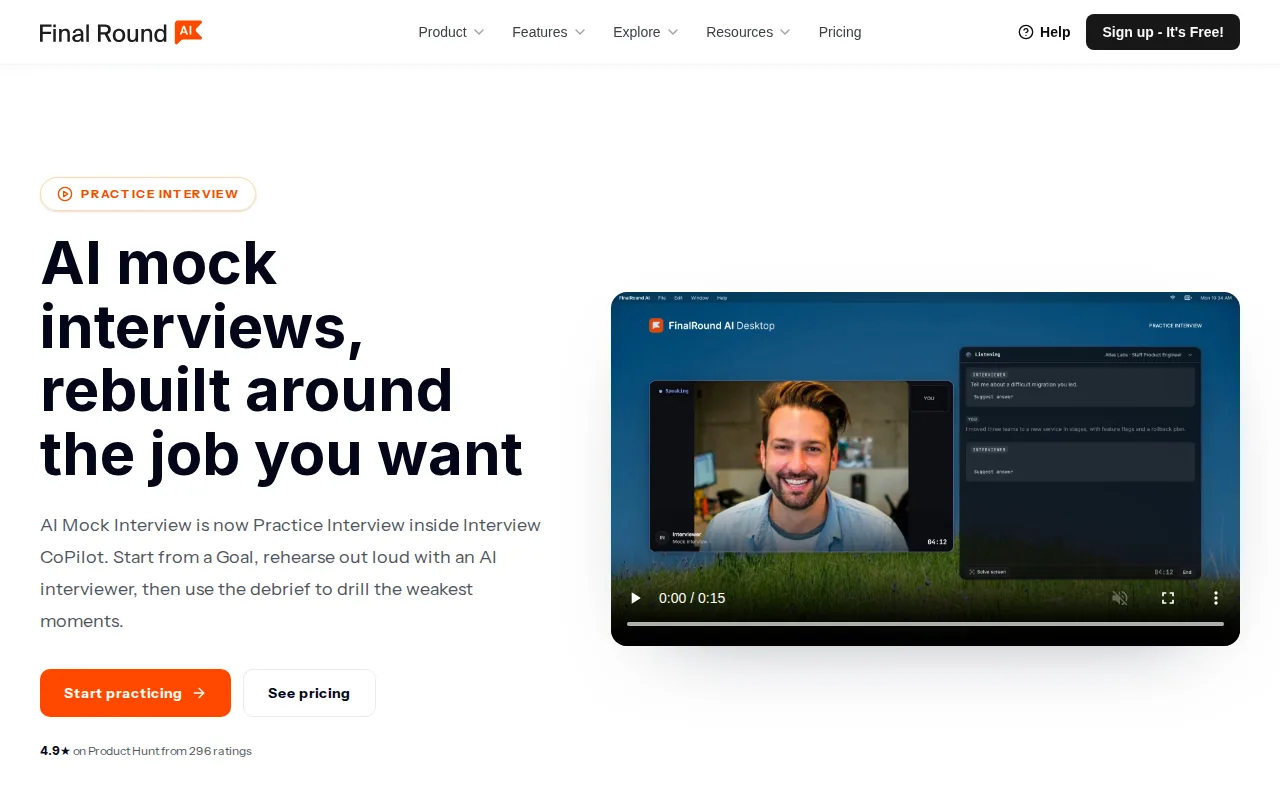
Consider it if you want a structured way to practise behavioral answers as part of your engineering preparation. STAR gives answers a clear shape. Keep your story focused on your own actions. If the question is about a disagreement over a service design, explain the context, your task, how you worked through the disagreement, and what happened next.
For technical questions, speak through your reasoning while you work. If you’re asked to design a URL shortener, for instance, start by clarifying expected traffic and the core features. Then explain your storage choice and how you’d handle growing load. A strong mock should help you spot where your explanation stops making sense, not just whether you reached an answer.
Final Round AI also has a separate Interview CoPilot product for live interview support. That is distinct from its AI Mock Interview practice mode. Use the practice product to build your answers, and check employer rules before using any assistance in an actual interview.
Mock coding interview platforms compared
The right choice depends on the kind of feedback you need. Peer practice puts another person across from you. AI-led tools make it easier to repeat a session on your own schedule. Human-led sessions can help you calibrate your performance with an experienced interviewer.
| Platform | Practice style | Useful for | What to keep in mind |
|---|---|---|---|
| Phantom Code AI | AI guidance for mock or live technical interviews | Coding, system design, and behavioral prep | Free signup credits; check interview rules before live use |
| Pramp | Peer sessions with role swaps | Speaking through solutions with another candidate | Session quality depends on your partner |
| interviewing.io | Practice with experienced interviewers | Expert feedback on technical rounds | Paid human sessions cost more than free practice |
| DevInterview.AI | AI-led voice mocks with scored feedback | Repeatable coding, system design, or behavioral practice | One full mock interview is free for new accounts |
| Sensei AI | Browser-based copilot and practice sandbox | Short coding practice and behavioral prep | Free sessions are limited to 15 minutes |
| Final Round AI’s AI Mock Interview | AI practice sessions with feedback | Behavioral answers alongside technical prep | Practice sessions need a paid plan |
When you review code, track more than whether it passes. Big O notation describes how an algorithm’s resource needs grow as its input grows.
For each mock, write down one thing to keep and one thing to fix. If you missed a boundary case, add a test for it next time. If you went quiet while coding, practise saying the next step before you type.
Mock Coding Interview FAQs
What happens in a mock coding interview?
A mock coding interview is a practice round that copies the shape of a technical screen. You get a problem, clarify its requirements, explain an approach, and write or discuss code under time pressure. The interviewer may ask follow-up questions. Afterward, use feedback to spot gaps in correctness, communication, or pacing.
How should I prepare for a coding mock?
Read the job description and identify the role’s likely interview focus. Practise a problem at the right difficulty, then rehearse explaining your plan aloud. Set up the editor and audio you expect to use. Prepare a few questions about the role for the real interview, and leave time after the mock to review what went well.
How do I use STAR for behavioral questions?
STAR means Situation, Task, Action, and Result. Start with the context, state what you needed to do, explain the steps you took, and end with the outcome. Keep the action part focused on your own choices. Practise with a story about a project setback or team disagreement, then check whether your answer makes your contribution clear.
How many mock interviews should I do?
There’s no single number that fits every candidate. Do enough sessions to find repeat patterns in your mistakes and practise fixing them. If you keep missing edge cases, add focused drills before booking another full mock. If your code is solid but your explanation is hard to follow, make speaking through your plan the main goal of your next session.
Conclusion
Choose the platform that matches your main gap: peer practice for live conversation, expert sessions for calibration, or AI for repeatable solo mocks. Practise explaining a solution aloud during a mock interview.