How to Practice Mandarin-English Code-Switching Interviews
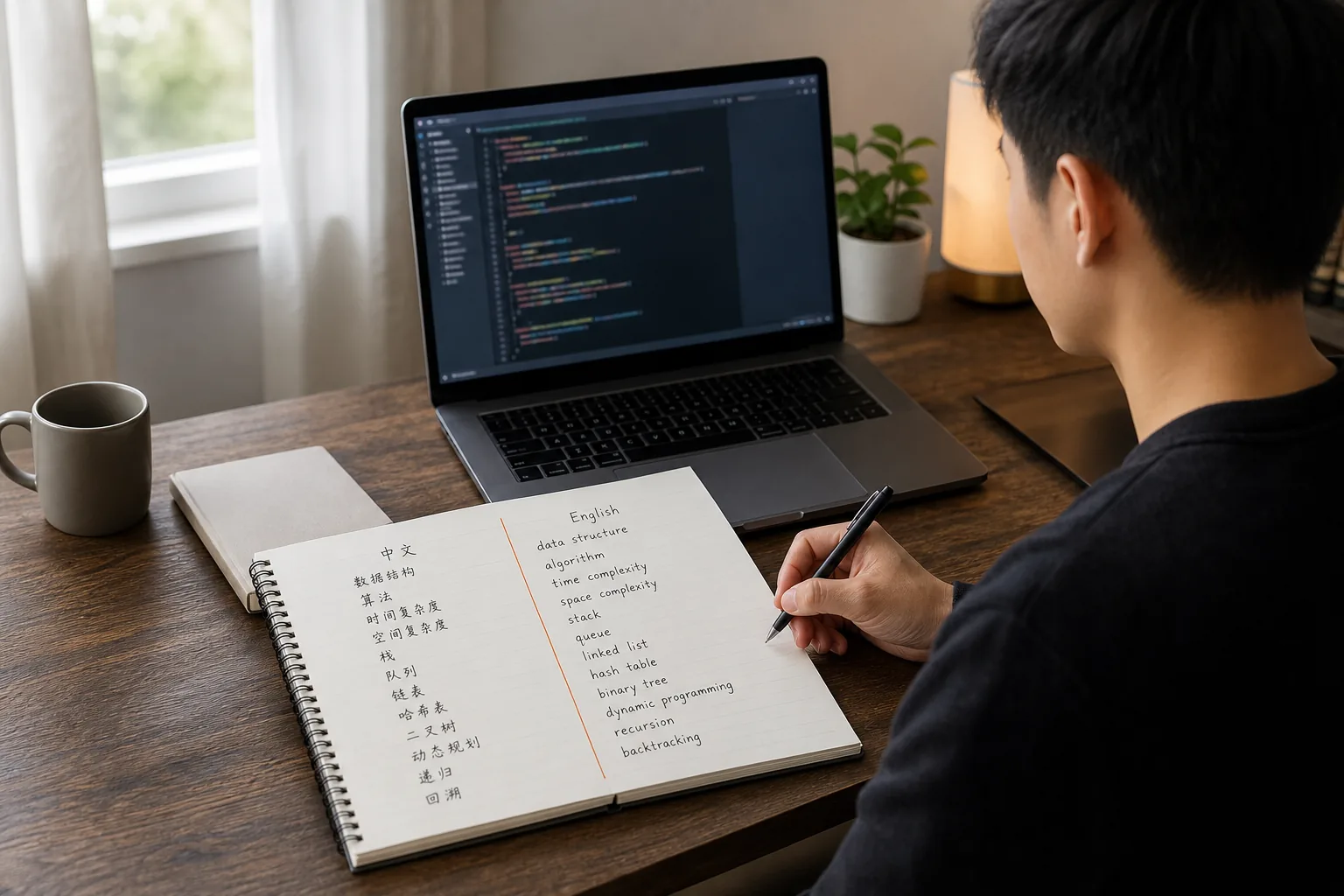
Learn to rehearse Mandarin-English interviews with clear language rules, technical vocabulary drills, timed coding mocks, and a focused recording review.
Mandarin-English interviews can shift languages mid-question or mid-answer, which makes it easy to lose your train of thought. To practice bilingual code-switching interviews in Mandarin and English, set rules for switching, map key technical terms, then rehearse the same interview tasks out loud.
Table of Contents
- Step 1: Set Clear Rules for When You’ll Switch Languages
- Step 2: Build a Mandarin-English Technical Vocabulary Map
- Step 3: Practice Explaining a Coding Problem While Switching
- Step 4: Rehearse Behavioral and System Design Transitions
- Step 5: Run a Timed Mock Interview and Review the Recording
- FAQ
- Conclusion
Step 1: Set Clear Rules for When You’ll Switch Languages
Goal: Make language changes deliberate enough that they don't interrupt your reasoning.
Before each practice round, decide what will trigger a switch. You might answer the opening question in the language the interviewer uses, then explain code in English if that's the language used for technical terms at work. Or you might use Mandarin to clarify a complex idea, then restate the key point in English.
Write down the rule in one sentence. For example: “I’ll answer in the interviewer’s language, but I can name code concepts in English and translate them if asked.” That gives you a default without forcing you to switch at awkward points.
Next, define a few useful switch points. Try changing languages when:
- You need to confirm what a question means.
- A technical term comes to mind faster in the other language.
- You want to restate a key decision for clarity.
Don't switch just to prove you can. A good change has a purpose: it helps you clarify the problem, explain a choice, or answer a follow-up. If you lose a word, pause and describe the idea in the language you have. Then give the matching term when it comes back.
Make a short opening script, too. For example: “I can work in Mandarin or English. I’ll follow your lead, and I may use English for code terms.” Say it aloud until it sounds like something you'd actually tell an interviewer. For a Mandarin-led practice round, make the same point in Mandarin.
Use that script in every mock, even if the practice partner already knows your language preference. Repeating it makes the first language change less surprising under time pressure.
By now, you should have a one-line language rule and a few clear reasons to switch.
Step 2: Build a Mandarin-English Technical Vocabulary Map
Goal: Recall the terms you need without stopping to translate every sentence.
Build a small vocabulary map from the interview topics you're studying. Start with terms that come up in coding rounds, such as 哈希表 (hash map), 滑动窗口 (sliding window), 边界条件 (edge case), and 时间复杂度 (time complexity). Add terms from system design if that's on your schedule, such as 缓存 (cache), 负载均衡 (load balancing), and 数据库分片 (database sharding).
For each term, add three things: the term in Mandarin, its English equivalent, and a short sentence you'd say in an interview. For example: “我会先用哈希表记录已经看过的值。” Then say the same idea in English: “I’ll use a hash map to store values I’ve already seen.” Keep sentences tied to a decision or action, not just a dictionary definition.
Sort entries by task instead of making one long word list. A coding group could cover data structures and complexity. A system design group could cover storage and traffic. A behavioral group could hold verbs you need to describe your role, such as “led,” “tested,” or “resolved.”
Phantom Code AI includes Mandarin-English among its bilingual modes, alongside support for Mandarin and other spoken languages. If you use an AI coach for practice, check that its language setup matches the kind of switching you want to rehearse in a mock round. The Phantom Code AI language and bilingual-mode details describe that support.
Review the map by speaking, not by silently rereading it. Cover one column and explain the term in the other language. Then use it in a full answer. Mark any term that makes you pause, and bring it into your next mock.
By now, you should have a working glossary built around the problems and roles you're preparing for.
Step 3: Practice Explaining a Coding Problem While Switching
Goal: Keep your explanation clear while the language changes.
Choose one coding problem you can solve without a long warm-up. Use a familiar pattern, such as a hash map for finding two numbers that add to a target. First, restate the task in the language you expect to use most. Then ask one clarifying question and explain your plan before you write code.
Try a short bilingual explanation. “I’ll scan the array once. 我会用哈希表记录每个数字需要的补数。” Then state the reason: “That lets me check for the matching value as I go.” The point isn't to insert Chinese into every line. It's to switch where it helps you express the idea, then return to a clear explanation.
Use the same order each time:
- Restate what the input and output should be.
- Describe the first approach in one or two sentences.
- Explain the data structure and why it fits.
- Walk through a small example.
- State time and space complexity.
On the next attempt, change the interviewer’s language. Keep the problem and the answer structure the same. This shows whether you can carry the reasoning across languages instead of memorizing one script.
Record a short section if you can. Listen for three things: long pauses before a key term, a switch that changes the meaning, or an explanation that trails off before the point is clear. Don't correct every accent or grammar choice. Fix the issue that made your reasoning hard to follow.
By now, you should be able to solve one problem while keeping the interviewer informed through a language change.
Step 4: Rehearse Behavioral and System Design Transitions
Goal: Switch languages without losing the structure of longer answers.
For a behavioral question, prepare a short story using situation, task, action, and result. Practice the story once in Mandarin and once in English. Then rehearse a version where you switch only at a natural point, such as explaining a technical action in English before summarizing its result in Mandarin.
Keep the facts steady across versions. Your role, the problem, and the outcome shouldn't change when the language does. If you lead with a technical term in English, add a brief explanation in Mandarin when the listener may not know it. That keeps the answer useful without turning it into a word-for-word translation.
For system design, practice a repeatable sequence. Clarify the goal first. Then describe the main components and one trade-off. For example: “我会先确认读写比例。” Next, explain in English why the read-to-write ratio could affect the caching plan. If you switch, mark the change with a short phrase such as, “Let me explain that trade-off in English.”
Practice switching during formal, interview-style prompts as well as casual conversation. This gives you a chance to rehearse clear transitions in the setting you are preparing for.
Now add follow-up questions. Ask yourself, “What would fail if traffic doubled?” or “What would I change if the team had less time?” Answer in the language that feels natural, then restate the decision in the other language if needed. Keep the structure intact even when the wording changes.

By now, you should have one behavioral story and one design answer that you can deliver in either language.
Step 5: Run a Timed Mock Interview and Review the Recording
Goal: Find the language slips that appear when you have to think and speak under a clock.
Set up a mock with one coding question, one behavioral prompt, or a short system design task. Use the time you'd expect in the interview. Ask a practice partner to choose the language at the start, then add one follow-up in the other language. If you're practicing alone, record both sides of the exchange and leave a pause before answering each prompt.
Phantom Code AI is a real-time AI interview assistant that listens, transcribes, recognizes problem types, and provides guidance during mock or live interviews. New accounts get free credits at signup with no card required. Use the mock setting to rehearse your own reasoning, then try the same question without assistance so you can tell what you can explain independently.
After the round, review only a few moments. Find one pause before a technical term. Find one answer where the language switch changed your point. Then find one place where you moved between languages smoothly. Write a correction for each weak moment, such as “state the input first” or “name the trade-off before the example.”
Use a simple review sheet:
- Clarity: Could a listener follow the answer?
- Switch point: Did the language change happen for a reason?
- Recovery: What did you say when a term slipped away?
- Technical detail: Did you explain the choice, not only name it?
Keep the next practice round narrow. If you lost time searching for terms, drill the vocabulary map. If your explanation got hard to follow, repeat the answer structure with a new prompt.
Repeat the weak part once, then run a fresh question. By now, you should have a clear next drill based on something you actually heard in the recording.
FAQ
Should I answer in Mandarin or English during a bilingual interview?
Use the language the interviewer starts with unless they invite you to choose. If you need another language to explain a point, say so briefly and make the switch clear. For practice, agree on the rule before the mock begins. That way, the language choice tests your communication rather than surprising your partner.
How do I switch languages without losing my train of thought?
Pause at a thought boundary, such as the end of a sentence or before you explain a trade-off. Keep your answer structure in mind, then continue with the next point in the other language. If a word disappears, describe its function first. You can return to the exact term once your reasoning is clear.
What Mandarin technical terms should I practice for coding interviews?
Start with words tied to the problems you are solving. Useful examples include 哈希表 for hash map, 滑动窗口 for sliding window, 边界条件 for edge case, and 时间复杂度 for time complexity. Add a sentence for each term so you can explain an action or choice, rather than only reciting a translation.
How often should I record bilingual mock interviews?
Record enough rounds to spot a pattern, but review one issue at a time. After a mock, replay a short section where you hesitated or switched languages. Pick one change for the next round, such as stating your plan before coding. A focused review is easier to use than trying to judge every word at once.
Conclusion
Build a language rule and a technical vocabulary map, then test both in timed practice. Start with one familiar coding problem: record your explanation, review one weak switch, and repeat it without help. Phantom Code AI can support a mock round when you want guided practice, but your final check should be whether you can explain the answer on your own.