Top 5 Hard LeetCode Problems to Challenge Yourself

Take on five hard LeetCode problems in arrays, dynamic programming, heaps, and sliding windows. Learn the core challenge and technique behind each.
Hard LeetCode problems test more than whether you know an algorithm. They test whether you can spot the useful structure, explain your choices, and handle edge cases under pressure. Here are five problems worth practicing, each with a different technique to sharpen.
We analyzed 28 comments and questions from Reddit and Quora about hard leetcode problems and found that 29% mentioned limited real world relevance.
Table of Contents
- Median of Two Sorted Arrays: Binary Search Under Pressure
- Regular Expression Matching: Dynamic Programming With Tricky Rules
- Merge k Sorted Lists: Heap and Divide-and-Conquer Practice
- Trapping Rain Water: Compare Two-Pointer and Stack Reasoning
- Minimum Window Substring: Sliding-Window State Management
- Hard LeetCode Problems Compared: Topic, Technique, and Interview Skill
- Hard LeetCode Problems FAQ
- Conclusion
1. Median of Two Sorted Arrays: Binary Search Under Pressure
This problem asks for the median of two sorted arrays in O(log(m + n)) time. A full merge is easy to picture, but it takes linear time and misses the main constraint.
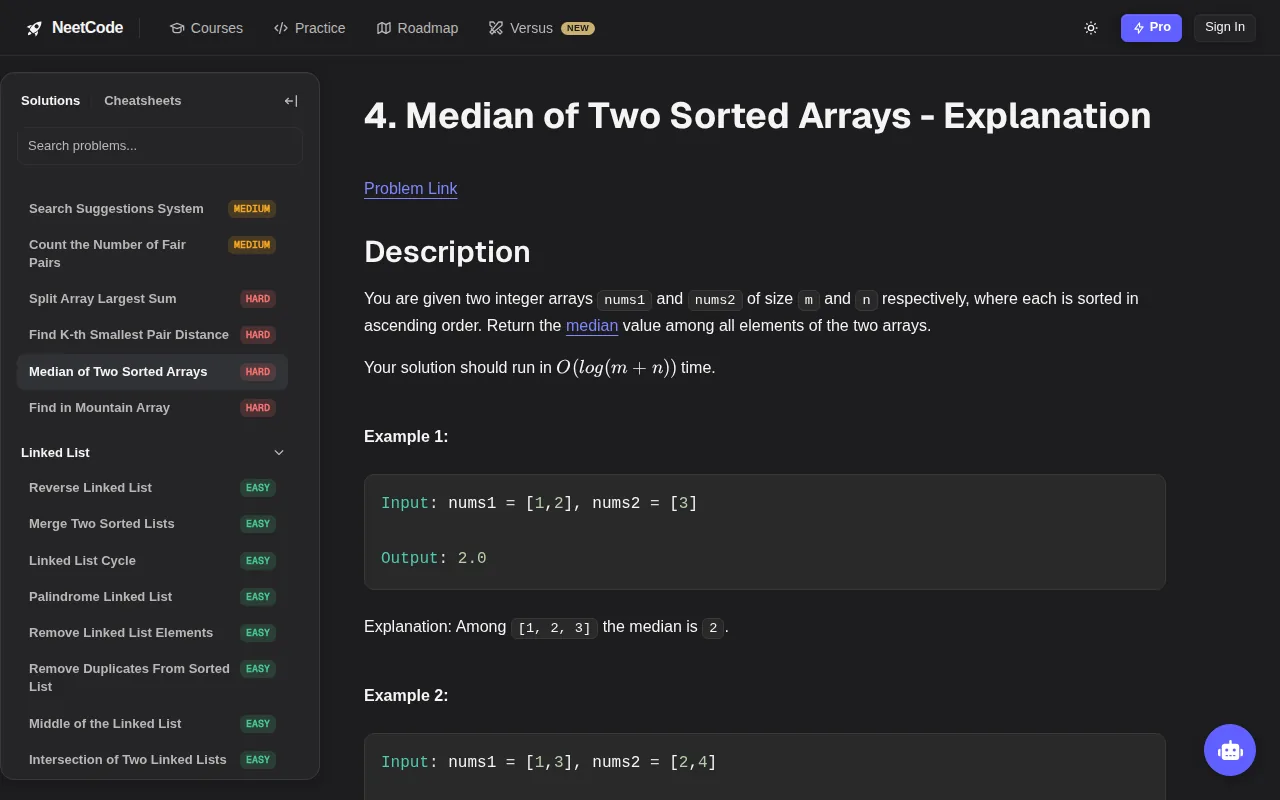
Instead, find a partition that splits both arrays into left and right halves. The left half should contain the right number of values, and its largest value must be no greater than the smallest value on the right. Since each input is sorted, you can check that condition with just the values beside each partition.
Binary search over the shorter array. For each possible cut, calculate the matching cut in the other array. If the left edge of the first array is too large, move its cut left. If the second array's left edge is too large, move the first cut right. The binary search method works here because the sorted order lets each check rule out half of the remaining choices.
Once the partition is valid, the answer comes from the largest value on the left. For an even total length, average that value with the smallest value on the right. Be careful with cuts at either end of an array, where one side has no value. Handle those edges explicitly rather than treating them as ordinary numbers.
In an interview, say why you search the shorter array: it keeps the search range small and makes the other cut easy to derive. Then test an empty array, arrays with different lengths, and a total length that is even.
This is a useful exercise in turning a requirement about a merged result into a search over a valid split. For more pattern practice across arrays and other topics, see LeetCode Patterns: A Practical Explainer.
Phantom Code AI can help with mock interview practice by transcribing a prompt and giving real-time guidance. For this problem, use any hint to check your partition logic, then try the solution again without help.
2. Regular Expression Matching: Dynamic Programming With Tricky Rules
Regular Expression Matching asks you to match a whole string against a pattern with two special rules: a dot matches any single character, and an asterisk matches zero or more of the character before it. A partial match does not count.
The hard part is the asterisk. When you reach a pattern character followed by an asterisk, there are two paths to test. The pair might match zero characters, so skip both pattern characters. Or it might match the current string character, so keep the pattern position and advance through the string.
Define a state by two positions: one in the input string and one in the pattern. Each state asks whether the remaining suffixes match. Save each answer, because different choices around an asterisk can lead back to the same pair of positions. Without that saved work, recursive calls can repeat the same checks.
A useful base case is reaching the end of the pattern. The match succeeds only if the input has ended too. For an empty input, the pattern can still match if it consists of pairs such as a letter followed by an asterisk, each of which can be skipped.
This problem is a good test of whether you can define a clear state before writing code. The dynamic programming approach stores answers to smaller subproblems, then uses them to resolve larger ones. A top-down solution with memoization is often easier to explain first; a table-based version can follow once the state transitions are clear.
After coding, test a pattern that matches zero copies, one that matches several copies, and one that fails only at the final character. That last case catches solutions that accept a matching prefix instead of the whole string.
3. Merge k Sorted Lists: Heap and Divide-and-Conquer Practice
Here, you’re given several linked lists, each sorted in ascending order. The goal is to combine them into one sorted list without throwing away the order you already have.
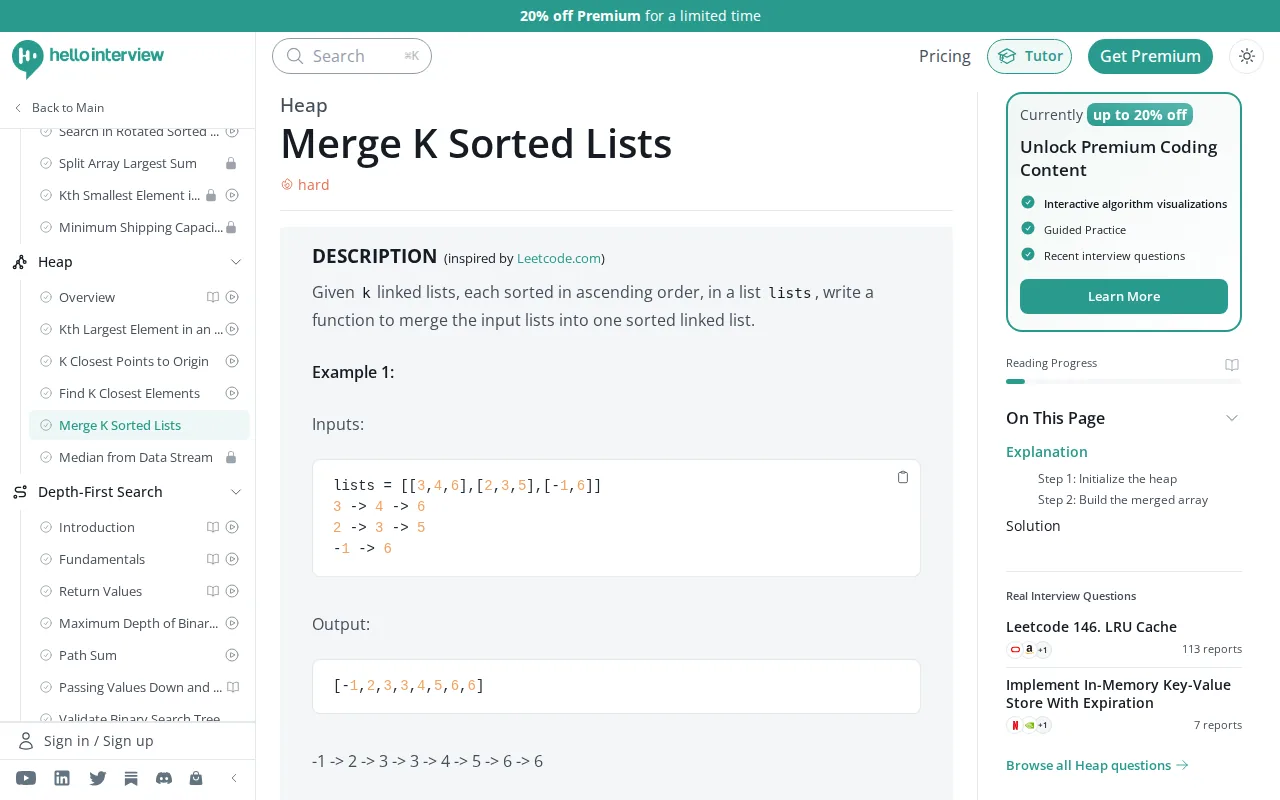
A simple method merges each new list into the result so far. But as the result grows, each later merge may have to scan many earlier nodes. Another method puts every value in an array and sorts it, but that ignores the fact that each input is already ordered.
A min-heap keeps the current head node from each nonempty list. Remove the smallest head, add it to the output, and place that node’s successor in the heap. Repeat until the heap is empty. Each node is handled once, and the heap holds at most one node per list at a time.
If there are N total nodes and k lists, this method takes O(N log k) time and O(k) extra space. The key interview point is why a heap fits: the next node must be the smallest among the current list heads, not among every node in every list.
Divide and conquer gives another good route. Merge lists in pairs, then merge those results in pairs again. This keeps the merging balanced, much like a merge sort. Comparing the two approaches is useful: the heap makes the next smallest node explicit, while pairwise merging reuses the standard two-list merge.
Watch for empty input, lists of different lengths, and duplicate values. Also be clear about whether you’re reusing existing nodes or building new ones. That choice affects implementation details, even though the core ordering idea stays the same.
4. Trapping Rain Water: Compare Two-Pointer and Stack Reasoning
Given bar heights across an elevation map, work out how much rainwater can sit between them. Each position’s water depends on the tallest wall to its left and its right. The water above a bar is the smaller of those wall heights, minus the bar’s own height, if that result is positive.
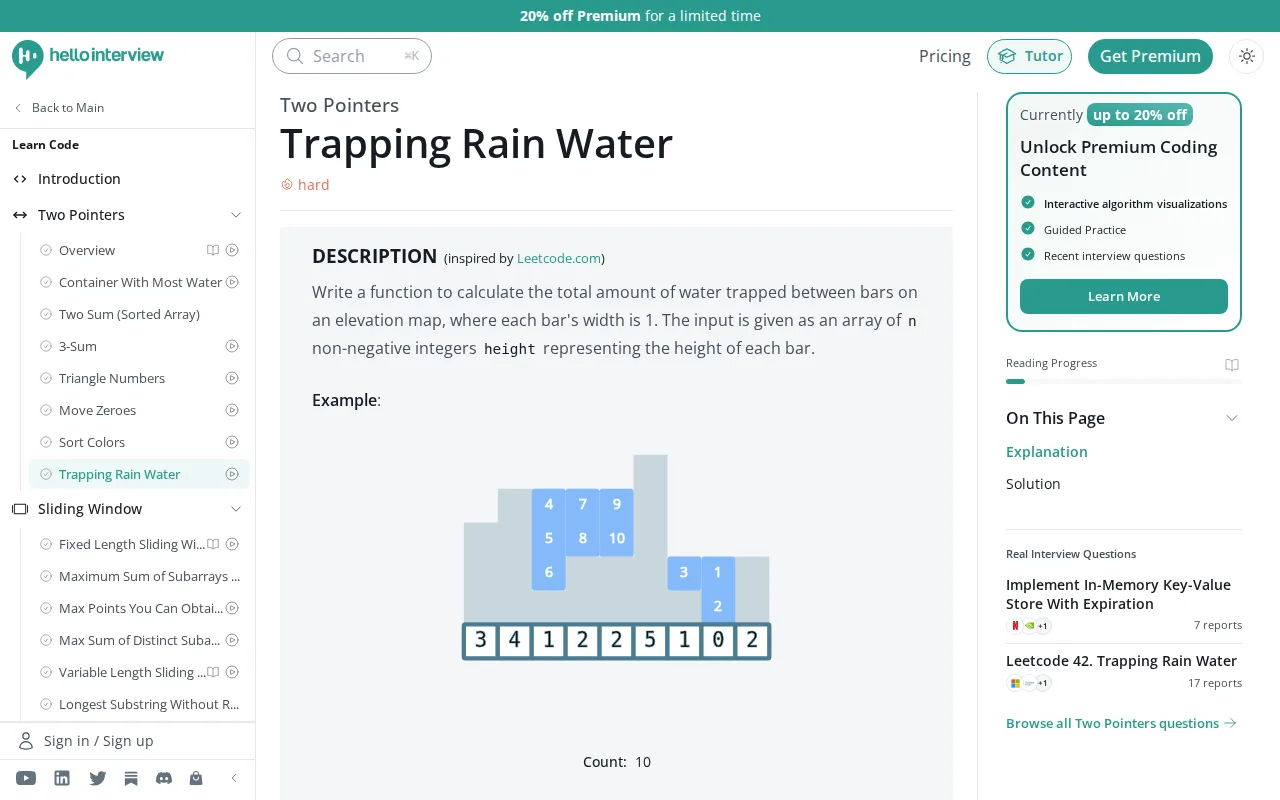
A direct approach finds the tallest bar on each side for every position. It’s easy to understand, but it repeats work. The challenge is to keep track of the needed boundary information as you scan.
With two pointers, start at both ends and track the tallest bar seen from each side. When the left maximum is no taller than the right maximum, the left side determines the water level at that position. Add any water there, then move the left pointer inward. Otherwise, process the right side. The shorter boundary is safe to resolve because the opposite side already has a wall at least as tall.
A monotonic stack offers a different way to reason about the same shape. Keep indices of bars in a stack. When a new bar is taller than the bar at the top, it may close a dip. Pop the dip, then use the new bar and the remaining stack top as the walls. The index gap gives the width; the difference in heights gives the water depth.
Choose the two-pointer method when you can explain why one side is settled at each move. Choose the stack method when you want to practice reading a basin as a bounded valley. Both approaches reward a careful dry run. Try a flat row, a steadily rising row, and a single deep dip to check your boundary logic.
In an interview, don’t jump straight to code. Explain what each pointer or stack entry represents, then show how one position’s contribution is calculated. That explanation makes off-by-one mistakes easier to spot.
5. Minimum Window Substring: Sliding-Window State Management
Minimum Window Substring asks for the shortest part of one string that contains every character from another string, including repeated characters. If the target has two of a letter, a valid window must have two as well.
Count the characters required by the target first. Then expand a window across the source string with a right pointer. Track the characters inside the window and how many required occurrences it has met. Once the window contains everything, move the left pointer forward while it stays valid. Save the shortest valid range as you go.
The tricky part is maintaining the count correctly. If the target needs two copies of a character, seeing one copy is not enough to meet that character’s quota. Extra copies can sit in the window, but removing one from the left may make the window invalid. Your update logic needs to distinguish those cases.
The scan runs in O(m + n) time, where m and n are the lengths of the source and target. Each pointer moves forward through the source, rather than restarting a full search for every possible substring. The working counts take space based on the character set.
Test a target with repeated letters, a target longer than the source, and a case where the shortest answer starts well after the source begins. Also test when no valid window exists. These cases reveal whether your code handles quotas and the empty-result condition.
Phantom Code AI can transcribe a prompt during mock interview practice, which gives you a written version to review after solving. Try explaining why shrinking the left side is safe only while the current window still meets every character quota.
Hard LeetCode Problems Compared: Topic, Technique, and Interview Skill
These five problems are useful for different reasons. Pick based on the skill you need to work on, not only the topic label. The best practice set should expose a gap you can name and then retest.
| Problem | Main technique | What it tests in an interview | Good choice when you need to practice |
|---|---|---|---|
| Median of Two Sorted Arrays | Binary search on a partition | Reasoning from sorted boundaries | Reducing a search space without merging |
| Regular Expression Matching | Dynamic programming with memoization | Defining states and handling branching rules | Building transitions for tricky cases |
| Merge k Sorted Lists | Min-heap or pairwise merging | Choosing a structure for repeated minimum lookup | Using existing order efficiently |
| Trapping Rain Water | Two pointers or monotonic stack | Tracking boundaries and explaining safe moves | Turning a visual shape into exact calculations |
| Minimum Window Substring | Variable-size sliding window | Keeping counts in sync as a window changes | Managing repeated character requirements |
For interview prep, solve each problem once without hints, then explain the core invariant aloud. Record the mistake you made or the step you couldn’t justify. Return to that same problem later and try again from a blank editor.
Phantom Code AI is designed for coding interview practice and can offer real-time guidance while transcribing the conversation. Use it in a mock session when you want to practice responding to spoken prompts, then repeat the problem independently to check what you can recall.
Hard LeetCode Problems FAQ
What is a good hard LeetCode problem to start with?
Merge k Sorted Lists is a useful starting point if you know how to merge two sorted lists. The heap solution builds on that ordered input and gives you a clear reason to use a priority queue. If you’re less comfortable with heaps, start by implementing pairwise merging, then compare its work with the heap method.
How should I practice hard LeetCode problems?
Try the problem without looking at a solution first. Write down the input pattern and the constraint that rules out a simple approach. Then state your key invariant before coding. Afterward, test edge cases and explain the time and space cost. Repeat the problem later without hints to see what stuck.
Are hard LeetCode problems asked in coding interviews?
Some interviews use hard-level questions, while others use easier problems or variations. Exact questions differ by team and interviewer, so don’t prepare by memorizing answers alone. Focus on the patterns behind a problem and practice explaining how you’d adapt the approach when the input or constraints change.
Should I use hints when practicing hard problems?
Hints can help when you’re stuck, but take one small hint at a time. Give yourself a chance to use it before asking for more. Then close the solution and write the approach yourself. During a mock interview, a tool such as Phantom Code AI can provide real-time guidance, but independent practice shows what you can solve unaided.
Conclusion
Choose one problem that targets a skill you can’t yet explain clearly, then solve it under a time limit and review your reasoning. If you want spoken-prompt practice, use Phantom Code AI in a mock session; afterward, redo the problem without guidance.