FAANG Interview Preparation: A Step-by-Step Plan
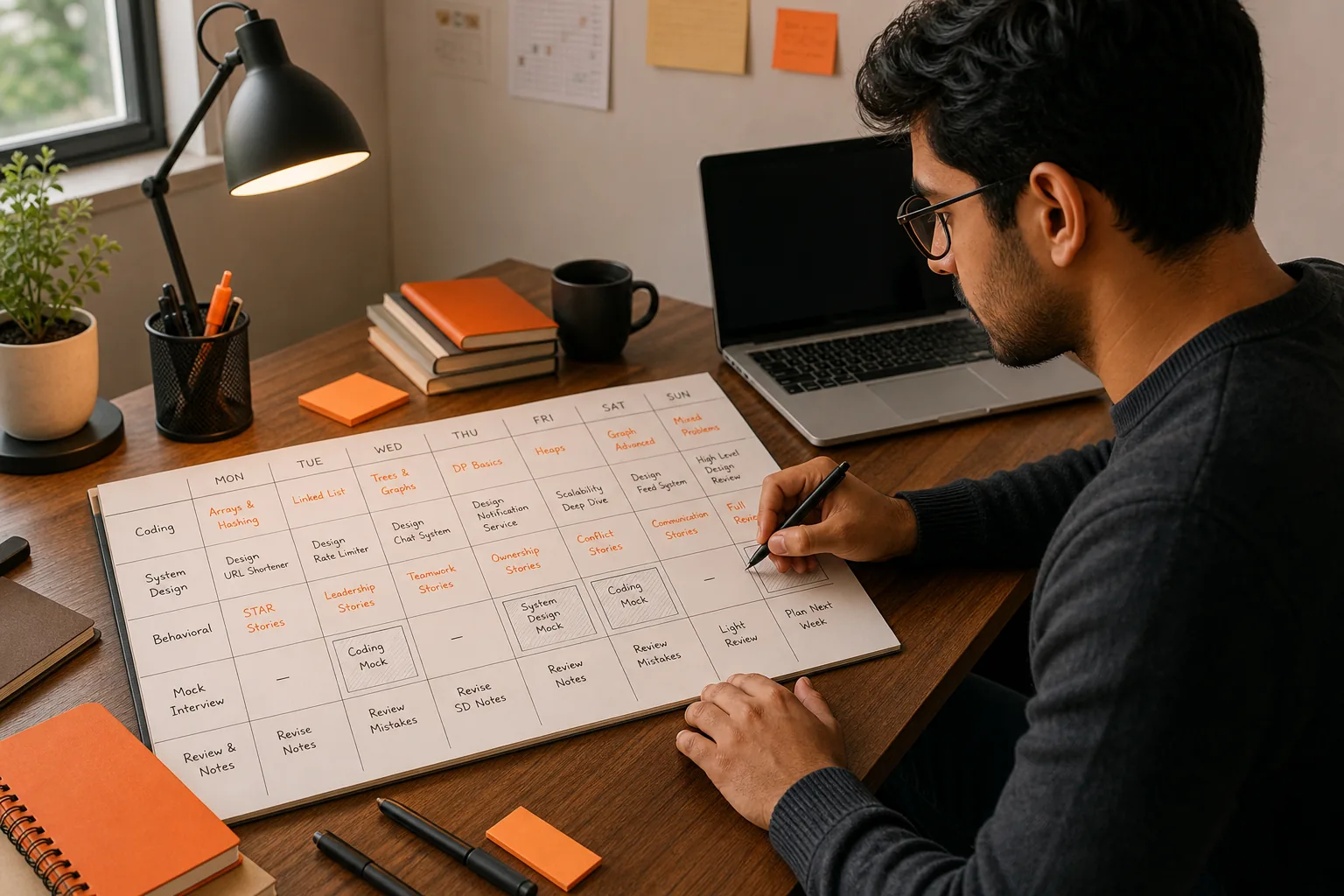
Build a focused FAANG interview preparation plan for coding, system design, behavioral rounds, and mock practice, with clear ways to track progress.
FAANG interview preparation gets harder when you spend all your time on coding and leave other rounds to chance. A clear plan helps you cover the full interview loop, practice how you think out loud, and spot weak areas before the real interviews.
Start by mapping the likely rounds. Then split your prep into focused practice blocks for algorithms, system design, behavior, and mock interviews.
We analyzed 5 top-ranking guides (Intervue, InterviewBit, Interview Kickstart, 2 AlgoCademy posts) about FAANG interview preparation and found that only 1 of 5 tells readers to keep a log of their mistakes. Just 2 of 5 lay out a multi-week schedule.
Table of Contents
- Step 1: Map the Interview Loop and Set a Preparation Plan
- Step 2: Build a Data Structures and Algorithms Roadmap
- Step 3: Practice Solving Coding Problems Out Loud
- Step 4: Prepare for System Design and Behavioral Rounds
- Step 5: Run Mock Interviews, Review Gaps, and Refine
- FAQ
- Conclusion
Step 1: Map the Interview Loop and Set a Preparation Plan
Goal: Know what you need to prepare for before you set your study schedule.
Ask your recruiter what the process includes, which role level you’re being considered for, and whether you’ll have a domain-specific round. A loop may include a recruiter screen, an online coding test, live coding, system design, behavioral questions, or a role-specific discussion. The exact mix varies by team and role, so use the information you get for your interview rather than treating a general outline as a promise.
Make a one-page map with each likely round, its format, and your confidence level. Mark the gaps honestly. For example, you may be comfortable with coding alone but less practiced at explaining your choices while you type. That’s a different problem from not knowing how to use a graph traversal.
Next, choose a timeline that fits your starting point and weekly schedule. A month can work for an engineer with solid fundamentals and time for regular practice. If core topics feel rusty, give yourself longer. The 30-day FAANG coding interview roadmap can help you turn a short prep window into weekly blocks, but adjust it to your actual interview loop.
Set a weekly target for each round type. For example, reserve weekday sessions for DSA, then use a weekend block for one system design prompt and a behavioral story review. Keep one lighter day in the week. Fatigue makes it harder to judge whether your practice is working.
Track actions you can control: new problems attempted, old mistakes reviewed, and mock sessions completed. Don’t use solved-problem count as your only measure. A problem you can explain and adapt is more useful than one you once got accepted by copying a known pattern.
Step 2: Build a Data Structures and Algorithms Roadmap
Goal: Learn to recognize problem patterns and choose a sound approach under time pressure.
Begin with arrays and strings, then add hash maps, two pointers, sliding windows, stacks, queues, trees, graphs, heaps, and dynamic programming. You don’t need to study each topic in isolation for weeks. Learn the core idea, solve a few problems that use it, then revisit it in mixed practice.
For each problem, write down the clue that points to a pattern. A sorted array may suggest binary search or two pointers. A prompt about the longest substring often points toward a sliding window. A shortest-path question may call for breadth-first search when every edge has the same cost.
Then work through a repeatable routine:
- Read the constraints and check what the input can contain.
- Describe a simple solution before trying to optimize it.
- Pick a data structure and explain why it fits.
- State the time and space cost, including any sorting step.
- Test a normal case, an edge case, and a case that could break your logic.
Big O notation describes how an algorithm’s time or space use grows as input size grows. Use it to explain trade-offs, not as a phrase to recite at the end. For instance, sorting before scanning may make a solution easier to reason about, while a hash map may avoid the sort. Your choice should fit the constraints and the problem’s goals.
Keep an error log. Name the cause, not just the topic: “forgot to move the left pointer after a duplicate” is more useful than “bad at sliding window.” At your next session, solve a fresh problem that tests the same idea. If you can explain why your earlier approach failed, you’re learning more than if you only reread the solution.
Let patterns guide your study, but don’t force every new prompt into the last pattern you practiced. A useful roadmap builds recall and judgment together.
Step 3: Practice Solving Coding Problems Out Loud
Goal: Make your reasoning easy for an interviewer to follow while you work.
For each timed problem, speak before you code. Restate the task in your own words, ask about unclear input, and name the cases you’ll need to handle. Then explain a first approach. If it’s too slow, say what makes it slow before you move to a better one.
During implementation, narrate decisions that affect correctness. You might say, “I’m storing each value’s index so I can check for the complement in one pass.” That gives the interviewer a chance to follow your choice and question it. You don’t need to describe every keystroke.
At the end, walk through your code with a small example. Check empty input if the prompt allows it. Also check duplicates, a single item, or a case where no answer exists. Then give the time and space complexity. A correct result with no explanation leaves the interviewer with less evidence of how you reached it.
Use a simple self-review after each session. Score yourself on whether you clarified the task, chose an approach, wrote readable code, tested the result, and explained complexity. These are useful signals because coding interviews assess communication and testing alongside problem solving.
Record a few solo sessions if you can. Listening back can reveal long silences, rushed explanations, or a habit of starting to code before stating a plan. Pick one habit to change in your next session. Trying to fix every issue at once makes it hard to tell what helped.
Phantom Code AI can support mock practice by listening, transcribing, recognizing problem types, and giving real-time guidance. Use that feedback to review your reasoning, then solve a fresh problem without prompts. The goal is to strengthen your own judgment. Before using any assistant during a live interview, check the employer’s rules and follow them.

Step 4: Prepare for System Design and Behavioral Rounds
Goal: Show clear judgment in open-ended design discussions and give evidence in stories about your work.
Work through system design prompts
Start each design prompt by clarifying the user’s needs. If asked to design a news feed, ask which actions matter most, what scale you should assume, and whether the interview focuses on posting, reading, or both. State your assumptions before drawing components.
Once the scope is clear, sketch the main flow. Explain where data enters, how it gets stored, and how a request reaches the user. Then pick one area for a deeper discussion. For a feed, you might compare assembling posts when someone opens the app with preparing a feed as posts arrive. Explain the trade-off you’re making and what could change your choice.
Practice designs that use different ideas, such as storage, search, messaging, and feeds. Don’t memorize a finished diagram. A follow-up about a new constraint should lead you to revise your design, not repeat a script.
Build a bank of STAR stories
Write short notes for stories about a hard technical choice, a mistake, a disagreement, and a project you owned. For each one, set out the Situation, Task, Action, and Result. Spend most of the answer on what you did and why. Be clear about your own part when the work involved a team.
Use outcomes you can support. If you don’t remember a metric, explain the result plainly rather than guessing. Prepare for follow-up questions about what you would change or how you handled a setback. Structured interviews typically use planned questions and consistent criteria to assess answers.
Adjust the emphasis for your role. A software engineer may need to explain a technical trade-off. A machine-learning engineer should be ready for questions about model choices and evaluation. A product manager may need to show how they made a decision with limited information. Ask the recruiter which specialist topics may appear.
Phantom Code AI supports practice for coding, system design, and behavioral interviews. Use mock feedback to make an answer clearer, but keep your stories accurate and in your own voice.
Step 5: Run Mock Interviews, Review Gaps, and Refine
Goal: Find the parts that break under interview conditions, then repair them with focused practice.
Start mocks once you have working knowledge of the basics. Use unseen problems when possible. A familiar prompt can test recall, but it won’t show whether you can reason through a new one while someone watches.
Practice in the format you expect. For a coding round, set a timer and use the same kind of shared editor or whiteboard you’ll have in the interview. For system design, ask a partner to change a requirement halfway through. For behavior, have them ask a follow-up about your specific role in the result.
After each mock, take a short break, then write down what happened. Separate knowledge gaps from delivery gaps. “Didn’t know how to model the graph” needs topic study. “Knew the traversal but never explained why it fit” needs a communication drill.
Turn each note into one next action. If you skipped testing, end the next three coding sessions with a spoken walkthrough. If your story ran long, cut background details and rehearse the action and result. If a design stayed vague, practice stating a scale assumption before drawing.
Phantom Code AI can help with guided mock practice and review. It runs on macOS and Windows, and new accounts get free credits at signup without a card. Treat any AI feedback as a prompt to check your reasoning, not as proof that an answer is correct.
Track readiness by round type. You’re making progress when you can solve an unfamiliar medium problem with clear reasoning, guide a design discussion from scope to trade-offs, and answer behavioral follow-ups without losing the thread. If one area still lags, spend the next week there rather than adding more work to every category.
FAQ
How long should I prepare for a FAANG interview?
Prepare for as long as you need to cover the rounds in your interview loop and improve your weakest areas. A focused month may suit an engineer with strong fundamentals and regular study time. If you’re rusty or targeting a senior role with design interviews, allow more time. Ask your recruiter for the likely format before setting a deadline.
How many coding problems should I solve before an interview?
There isn’t one problem count that guarantees readiness. Focus on recognizing patterns, explaining your choices, and testing solutions. Keep a log of mistakes and revisit them with new problems. If you can handle unfamiliar questions and explain the time and space costs, you’re better prepared than someone who has solved many prompts without reviewing them.
Should I use AI while preparing for coding interviews?
Yes, AI can help you practice by prompting your reasoning or giving feedback during a mock. Don’t treat its suggestions as verified answers. Try the problem yourself first, check the reasoning, and then solve another prompt without help. During a live interview, use an assistant only if the employer’s rules allow it.
How do I know if I’m ready for the interview loop?
You’re closer when you can work through an unfamiliar coding prompt without long, unexplained pauses, lead a system design discussion from requirements to trade-offs, and support behavioral answers with specific actions. Use mocks to test those skills. A weak result is useful if it gives you one clear repair task before the next session.
Conclusion
Build your plan around the rounds you’re likely to face, then use mock interviews to find and fix the gaps. This week, ask your recruiter about the loop and schedule your first timed practice session.