Coding Interview Cheat Sheet: Big-O, Patterns, Practice
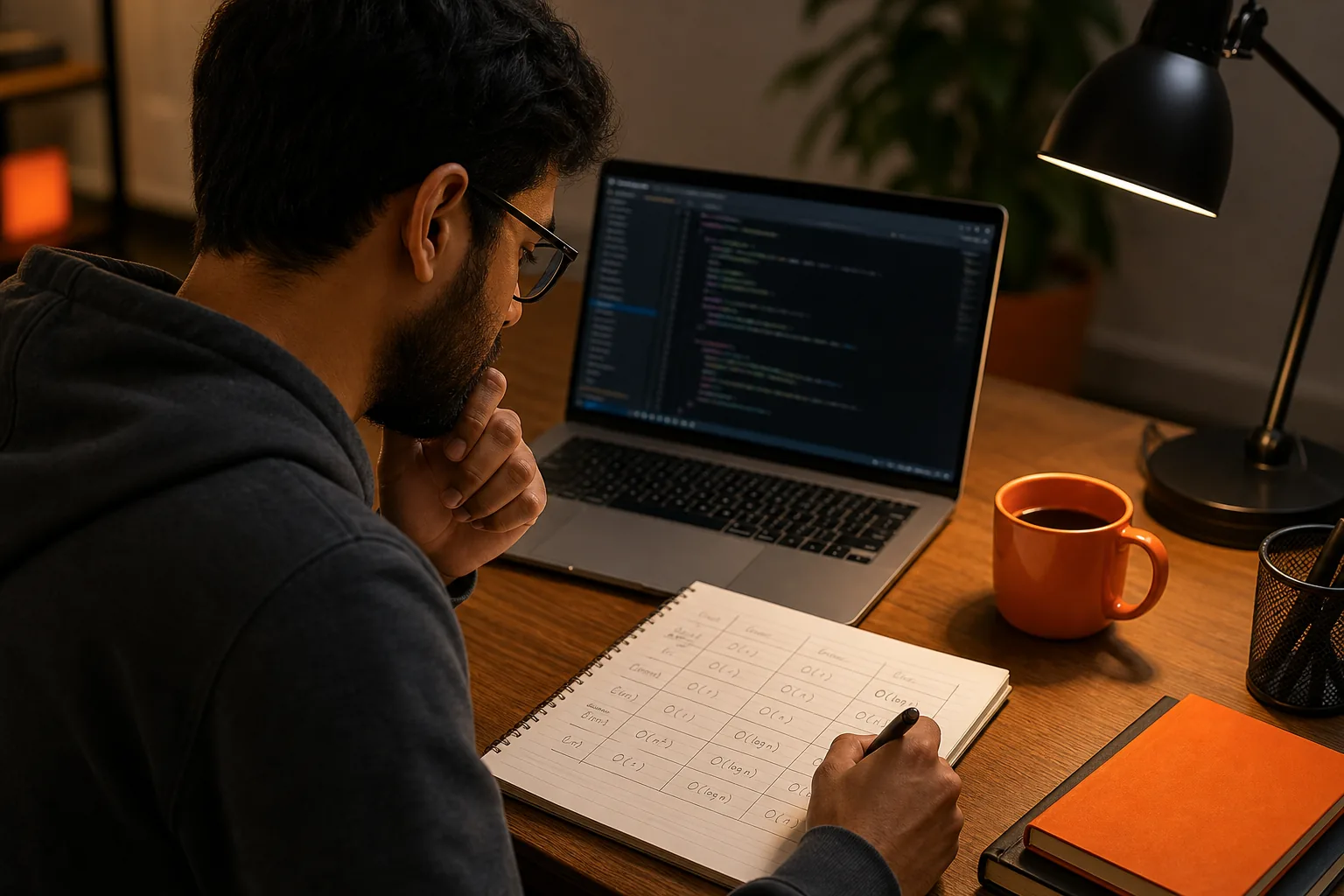
Use this coding interview reference to review Big-O, spot DSA patterns, choose practice resources, and prepare for technical, design, and behavioral rounds.
A coding interview cheat sheet is useful when it helps you make a decision, not when it gives you one more page to memorize. Start with the costs and patterns you need to explain, then use practice materials to test whether you can spot them without a label.
We analyzed 30 Reddit comments about coding interview cheat sheets and found that 27% mentioned overly theoretical interview questions.
Table of Contents
- Big-O Cheat Sheet: Operations to Recall Under Pressure
- Pattern Recognition Resources for Choosing an Approach
- Worked Coding Pattern Examples for Deeper Review
- Study Plans and Question Sets for Structured Practice
- Mock Interview Practice and Real-Time Interview Support
- FAQ
- Conclusion
Big-O Cheat Sheet: Operations to Recall Under Pressure
Big-O describes how an algorithm’s time or extra memory grows as its input grows. In an interview, state both. Then explain the choice that creates the cost, such as scanning a list or storing values in a hash map.
Keep this short reference in mind. It’s a starting point, not a substitute for checking what each operation does in your language.
| Operation or approach | Typical cost | Watch for |
|---|---|---|
| Read an array item by index | O(1) | Finding an item by value still needs a scan. |
| Scan an array once | O(n) | Nested scans over the same input can reach O(n²). |
| Binary search | O(log n) | The search space must be ordered or have a monotonic condition. |
| Sort n items | O(n log n) | Sorting may simplify later work, but it changes the input order. |
| Hash lookup | O(1) average | Worst-case behavior can be O(n). |
| Append to a dynamic array | O(1) amortized | An occasional resize takes O(n). |
Extra space counts memory your solution adds beyond the input. A frequency map for n values takes O(n) space. A few pointers take O(1). Recursive calls count too: tree depth h can mean O(h) stack space.
Big-O compares how time or memory grows as input size increases. Interview answers should explain trade-offs, not just name a complexity.
One common trap is removing the first item from an array-backed list. The remaining items may need to shift, so the operation costs O(n). If your code repeatedly inserts at the front, look for a different structure or build the result in reverse.
When you compare solutions, be precise: “This version takes O(n) time and O(n) extra space because the map stores seen values.” That tells the interviewer what drives the cost.
Pattern Recognition Resources for Choosing an Approach
Pattern recognition begins with the prompt’s shape. A sorted array may suggest two pointers. A contiguous substring with a changing condition often points to a sliding window. A graph of dependencies may call for topological sorting.
Useful references connect a cue in the question to a technique and its likely cost. A modular set of cheat sheets can make that easier: one reference for operation costs, one for pattern triggers, and another for worked examples. That structure lets you look up the exact gap instead of rereading a long all-in-one document.
For a broader set of problem cues, the LeetCode patterns guide can help you compare common techniques by problem type. Use it to build a shortlist of patterns to drill, not as proof that every prompt has one obvious label.
Cards suit quick recall. A set of pattern recognition cards can prompt you to ask which technique fits before you see a solution. A searchable pattern cheat sheet has a different use: it lets you look up a technique by category or keyword.
Don’t treat any pattern count as a universal syllabus. Different resources group techniques in different ways. Some put BFS and DFS under graph traversal; others split them into separate patterns. Your goal is to recognize the invariant, the rule that stays true as your algorithm runs.
Try this sequence when a prompt feels unfamiliar:
- Check the input size and constraints. They can rule out slow approaches.
- Look for a structural clue, such as sorted data, a contiguous range, or repeated states.
- Choose a data structure whose operations fit the task.
- Say the expected time and space cost before you code.
If the prompt says “longest contiguous segment,” ask whether a window can expand and shrink while keeping a clear condition true. If it asks for the k largest values, compare a size-k heap with sorting the full input. The question’s structure should lead your choice.
Worked Coding Pattern Examples for Deeper Review
Worked examples are most useful when they show why a pattern fits. Read each problem once for the task, then again for the constraint that shapes the solution.
Two pointers on sorted data
Suppose a sorted array must return a pair that sums to a target. Put one pointer at each end. If the sum is too small, move the left pointer right; if it’s too large, move the right pointer left. Each move removes pairs that can’t work, so the scan takes O(n) time and O(1) extra space.
The sorted order is doing the work. Without it, moving a pointer based on the current sum would not safely rule out other pairs. A hash set may fit an unsorted version, but it uses O(n) extra space on average.
Sliding window for a constrained substring
For the longest substring without repeated characters, expand the right edge one character at a time. Track the last position of each character. When a repeat appears inside the current window, move the left edge past its earlier position. Each edge moves forward, so the scan is linear.
Be careful not to move the left edge backward. If a character’s saved position is already outside the current window, it should not change the window’s start.
Heap for a small top-k result
When the task asks for the k largest values, sorting all n values costs O(n log n). A min-heap capped at k items can take O(n log k) time, because each new value only needs to compete with the smallest item in the heap. It also uses O(k) space.
That choice fits when k is much smaller than n. If the problem asks for the whole input in order, a heap adds work without helping the output.
A catalog with worked examples can help you compare these cases, but don’t memorize code alone. Explain the invariant: what stays true after every pointer move, window update, or heap change? That explanation is what lets you adapt when the prompt changes.
Study Plans and Question Sets for Structured Practice
Choose a study resource based on the gap you need to close. A broad curriculum helps with coverage. A question set helps you test specific patterns. A searchable sheet is handy when you need a quick reference during review.
A structured study plan such as coding-interview-university on GitHub covers algorithms, data structures, and coding interviews, which can suit people who want a defined curriculum rather than a single-page reference.
Here’s how several resource types differ in use. Treat the format as part of your choice: a card can prompt recall, while a searchable reference can help you find a topic faster.
| Resource | Best use | What it covers | Choose it when |
|---|---|---|---|
| Big-O cheat sheet | Quick complexity review | Data structure operation costs | You need to explain why an operation changes the runtime. |
| Algorithm patterns cheat sheet | Choosing a starting approach | Pattern triggers, structures, and costs | You know the basics but hesitate at the prompt. |
| Fuller coding patterns catalog | Learning through examples | Deeper worked pattern examples | You need to see how a technique changes across problems. |
| Pattern recognition cards | Active recall | Prompts for matching problems to patterns | You want to practice choosing before seeing a solution. |
| coding-interview-university | Organized topic study | Algorithms, data structures, and interview preparation | You want a structured, step-by-step topic plan. |
| Educative-99 | Pattern-focused question practice | 99 questions grouped by pattern | You want a finite set tied to reusable techniques. |
| DSA Pattern Cheat Sheet | Finding a topic quickly | Patterns you can look up by category or keyword | You want to narrow a reference by a specific topic. |
Some resources split the material into separate references instead of one large document. That can be easier to use if you’re revising one skill at a time. A study plan that spaces patterns for you may help when sequencing is the hard part; a question set is better for checking whether you can apply what you’ve studied.
Before you build a schedule around a cheat sheet, check what form it takes and whether its material fits your needs. Don’t assume a short title means a printable page or a regularly refreshed set.

Use a tracker with three fields: problem cue, chosen pattern, and the reason it fits. Add a fourth field for your error, such as missing a boundary case or using O(n²) when a map could help. Review those errors before adding more questions.
Mock Interview Practice and Real-Time Interview Support
A reference builds recall, but a mock round tests delivery. Set a timer and solve without a pattern label. Say your assumptions aloud, compare a simple approach with a faster one, then test the result with an edge case.
After each round, write down where time went. Did you spend too long choosing a pattern? Did you code before clarifying duplicates or empty input? Did you reach a correct answer but skip the complexity explanation? These notes give your next practice session a clear target.
Phantom Code AI is an invisible desktop assistant for interview practice. It listens and transcribes, recognizes problem types, and provides real-time guidance during mock or live technical interviews. It can also support preparation for system design and behavioral rounds.
For most candidates, use an assistant as part of mock practice: pause when you need help, then close it and solve a fresh problem unaided. That tests whether the hint taught you something. If you consider any tool during a live interview, follow the employer’s rules and disclose or avoid assistance as required.
Keep the roles separate. A cheat sheet helps you recall a cost or cue. A mock interview tests whether you can explain and adapt. Phantom Code AI can add guidance to a practice session, but your own reasoning still needs to work when the tool is gone.
FAQ
What should a coding interview cheat sheet include?
A useful coding interview cheat sheet should include common time and space costs plus cues for major problem patterns. Add a few examples that show when a pattern fits. Keep the sheet small enough to review, then use unlabeled questions to check whether you can choose an approach without seeing its name.
How do I remember Big-O under interview pressure?
Connect each complexity to an operation you can see in the code. A full scan is O(n); nested scans may be O(n²); halving a search space is O(log n). Then state extra space separately. Explaining what creates the cost is more useful than reciting a complexity ladder from memory.
How many coding patterns should I study?
There isn’t one pattern count that fits every interview or resource. Start with common techniques such as two pointers, sliding window, graph traversal, heaps, and dynamic programming. Add patterns when your target roles or practice results show a gap. Focus on recognizing cues, not finishing a list of labels.
How should I practice coding interview patterns?
Study one pattern, solve a few examples, then switch to mixed problems without labels. Before coding, name the clue that suggests your approach. Afterward, review correctness, complexity, and edge cases. If you can explain why the pattern fits a new problem, you’re learning more than a template.
Conclusion
Use a short reference for recall and timed, unlabeled problems to test your judgment. Pick one pattern you hesitate on, solve a fresh example aloud, and write down the cue that helped you choose it.