Many sliding window solutions run in linear time. But a careless version can still repeat work and drift toward quadratic time. The fix is simple: define what your window means, update only what changes, and remove stale data at the right moment.
Use the steps below to solve fixed-size arrays, variable-size strings, and window maximum problems. The same pattern also gives you a clear way to explain your code in an interview.
We reviewed the 5 highest-ranking sliding window guides today, from GeeksforGeeks, freeCodeCamp, USACO Guide, techinterview.org, and a dev.to walkthrough. All 5 cover a fixed-size window, and 4 explain a variable-size window, but only 2 cover a monotonic deque for window maximum or minimum. None of the 5 include a section on testing, debugging, or explaining a solution aloud during an interview. Skipping the deque pattern and the interview explanation step leaves out two of the places candidates most often lose points.
Table of Contents
- Step 1: Identify the Window and Define Its Invariant
- Step 2: Solve Fixed-Size Window Problems
- Step 3: Build a Variable-Size Window That Expands and Shrinks
- Step 4: Use a Monotonic Deque for Window Maximum and Minimum
- Step 5: Test, Debug, and Explain Your Solution in an Interview
- FAQ
- Conclusion
Step 1: Identify the Window and Define Its Invariant
The first step in the sliding window technique is to name the contiguous range you're tracking and state what must stay true inside it.
Start by asking three questions:
- Does the problem concern a subarray or substring?
- Is the window length fixed, or can it change?
- What fact must remain true while the window moves?
That last fact is the invariant. For a fixed-size sum problem, it might be: “currentSum equals the sum of every value between left and right.” For a substring problem, it could be: “the window contains no repeated character.” For a minimum-window problem, it may be: “the window contains every required character in the needed count.”
Write the invariant before writing the loop. This small habit prevents many off-by-one bugs because every pointer move must preserve or restore a known condition.
Use two indices for most windows. Letleftmark the first item. Letrightmark the newest item. The current window is usually the inclusive range fromleftthroughright, so its length is:
right - left + 1That+ 1matters. Forgetting it causes wrong lengths when both pointers refer to the same item.
Next, decide what state you can update instead of recompute. A sum needs one number. Character counts need a map or array. A window maximum needs a structure that can discard values that can no longer win.
There is a useful five-part loop hiding in most versions:
- Extend the right side.
- Update the window state.
- Check whether the window is valid.
- Move the left side when the rule requires it.
- Record the best answer.
Fixed windows skip the validity step because their size is known. Variable windows use it constantly. A monotonic deque uses a different state rule, but it still adds new data, removes data that cannot help, and checks the current range.
When you practice, say the invariant out loud. Phantom Code AI can help you rehearse that explanation during a mock coding round, but you should still be able to justify every pointer move yourself.
Step 2: Solve Fixed-Size Window Problems
A fixed-size sliding window keeps exactlykitems while it moves across an array or string.
Consider this prompt: find the maximum sum of any contiguous subarray of lengthk. A slow method computes the sum of each candidate range from scratch. That repeats work because neighboring windows share most of their values.
Instead, build the first window once. Then move one position at a time. Subtract the value that leaves on the left. Add the value that enters on the right. The window sum now describes the next range without another full pass through its contents.
currentSum = sum of the first k values
best = currentSum for right from k to n - 1: currentSum += values[right] currentSum -= values[right - k] best = max(best, currentSum)
Each array value enters the sum once and leaves once. That makes the scan O(n) after initialization, with O(1) extra space. The same idea works for an average, since the denominator stays atk. It also works for a count, such as the number of vowels in each substring of lengthk.
Check the input before the loop. Ifkis zero, negative, or larger than the array, the prompt must define what to return. Don't silently assume a valid range. In an interview, ask about that edge case.
Be careful about when you record the result. The first complete window must be included. A common mistake is to update the answer before the window reaches lengthk, which produces a partial range.
Another mistake is removing the wrong value. Whenrightpoints to the new item, the item leaving is atright - k. If you use a separateleftpointer, removevalues[left]first, then incrementleft.
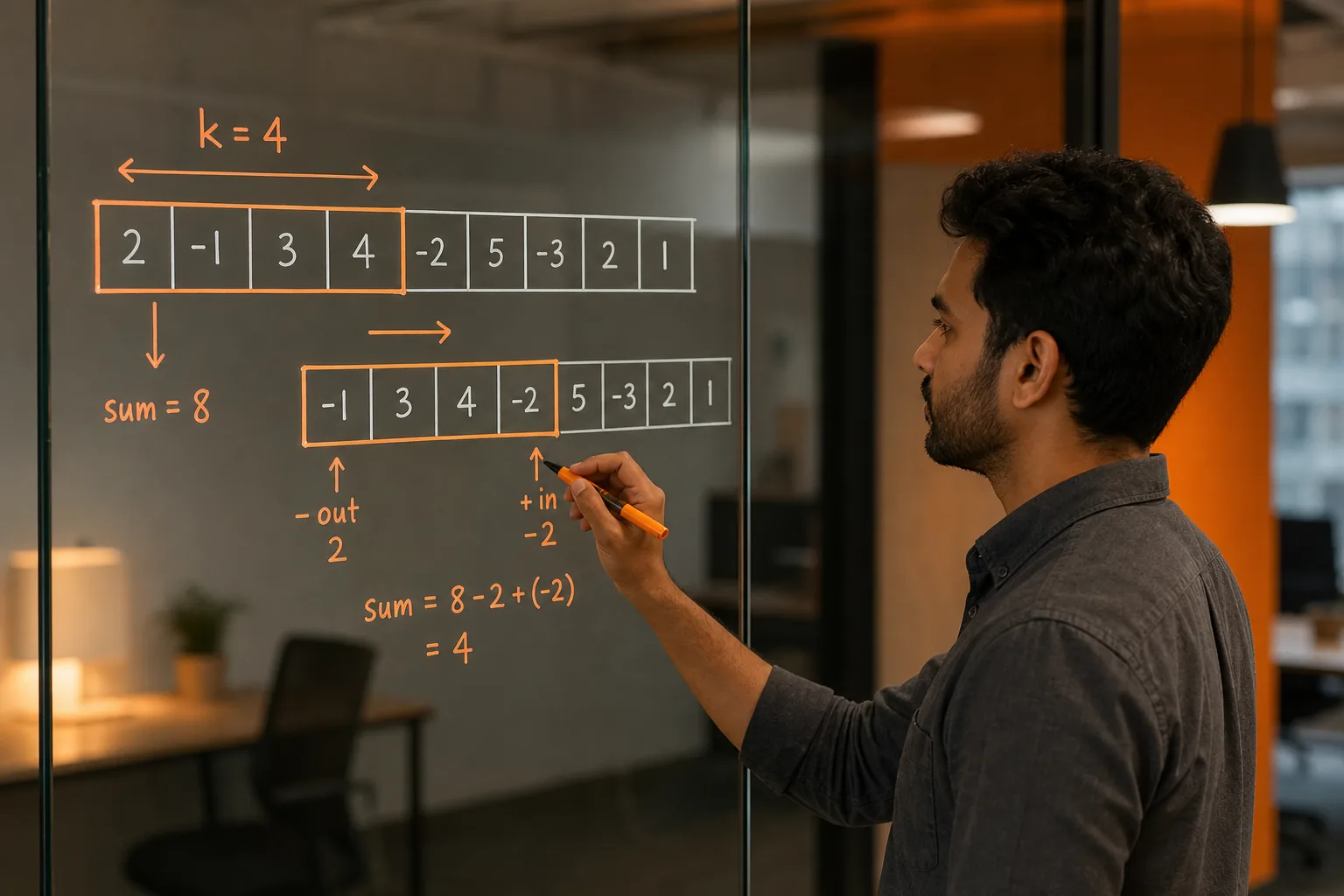
For strings, the state may be a count rather than a sum. Suppose you need the number of windows that contain at least two vowels. Add the new character's effect, remove the old character's effect, then test the count. The movement stays the same.
The fixed-size pattern is often the best first problem to practice because the invariant is easy to check: the window length must equalkafter every slide.
k = 3on paper. Mark the entering and leaving index for every move. This catches boundary errors faster than staring at the loop.Step 3: Build a Variable-Size Window That Expands and Shrinks
A variable-size window grows or contracts until it meets a condition. This form of the sliding window technique fits prompts such as “longest substring without repeats” or “smallest subarray with sum at least a target.”
Start withleft = 0. Moverightacross the input one item at a time. Add the new item to your state. The window may now be invalid, so moveleftforward until the invariant becomes true again.
For a positive-integer array, the minimum subarray sum pattern looks like this:
left = 0
currentSum = 0
bestLength = infinity for right from 0 to n - 1: currentSum += values[right] while currentSum >= target: bestLength = min(bestLength, right - left + 1) currentSum -= values[left] left += 1
The inner loop doesn't make this O(n²) by itself. The left pointer never moves backward. Across the full scan, each item can enter once and leave once, so the total pointer movement stays linear under the conditions that make this pattern valid.
Those conditions matter. The sum example relies on positive values. If negative values can appear, removing the leftmost value may increase or decrease the sum in ways that break the usual shrink logic. Don't apply the template by sight alone. Check whether moving either pointer gives you a predictable path toward validity.
For strings, use a frequency map or set. In a “longest substring without repeated characters” problem, add the right character. If it already violates the rule, remove characters from the left until its count is acceptable. Record the length after the window is valid.
Minimum and maximum questions reverse the timing. For the shortest valid window, record a candidate before shrinking more. For the longest valid window, shrink first when invalid, then record the restored range. Mixing up that order can return a valid answer, but not the best one.
Keep the state tied to the window. If you remove a character from the left, update its count immediately. A stale map can make an invalid substring look valid for several iterations.
For more pattern drills, the Two Pointers and Sliding Window interview questions page gives recognition cues such as “contiguous subarray” and “longest substring with a property.” Use those cues to classify a prompt before coding.
Phantom Code AI is also useful when you want to practice saying why the window expands at one point and shrinks at another. That explanation is often where a correct solution becomes a strong interview answer.
Step 4: Use a Monotonic Deque for Window Maximum and Minimum
Use a monotonic deque when each fixed-size window needs its maximum or minimum and a simple running sum cannot describe the answer.
Suppose the array is[4, 2, 12, 3, 8]andk = 3. The first window is[4, 2, 12], so its maximum is 12. After the window moves, the next range is[2, 12, 3]. Rechecking all three values works, but it wastes time on large inputs.
The deque stores indices, not just values. For a maximum:
- Remove indices from the front when they fall outside the current window.
- Remove indices from the back while their values are less than the new value.
- Add the new index to the back.
- Read the maximum from the value at the front index.
Why can smaller values leave from the back? The new value is later in the array and is at least as large. It will stay in the window at least as long, so an older smaller value can never become the maximum first.
For a minimum, reverse the comparison. Remove from the back while the stored value is greater than the new value. The front then holds the index of the smallest current value.
The index check is the part people miss. Before reading the front, remove any index less thanright - k + 1. A deque can remain monotonic while still containing an item that no longer belongs to the window.
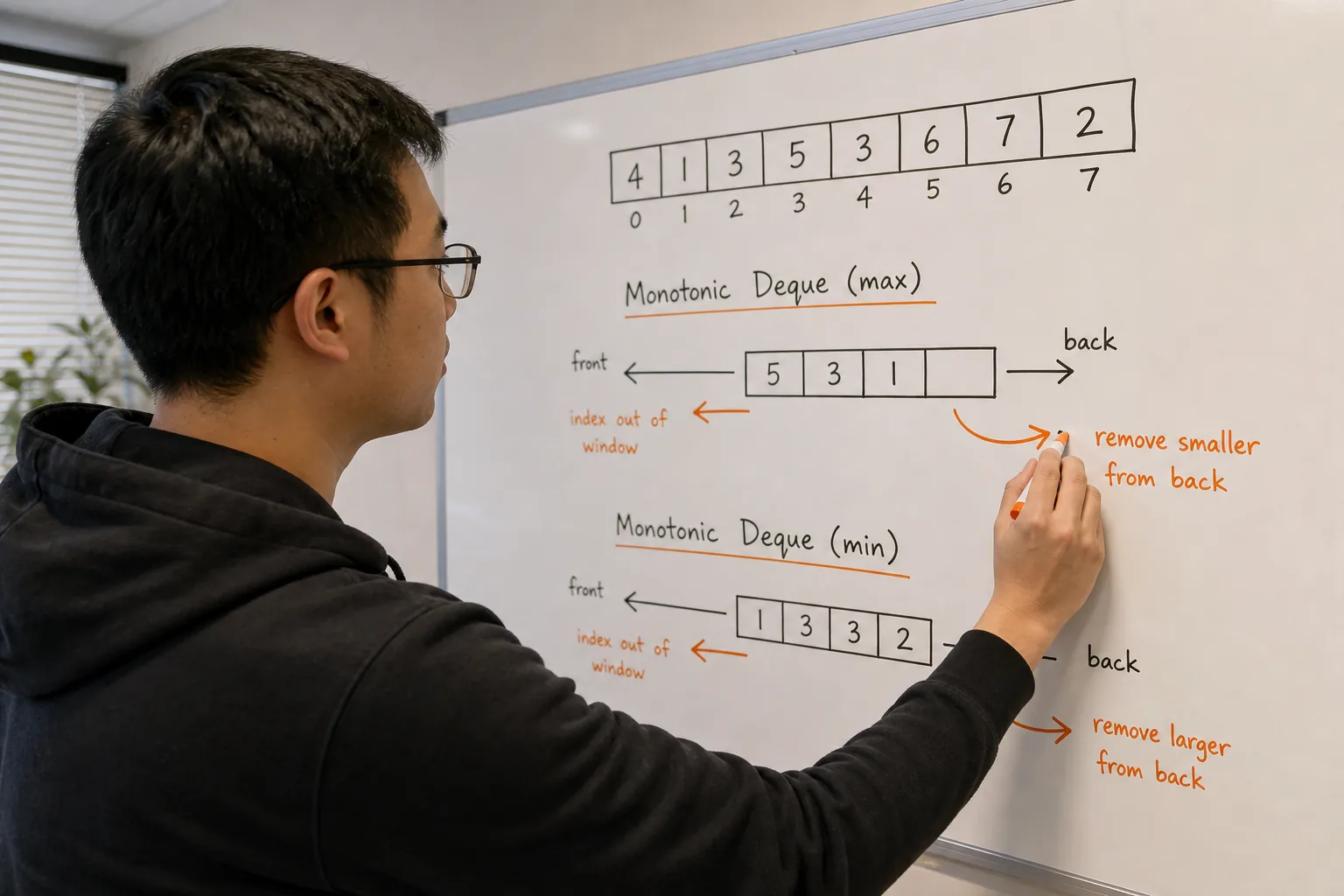
Every index enters the deque once. It can leave once from the front or back. That gives O(n) total deque operations, with O(k) space in the worst case.
Keep values and indices separate in your mental model. Values decide which candidates can be discarded. Indices decide whether a candidate is still inside the window. Mixing those jobs causes subtle errors with duplicate values.
Step 5: Test, Debug, and Explain Your Solution in an Interview
A good interview solution needs more than a working loop. Test the invariant, state the complexity, and walk through one small input.
Use these cases before you claim the code is done:
| Test case | What it checks | Typical failure |
|---|---|---|
| Empty input | Initial state and return value | Reading index zero before checking length |
| Window size one | Pointer movement | Removing the new item by mistake |
| Window size equals input length | First-window handling | Returning a default answer instead of the full range |
| All values equal | Duplicate handling | Dropping the wrong deque index |
| Best answer at the start | Result retention | Overwriting the answer with a worse later window |
| Best answer at the end | Final iteration | Stopping before the last right index |
| No valid variable window | Failure behavior | Returning infinity or an invalid range |
Then trace the pointers. Write the currentleft,right, and state after each loop. Don't trace every detail for a huge input. A five-item example usually exposes the bug.
Explain complexity honestly. A fixed-size sum is O(n) time with O(1) extra space. A variable window with a frequency map is often O(n) time, with space tied to the number of tracked keys. A deque solution is O(n) time and O(k) space.
Don't say every sliding window solution is automatically linear. If your loop rebuilds a sum, scans the whole window, or sorts its contents after every move, the window label doesn't save it. Ask how often each item is processed. That count gives a better complexity argument.
During a coding interview, use this explanation order:
- Describe the brute-force idea briefly.
- Point out the repeated work.
- State the window invariant.
- Explain what enters and leaves.
- Give time and space costs.
- Test an edge case aloud.
If you get stuck, don't jump straight to code generation. State the smallest valid window and ask what changes when the right pointer moves. Phantom Code AI can support mock interview practice by listening to your explanation and helping you identify the problem pattern, but the final reasoning should be yours.
FAQ
What is the sliding window technique?
The sliding window technique tracks a contiguous part of an array or string while moving its boundaries. Instead of recomputing each range, you update the state as one item enters and another leaves. Common versions use a fixed length, a condition-based length, or a deque for window maximum and minimum queries.
When should I use a fixed-size sliding window?
Use a fixed-size sliding window when the prompt gives an exact length such ask. It fits maximum sum subarray problems, rolling averages, and counts across substrings of lengthk. Build the first range, then subtract the leaving item and add the entering item.
When does a variable-size window fail?
A variable-size window can fail when pointer movement doesn't lead predictably toward a valid range. The common sum template depends on positive values. Negative values can break that reasoning because removing an item may raise the sum. Check the input rules before using expansion and shrinking.
Why does a sliding window use a deque?
A deque helps when each window needs a maximum or minimum. It keeps candidate indices in monotonic order, so the best candidate stays at the front. You must remove indices that leave the window. Forgetting that check can return a value from an older range.
Is every sliding window solution O(n)?
No. A well-built sliding window often runs in O(n), but repeated scans or repeated sorting can make it slower. Count how many times each item enters, leaves, or gets inspected. If the same window is fully processed at every position, the code may approach O(n²).
Conclusion
Start with fixed-size windows, then practice variable conditions and monotonic deques. For your next problem, write the invariant before the loop and trace one edge case by hand. When you want more guided interview practice, Phantom Code AI can help you rehearse the reasoning aloud in a mock coding session.